Allstate roadside assistance for EVs still covers a jump and a tow. It doesn’t put miles into an empty pack on a Bay Area shoulder. If the traction battery is empty, they don’t charge it in place. They arrange a tow to a plug instead.
A dead 12-volt and an empty pack aren’t the same call
From the curb, both failures look like a car that won’t wake. The 12-volt battery runs locks, screens, and computers. Allstate’s jump benefit is built for that small battery. A contracted tech can attempt a jump on scene. That’s the same play they use on a gas car.
The traction pack is the big battery that moves the wheels. When that’s at zero, a jump doesn’t add range. Allstate’s roadside kit doesn’t roll with a 240-volt source. So the file turns into a tow toward a place you can plug in.
What Allstate Motor Club actually puts on the road
Allstate sells roadside as an add-on, and Allstate Motor Club administers it. It covers a flat tire, a lockout, fuel delivery, a jump, and a tow. Fuel delivery doesn’t fill an EV. It’s leftover from the gas-car version of the same plan.
The person at your bumper is a contracted provider, not an Allstate employee. They work the same playbook used on a Camry. If the car has to ride, ask for a flatbed first. Many EVs shouldn’t be pulled on their driven wheels.
Your tier sets the towing limit, not this page
Allstate offers more than one roadside tier. Covered miles and any payout limits change between them. A figure that fits one policy can be wrong on yours. This page couldn’t confirm one published Allstate mile cap for every driver. It also couldn’t confirm a payout limit that applies to every Bay Area policy.
Open your declarations page, or call Allstate while you’re still at home. Ask what’s covered for towing distance. Ask whether a separate limit applies per tow. Don’t learn that on the I-880 shoulder, or on the Bay Bridge approach.
Local rules that kick in once you’re stopped
A Bay Area stall isn’t a blank legal space. CVC 21718 bars stopping on a freeway except in limited cases. One case is a car so disabled that stopping is unavoidable. You’ve also got to have summoned help already. CVC 22651(f) covers a car left more than four hours on a full-access-control freeway. It can be removed if it can’t move under its own power. Confirm current enforcement with CHP or Caltrans District 4. They set it, not this page.
On weekday peaks, the Freeway Service Patrol covers beats for MTC, CHP, and Caltrans. 511.org lists weekday hours as 6 to 10 AM and 3 to 7 PM. Dial 511 and say Freeway Assist, or use a call box. The MTC FSP page lists gas, jump-starts, and radiator refills. It doesn’t mention electric vehicles or out-of-charge help. That was checked on 2026-09-18. Outside those hours, the CHP Rotation Tow Program assigns an approved vendor. You don’t pick the company.
Inland heat also changes how fast a pack falls, even when coverage stays the same. 1961-1990 NWS normals put San Francisco’s July high near 71.5F. Livermore sits near 89.7F, and Antioch is about 90.4F. Gilroy is about 88.3F, and San Jose is about 82F. A climb on SR-24 toward Walnut Creek uses more energy than a cool SR-1 run. The same is true on I-580 toward Livermore, or on SR-4 toward the Delta. That’s climate, not a missing station.
Older housing shapes the other failure. San Francisco’s ACS stock is 77.2% pre-1980. Daly City is 78.7%, Oakland is 77.9%, and Berkeley is 80.8%. Plenty of those addresses are apartments with street parking. The car sits, and the 12-volt can sag. Allstate can still try that jump. An empty traction pack still needs power at the car, or a ride to a plug.
What a mobile charge does that the tow cannot
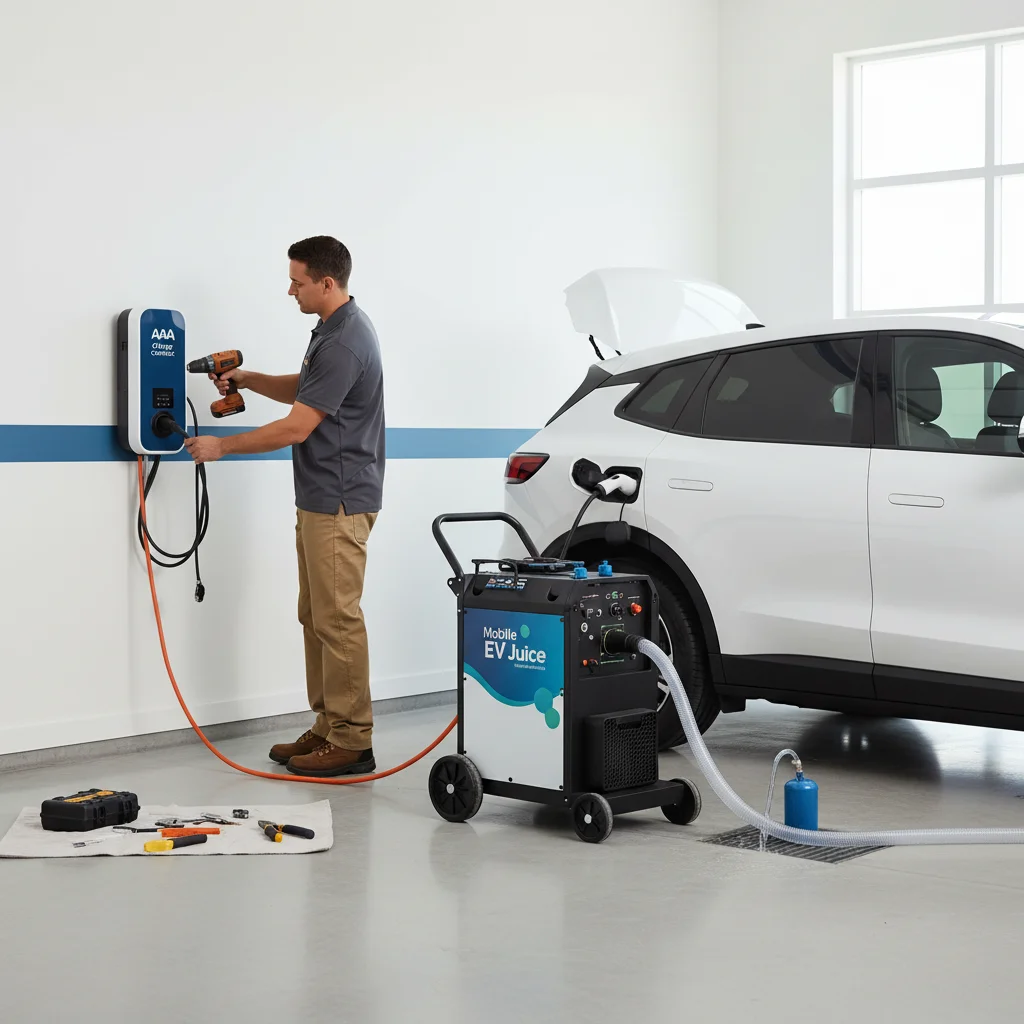
Mobile EV charging is the part Allstate’s plan doesn’t carry. Charge Pro SF connects you with independent local operators. Those operators bring a 240-volt Level 2 source to the car. Tesla gets a native NACS plug. Other brands use a CCS or J1772 adapter. Typical charging time is 15 to 30 minutes for about 10 to 20 miles of range. That’s session time, never an arrival time. The operator quotes you before work starts and bills you directly.
You leave under the car’s own power. You don’t ride a flatbed, then wait again at a post. That’s the point of out-of-charge recovery when the car is otherwise fine. See Geico roadside for an EV for the same pattern. There’s also AAA versus a mobile charge when your EV won’t move.
On a freeway shoulder, start with Your EV died on a Bay Area freeway. For the hook-versus-charge choice, read why towing a dead EV in the Bay Area gets costly. Then read mobile EV charging or a tow, which you need first.
Keep Allstate for the jobs it already does well
None of this is a reason to drop the Allstate add-on. Keep it for flats, lockouts, and mechanical problems that belong in a shop. Call a mobile charge when the car is healthy and the pack is empty. Those are two different failures. You can hold both numbers.
Does Allstate roadside assistance charge EVs on site?
No. An empty pack gets a tow toward a place you can plug in. The standard benefit doesn’t include a portable charger.
Who actually shows up when you call Allstate for an EV?
Allstate Motor Club sends a contracted provider. It’s the same network used for gas cars. Ask the dispatcher for a flatbed if the vehicle has to be towed.
What’s Allstate’s towing distance limit on a Bay Area EV?
It depends on the roadside tier on your policy. Check your declarations page or call Allstate. No single mile or payout figure could be confirmed that covers every plan.
If your EV is empty anywhere in the Bay Area, call Charge Pro SF. The number is (415) 630-6268. An operator quotes you before any work starts.