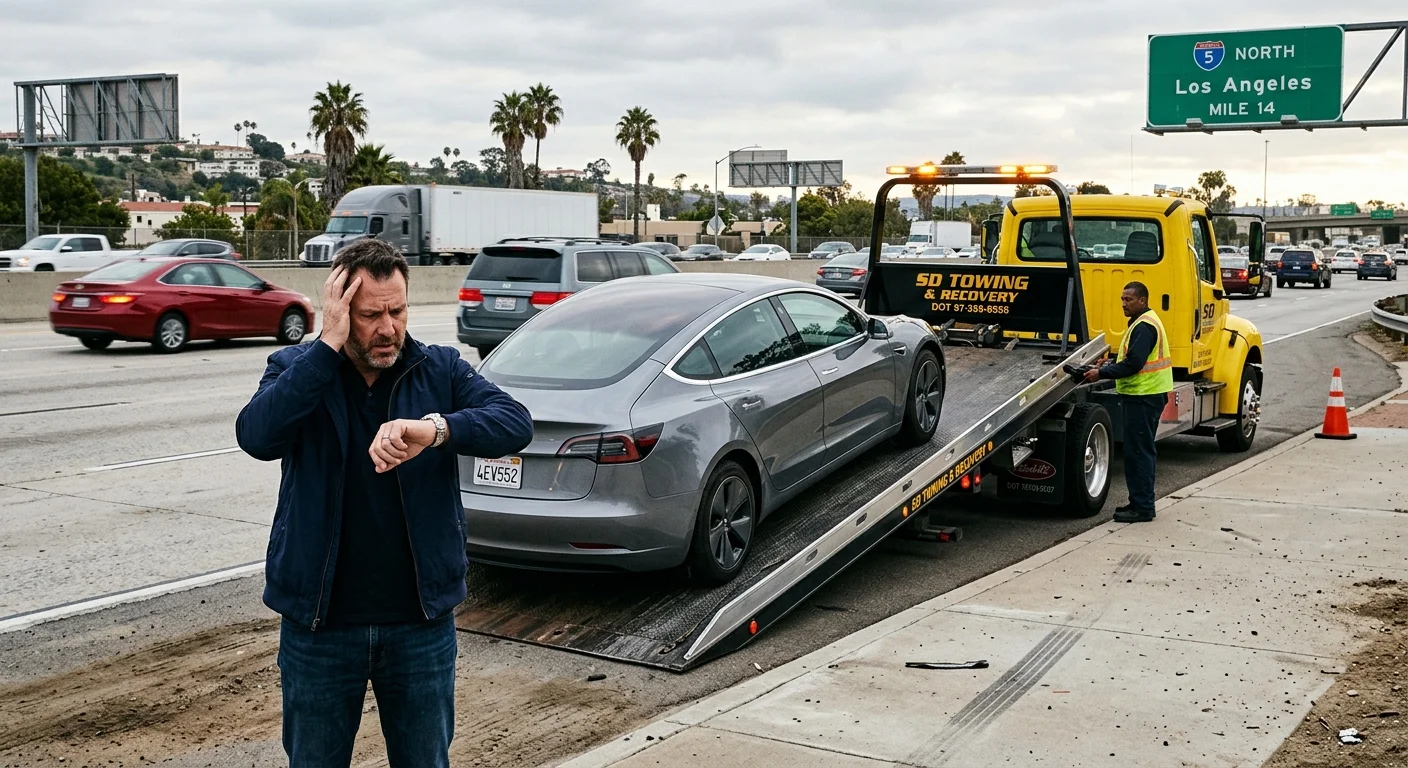
The cost to tow an EV in the Bay Area isn’t a statewide sticker price. CVC 22651(f) can turn a freeway stall into a removal after four hours. The car has to be one you can’t move under its own power. San Francisco’s AutoReturn rules add a separate city bill. California doesn’t cap ordinary private tow rates. The operator quotes you before the truck moves.
The four-hour freeway clock comes first
You already know you shouldn’t sit in a live lane. California Vehicle Code 21718 also bars stopping on a freeway except in a few cases. One of those is a vehicle so disabled that the stop is unavoidable. You’ve also got to have summoned another vehicle for help. Call for help, then stay out of traffic.
The four-hour rule is the part most drivers miss. After that window, a car that can’t roll can be removed. The freeway has to be full-access-control. That’s a removal rule, not a dispatch promise. It does mean an empty pack on I-580 over the Altamont can become an impound. I-680 through Sunol and I-880 in Hayward work the same way. After you stall, start with your EV died on a Bay Area freeway.
Caltrans District 4 covers the nine Bay Area counties. 511 SF Bay is the regional traveler line. Neither one sets a private tow quote.
AutoReturn is a different bill than a highway hook
Inside San Francisco, SFMTA’s towing contractor is TEGSCO, LLC, doing business as AutoReturn. That’s the city program, not a freeway beat. It isn’t a roadside hook you shop around. AutoReturn publishes administrative, tow, storage, and dolly charges on sfmta.com. No verified effective date sat on that page when we checked. Confirm the current schedule with AutoReturn or SFMTA before you pay. Don’t treat an old screenshot as the bill. For local context on the city, start at the San Francisco EV charging page.
Storage isn’t a single line either. SFMTA publishes a free storage window at the start, then a daily schedule. Confirm both on sfmta.com before you pay. The longer the car sits, the more that published storage line grows. A dead pack left in a San Francisco garage can outrun the hook itself. That can happen before anyone talks about charging.
San Jose and Oakland also have private-property tow frameworks on the books. Look at San Jose Municipal Code Chapter 6.66 and Title 23. Oakland’s towed-vehicle pages are the other source. The specific rate text wasn’t verified in this pass. Ask the lot or the city, not a guess.
FSP and CHP rotation decide who you get on the freeway
The Freeway Service Patrol is a partnership of MTC, CHP, and Caltrans. Private tow companies run the beats under competitive bid. Published FSP hours are Monday through Friday. The windows are 6 to 10 a.m. and 3 to 7 p.m. Dial 511 and say Freeway Assist, or use a call box.
FSP lists crashes, debris, a free gallon of gas, jump-starts, and radiator refills. MTC says the patrol handles over 100,000 incidents a year. The MTC FSP page doesn’t mention electric vehicles or out-of-charge help. We couldn’t confirm that an empty traction pack is in scope. If you’re out of range, treat 511 as a safety call.
Outside those weekday peaks, freeway tows often go through the CHP Rotation Tow Program. Approved vendors take turns. You don’t pick the company. CHP sets rates for its own rotation vendors. California doesn’t cap ordinary private or consensual tow rates statewide. For a call you make yourself, the operator sets the number. Local ordinance can still apply. The operator should quote you before the truck moves.
Private lots add their own tow math
A stall at a mall or office garage is usually CVC 22658 territory. Posted apartment lots fall under that statute too. The statute requires a posted sign at least 17 by 22 inches. Lettering has to be at least one inch high. The sign has to say the car can be removed at the owner’s expense. It also needs the enforcement phone number and each tow company’s name and number. The operator must notify law enforcement within one hour and give written notice.
Overcharging past the approved private-property rate creates liability for four times the amount charged. That ceiling is tied to the CHP-approved or law-enforcement rate. It isn’t a statewide cap on every consensual EV tow. If a lot in Oakland or San Jose hooks the car, read the posted sign. The same goes for El Camino in Redwood City. Ask for the written notice.
What actually moves a consensual EV tow quote
Skip the hunt for a published Bay Area average. There isn’t a verified one. For a call you place, the quote moves with a few real inputs.
Distance is the first. A shoulder on US-101 in San Mateo is one kind of run. A stall on SR-4 toward the Delta is another. So is a car left after a night near SFO in San Bruno. Time of day is the second. Peak FSP hours, overnight, and weekend shoulders aren’t the same dispatch. How much range you still need is the third. A tow to a working post is a longer job. A short move off the shoulder is a different quote.
Special gear is the fourth. Most dead EVs need a flatbed so all four wheels leave the pavement. A two-wheel lift can load the motors or the pack. That risk jumps if the car can’t enter the right tow mode. Tesla owners should read how to tow a Tesla with no power first. Not every truck on a CHP rotation is set up for that. Ask before you agree.
Tolls can show up if the route crosses a state-owned bridge. The seven Caltrans bridges include the Bay Bridge and San Mateo-Hayward. They also include Antioch, Benicia-Martinez, Carquinez, Dumbarton, and Richmond-San Rafael. They’re all-electronic. Cash ended in March 2020. Direction matters on every span. Antioch, Benicia-Martinez, and Carquinez toll eastbound only. Dumbarton, Richmond-San Rafael, the Bay Bridge, and San Mateo-Hayward toll westbound only. The Golden Gate Bridge is a separate district, southbound only into the city. A tow across a span still hits FasTrak, a plate account, or an invoice. Confirm that line on the quote.
Inland heat changes the stall, not the tow tariff. Livermore’s July normal high is 89.7F, from 1961-1990 NWS normals. Antioch’s is 90.4F. San Jose sits near 82F. San Francisco’s July normal high is 71.5F. A pack that felt fine on the coast can sag on the I-580 climb. East County and Tri-Valley stalls often need more range to get home. A short hop in Daly City is a different problem. Gilroy’s July normal high is 88.3F.
Why the second hook is the expensive part
A tow only helps if the drop-off can actually charge your car. You don’t pick a CHP rotation vendor. A consensual tow may leave you at a shop that can’t charge your port. The stall might be occupied, down, or locked behind an app you don’t have. Then you’re still dead, and you’re shopping a second move.
Don’t assume a mileage figure to a working post. Name the site if you already know it. Otherwise ask the operator where they plan to leave you. Ask whether that post matches your port: NACS, CCS, or J1772.
That’s why many drivers compare a tow against a mobile charge first. The comparison is about control, not a made-up average.
A roadside charge changes the job
Charge Pro SF is a referral line. It matches you with independent local operators. It doesn’t own trucks, set prices, or run the tow. The operator quotes you before starting and bills you directly.
What those operators bring is a 240-volt Level 2 source to the car. Tesla cars take a native NACS plug. Other EVs use a CCS or J1772 adapter. Typical charging time is 15 to 30 minutes. That usually adds about 10 to 20 miles of range. That’s plug time, never a promise about when someone arrives. They can also jump or replace a dead 12-volt battery on site. That’s a different failure than an empty pack.
If the car can take that boost, you may not need the freeway removal path. You may not need the AutoReturn lot or a flatbed at all. Your EV stays where it is. Nobody’s dragging motors on a wheel lift. You aren’t betting that the drop-off post works. Read what a mobile EV charge quote covers before you compare it with a hook.
For a car that still won’t wake, start with the 12-volt. Then decide if you need mobile EV charging or a proper flatbed. When you need a mobile charge, not a tow walks through that split.
If you’re already on the shoulder
Stay out of the lanes. Summon help so you fit CVC 21718. On a freeway during FSP hours, 511 and Freeway Assist is the safety call. Don’t wait out the four-hour CVC 22651(f) clock hoping the pack recovers.
If San Francisco already tagged the car for AutoReturn, use the SFMTA pages. Use AutoReturn’s own channels too. Confirm storage and release rules there. If a private lot has the car, photograph the CVC 22658 sign. Ask for the written notice.
If you want an on-site charge instead of a haul, call (415) 630-6268. Charge Pro SF will connect you with a local pro. That person quotes the job before any cable goes on. They bill you directly.