A Tesla low battery warning means the pack is below the level Tesla sets as the warning threshold. The exact percentage varies by model year, but the warning shows up with enough pack left to act. The driver still has time to top off at a working post, pull into a lot, or call for a mobile charge before the car hits zero.
The Bay Area has two failure modes that turn a low battery warning into a real stranding. The Caldecott Tunnel on SR-24 eats range on the west climb. The SR-17 climb out of Los Gatos eats range on the way to Santa Cruz. A driver who ignores the warning on those grades is the canonical mobile charge call.
This post walks through what the warning actually means, what to do when it shows up, and when the right call is a local operator with a 240V Level 2 source.
What the warning means
Tesla sets the low battery warning at a state of charge that gives the driver time to find a charger. The exact percentage depends on the model year and the software version. Newer Model 3 and Model Y versions set it around 20 percent. Older versions set it around 25 percent.
The warning is not an emergency. The pack is below the comfortable range and the car is asking the driver to plan a charge soon. The car will still drive. The car will still reach a working post on most Bay Area roads.
The pack hits zero when the contactors open and the car stops. The warning is the lead-up. The driver has a window of miles between the warning and zero, depending on terrain and climate.
What to do when the warning shows up
The first move is to find the next working post. The Tesla in-car navigation shows nearby Superchargers and the estimated range to each. A driver who acts on the warning within a few minutes will reach the next post without a problem.
The second move is to drop speed. Range drops nonlinearly with speed on US-101 and I-880. A driver at 75 mph uses noticeably more range than a driver at 65 mph on the same stretch. Drop speed to 60 or 65 and the range estimate extends.
The third move is to turn off accessories. Climate control, seat heaters, and the infotainment system all draw from the traction pack. A driver who needs every available mile can turn off the climate and run the defroster only.
The fourth move is to pull into the next lot or side street. A Tesla that pulls into a parking lot with the warning showing is a Tesla that can be charged with a mobile operator. A Tesla that runs out on the shoulder needs a tow plus a charge.
When SR-24 or SR-17 is the situation
The Caldecott Tunnel on SR-24 between Oakland and Lafayette is a real range cost. The west climb from Oakland into Lafayette eats range on the grade. A driver who enters the tunnel at 15 percent state of charge arrives at the Orinda side on a much smaller number. The return trip regenerates some of it back, but only if you let the car coast.
The SR-17 climb out of Los Gatos toward Santa Cruz is the other Bay Area range trap. The grade is steep and the curves are tight. A driver heading to Santa Cruz on a thin pack does not get a second chance. The summit sits high enough that you will not make it back down with much to spare.
The fix is to top off before the climb, not at the bottom of the hill. A driver who arrives at the Caldecott on 30 percent and the Los Gatos summit on 30 percent has the range to handle the climb. A driver who arrives on 10 percent does not.
When the call is a local operator
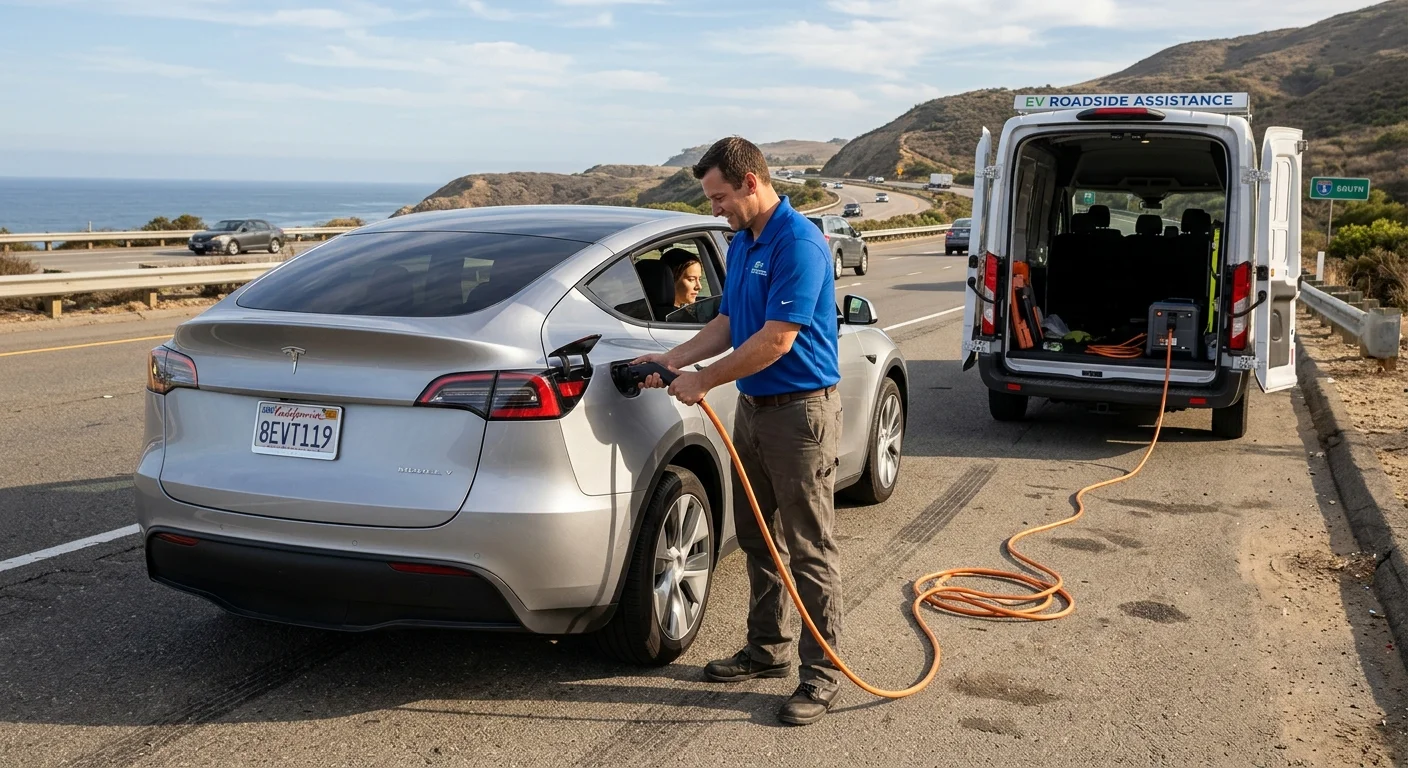
A local operator is the right call when the driver has pulled into a lot or onto a side street with the warning showing and the next working post is too far. The operator arrives with a 240V Level 2 source and a NACS cable. A typical session adds 10 to 20 miles of range in 15 to 30 minutes of charging time. That is enough driving room to reach a working Supercharger, a home charger, or a garage outlet.
A local operator is also the right call when the warning shows up on a shoulder and the driver cannot safely reach a lot. The operator arrives at the shoulder, adds range, and the driver drives to a working post.
The pros we connect you with are licensed and insured. They quote before any work starts. They bill you directly. The work covers every Bay Area city and community, from Pacifica to Brentwood and from San Mateo to San Jose.
What not to do on the warning
Do not ignore the warning until the pack hits zero. The Bay Area has enough public posts that a working charger is rarely more than a few exits away on US-101 or I-880. The exceptions are the Coastside, the Altamont, and the run to Santa Cruz. Plan around those gaps before the trip, not when the warning shows up.
Do not assume a DC fast post is working. The post may be offline or full. A driver who arrives at a down post on a thin pack is the canonical mobile charge call. Check the Tesla app for stall status before driving to the site.
Do not assume the warning is the same as zero. The warning has miles of cushion. The driver has time to act. The pack at zero is a different problem.
How to plan around the warning on long trips
Plan the trip before the warning. The Tesla in-car navigation estimates range to each charger on the route. A driver who plans a 20 percent buffer at each stop avoids the warning on most trips.
Plan around the Bay Area gaps. The Coastside from Pacifica to Half Moon Bay has long stretches with no DC fast at all. The Altamont Pass on I-580 has gaps between Livermore and Tracy. SR-17 over the Santa Cruz Mountains has gaps between Los Gatos and the summit. Plan a top-off before each gap.
Plan around weather. Atmospheric-river rain spikes post failures across the South Bay. Coastal fog adds corrosion to connector pins. A post that worked yesterday may not work today. The Tesla app shows stall status in real time.
FAQ
What is the Tesla low battery warning?
A dashboard alert that the pack is below the comfortable range. The exact percentage varies by model year. The car will still drive.
How many miles do I have after the warning?
It depends on terrain and climate. The Bay Area flatlands give you 15 to 30 miles. A climb on SR-24 or SR-17 can eat that in a few minutes.
What is the safest thing to do when the warning shows?
Find the next working post in the Tesla navigation. Drop speed to 60 or 65. Turn off accessories. Pull into a lot if the post is too far.
Can a local operator add range at the curb?
Yes. The operator arrives with a 240V Level 2 source. A typical session adds 10 to 20 miles in 15 to 30 minutes of charging time.
How do I avoid the warning on long trips?
Plan a 20 percent buffer at each stop. Plan around the Bay Area gaps. Check the Tesla app for stall status before driving to a post.
Call (415) 630-6268 when the warning shows up and the next working post is too far. The operator quotes a 240V add at the car. Nobody on this line promises an arrival clock.