A Tesla that won’t wake is almost always a 12V problem. The traction pack is the headline. The 12V is the small battery that runs the screens, the locks, and the contactors that put the car in drive. When the 12V dips, the Tesla looks fully dead at the curb. The traction pack can be at 80 percent and the car will still refuse to wake.
Bay Area drivers hit this in two different climates. Inland heat at Brentwood and Antioch drains the 12V faster than the trunk in the sun. Cool coastal nights at Pacifica and Half Moon Bay drain the 12V through the alarm and body module over a long sit. The pack is fine in both cases. The 12V is the issue.
This post walks through the two failure modes, the order to try at the curb, and what a local operator does when the 12V is the cause.
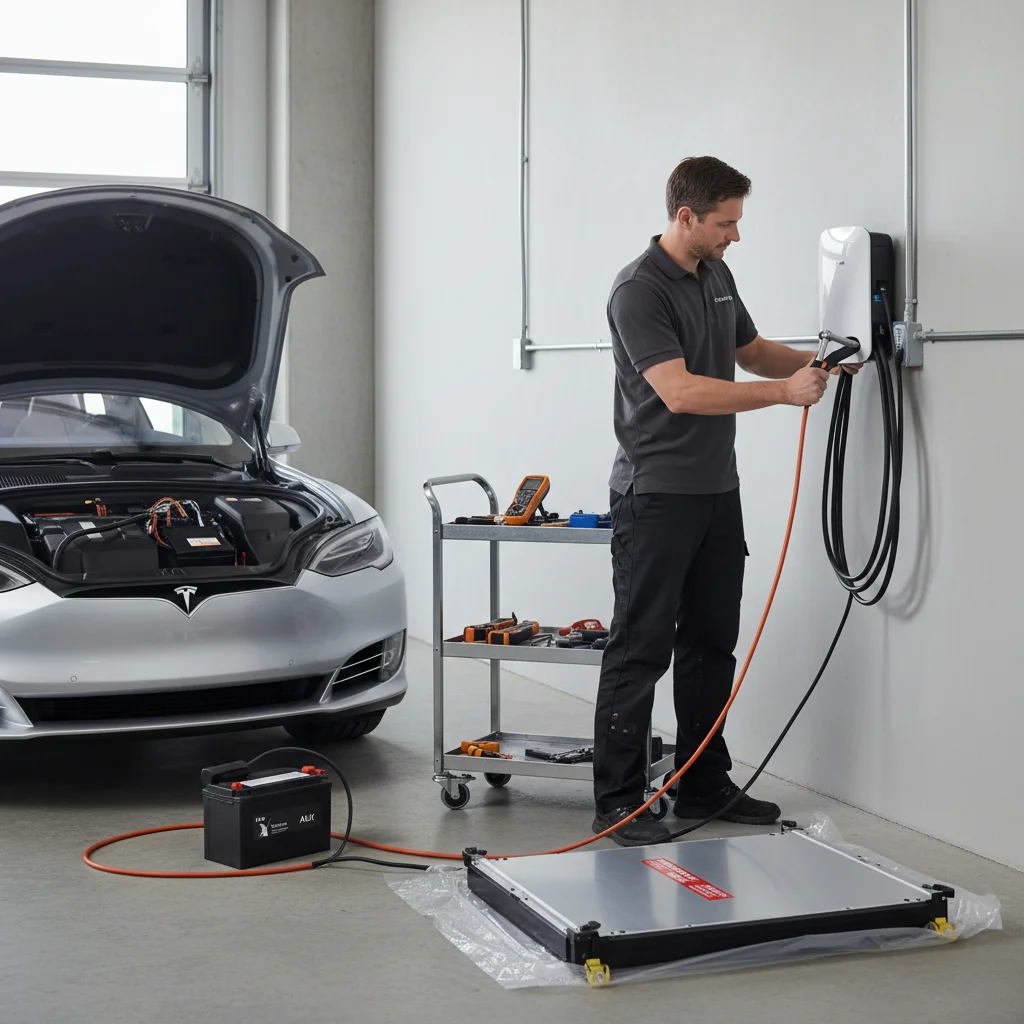
The two failure modes that look the same from the curb
A Tesla that won’t wake can be one of two failure modes. The dashboard is dark in both. The doors do not respond in both. The app may or may not answer in both.
A dead 12V is the common case. The traction pack has real range. The 12V does not. The contactors will not close. A jump pack wakes the car in under a minute. The DC-DC converter tops off the 12V from the traction pack. Drive for 20 minutes and the 12V is healthy again.
An empty traction pack is the less common case. The 12V is fine. The pack is at zero. The contactors will not close because the pack has nothing to connect to. A jump pack wakes the car, the dashboard comes alive, and the car immediately throws a low-pack warning. The fix is a Level 2 add at the car.
The two failure modes need different fixes. Mixing them up is how people request a tow that did not need to happen.
How to tell which one you have
Open the Tesla app before you try anything else. The app talks to the car over cellular. If the car is awake enough to answer, the app shows the pack state of charge and the 12V health.
A high pack state of charge with a dark dashboard is the 12V signature. The pack is fine. The 12V is dead. The fix is a jump.
A low pack state of charge with a dark dashboard is the empty pack signature. The pack is at zero or close to it. The 12V may be fine. The fix is a Level 2 add.
A dark dashboard with no app response is harder. The cellular connection may be offline because the body module is asleep. The fix is a jump first. If the car wakes and shows a high pack state, the 12V was the cause. If the car wakes and shows a low pack state, the next step is a Level 2 add.
The order to try at the curb
Three steps in this order, then call.
Press the door handle. A 12V at the edge may not register a handle press. Try the physical key fob. The fob wakes the car through a different path.
Try the Tesla app. The app shows pack state of charge if the car is awake enough to answer.
Open the front tow-eye cover and connect a lithium jump pack. The front pigtails sit on the driver’s side of the front bumper on most model years. Connect positive first, then ground. Wait 30 seconds. Press the door handle. The car should wake.
If the jump pack has charge and the car does not wake, the body module has a fault or the 12V is more deeply drained than a 30-second wait can recover. Move to calling a local operator.
What a local operator does in each case
A dead 12V is the operator’s fast case. The operator connects a lithium jump pack, the car wakes, and the driver drives away. The whole session lands in 5 to 10 minutes.
An empty traction pack is the operator’s slower case. The operator jumps the 12V first, then connects a 240V Level 2 source. A typical session adds 10 to 20 miles of range in 15 to 30 minutes of charging time. That is enough driving room to reach a Supercharger, a home charger, or a garage outlet.
The pros we connect you with are licensed and insured. They quote before any work starts. They bill you directly.
Where Bay Area drivers hit this
Inland heat at Brentwood and Antioch. The hottest part of the market. A Tesla that sits at the curb through a 100F day sees the 12V drain faster than the trunk. The next morning the dashboard is dark.
Coastal fog at Pacifica and Half Moon Bay. The damp cool environment drains the 12V through the alarm and body module. A Tesla that sits for a week returns to a dark dashboard.
Street parking in San Francisco. The Sunset, the Richmond, and the Marina all see older apartment stock. Cars sit for a week at a time during long trips. The 12V drains in that window.
Long SFO sits in San Bruno and Millbrae. Travelers leave the car in long-term parking and come back to a dark dashboard. The traction pack is fine. The 12V is not.
Each of these is the same fix. A 12V jump, then a 12V replacement if the jump does not hold.
What to keep in the Tesla frunk
A lithium jump pack rated for 1000A peak is the right tool to keep in the frunk. It charges off any USB outlet and wakes a dead 12V in under a minute. Charge it every 90 days.
A set of gas-car jumper cables is the wrong tool. The Tesla manual warns against jumping from a running gas car. Use a lithium pack.
FAQ
Why won’t my Tesla wake with a full pack?
The traction pack shows as full on the app but the dashboard is dark. That is the 12V signature. Jump the 12V first, then drive for 20 minutes to top off the 12V through the DC-DC converter.
How do I tell if my Tesla pack is empty?
Open the Tesla app. A pack at zero shows clearly. If the app does not answer, jump the 12V first and check the pack state when the car wakes.
Where are the Tesla jump terminals?
Front pigtails under the tow-eye cover on the driver’s side of the front bumper. Connect positive first, then ground. Wait 30 seconds before pressing the door handle.
Will a jump from another car hurt my Tesla?
Yes. A running gas car puts out voltage spikes that can damage the body control module. Use a lithium jump pack, not another car.
Can a roadside operator add range at my Tesla?
Yes. The operator jumps the 12V first, then connects a 240V Level 2 source. A typical session adds 10 to 20 miles.
Call (415) 630-6268 when the Tesla is dark and the app does not answer. The operator quotes a 12V jump and a Level 2 add before any cable goes on. Nobody on this line promises an arrival clock.