A Subaru Solterra that won’t start in a curb spot in Berkeley, or in a downtown Mountain View garage, almost always has a dead 12-volt battery. The READY light never appears. The dash stays dark. The doors may not unlock from the fob. The traction pack can still hold plenty of range, and the car can’t reach any of it.
Why the small battery matters on a Solterra
The Solterra runs on two batteries. A high-voltage traction pack moves the car. A conventional 12V lead-acid battery powers every low-voltage system, including the computers that wake the high-voltage system up. If the 12V is dead, the traction pack stays locked out no matter how full it is.
So a Solterra showing 70 percent range can still refuse to start. The dash never lights, the screens stay black, and there’s no chime when you press the power button. People assume they’re out of charge. They’re not. The 12V just can’t boot the car.
The Solterra’s 12V is a standard lead-acid unit. EVs don’t run an engine to top it back up. A weak 12V tends to die quietly over days, then completely on the morning you actually need the car.
Where the 12V sits and how to check it
The Solterra shares its layout with the Toyota bZ4X. The 12V battery sits under a plastic cover on the driver’s side of the front compartment. You can reach the terminals there, but the manual also gives dedicated jump posts on the same side so you don’t have to pull the cover off.
Jump point locations:
- Positive (+): red terminal post under a hinged red plastic cover, driver’s side front of the engine bay, marked with a ”+” symbol.
- Negative (-): don’t clamp the battery’s negative terminal. Use an unpainted metal bracket or bolt on the bay structure, away from the battery, so any spark stays clear of off-gassing.
Year and trim variations exist. Confirm your exact year in the owner’s manual before you connect anything. If you’re not sure, an operator who works on Solterras regularly will know the layout cold.
Steps to wake the car
A jump on the right posts brings the small battery back. The order matters.
- Confirm the donor vehicle or portable jump pack is off before you connect anything.
- Clamp positive to the Solterra’s red jump post, then positive to the donor’s positive.
- Clamp negative to the donor’s negative, then the last negative to bare metal on the Solterra, not the battery.
- Power the jump pack on, or start the donor car, and wait two to three minutes.
- Press the Solterra’s power button. The dash should light and the READY light should appear.
- Remove the clamps in reverse order once it’s awake.
Don’t try to jump the traction pack. The high-voltage terminals are not where you connect anything. The 12V posts are the only safe target.
Symptoms that point at the 12V, not the traction pack
A few signs separate a dead 12V from a real high-voltage problem.
- Dash, ambient lighting, and infotainment all stay dark when you press Power
- Key fob unlock does nothing, and the physical key is your only way in
- Hazard lights won’t turn on
- No chime or “clunk” from the door locks as you walk up
- The car was fine yesterday, then completely dead this morning
That last one is the tell. A 12V usually fails overnight after it’s been quietly weakening for days or weeks. If the dash lights up, throws a high-voltage system warning, then shuts down, that’s a different fault and belongs at a dealership. For the plain “nothing happens” case, start with the 12V.
Curb parking and Bay Area climate stress the small battery
The Bay Area’s street-parking density sets up the failure mode. Pre-1980 housing in San Francisco sits at 77.2 percent on the ACS 2019 to 2023 table. Berkeley’s share is 80.8 percent. Oakland is 77.9 percent. Older housing means apartments and flats without assigned charging. A Solterra ends up on the street more often than in a private garage with a plug.
Then the climate adds pressure. San Francisco’s July average high is 71.5F on the 1961 to 1990 NWS normals. Berkeley sits in a similar range. Move inland and the heat jumps. Concord’s July normal high is hotter than the coast. Livermore hits 89.7F in July on the same vintage. Antioch is 90.4F. Lead-acid chemistry doesn’t tolerate sustained heat. A 12V that would have lived another year in Pacifica can sulfation out faster in Walnut Creek or Danville.
The Solterra uses a CCS charge port, so it can take a DC top-off in the field. That’s how an operator delivers range if the traction pack is the real issue.
When the traction pack is actually empty
Sometimes the 12V is fine and the real problem is range. If your dash actually lights up, you get a READY light, but the car shows zero or near-zero miles and won’t drive, the traction pack is depleted, not the 12V. A jump won’t fix it.
The Solterra uses a CCS charge port. Operators carry a CCS adapter and can add real range right where you’re parked. That typically adds 10 to 20 miles of range, enough to reach the nearest fast charger or get you home. Our out of charge recovery service is separate from a 12V jump.
What an operator does on site
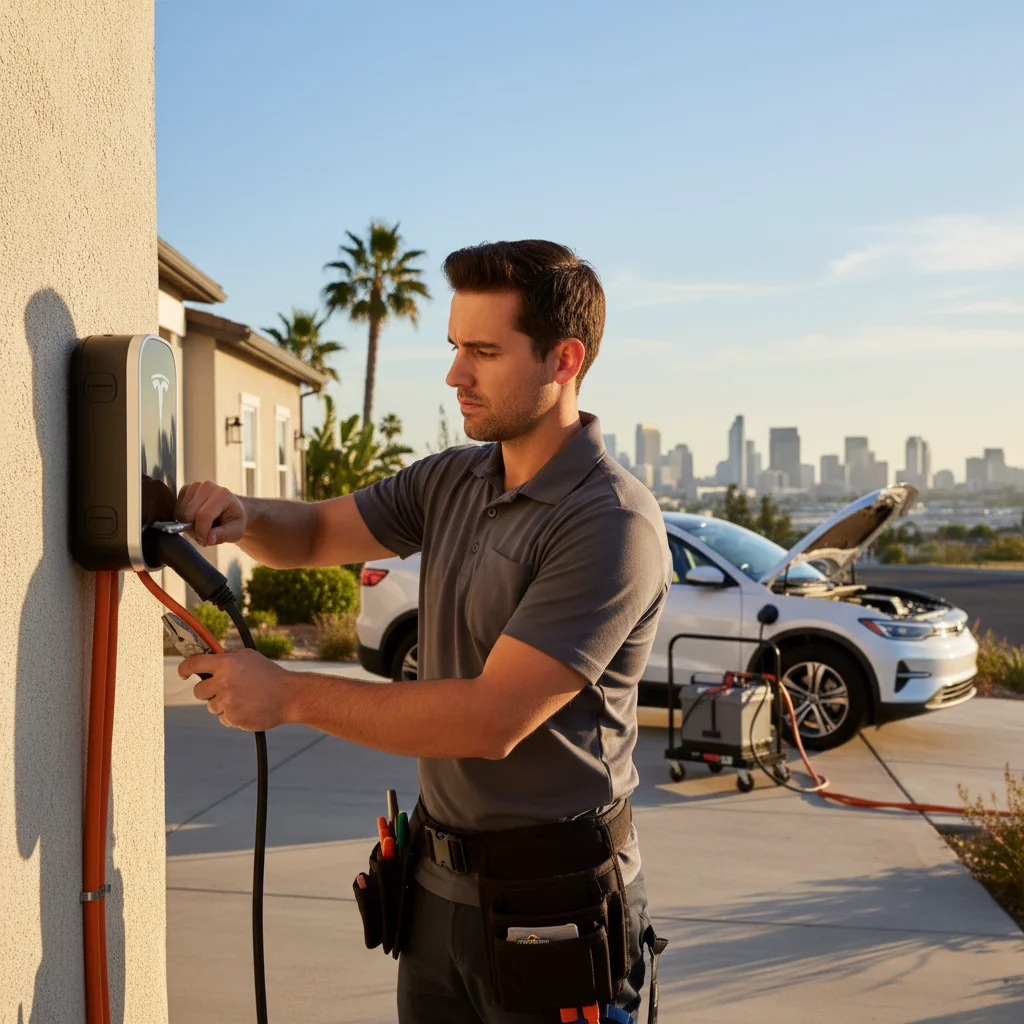
A Bay Area operator arrives with a portable 12V supply and a CCS adapter for the Solterra. For a dead 12V, the operator jumps the correct posts and gets the READY light back, then checks whether the battery will hold or needs replacing. On-site 12V replacement is a serviceable job. Confirm the spec with the operator before they start.
If the issue is range instead, the operator delivers charge through the CCS port. They typically add 10 to 20 miles. The operator quotes you before starting. They bill you directly. Charge Pro SF doesn’t set the price. The operator who takes the job quotes you before any cable goes on.
What moves the quote
Distance to the curb spot. Time of day. Whether the job is a jump, a 12V swap, or a pack top-off. A jump only is a different job than a battery replacement. If the operator also needs to add range, how many miles you need matters. Operators generally charge more for an overnight call, so ask when they quote you.
We don’t publish those numbers here. Confirm them with the operator who takes the job. Charge Pro SF is a referral line. We match you with independent local operators. The pros we connect you with are licensed and insured. We don’t own trucks. We don’t perform the work.
Calling for a Solterra roadside
We serve every city in the Bay Area. If your Solterra is dark in Oakland, in San Jose, or anywhere in between, call (415) 630-6268 for a match to a local operator. The operator who takes the job gives you the quote.