Rivian publishes a roadside help number for stranded owners. The number is in the Rivian app under Service, then Roadside, and on the Rivian website. The dispatch routes through a third-party contractor network that Rivian manages. Bay Area drivers report waits of several hours when service centers are slammed, and waits of a day or more for non-emergency mobile appointments. The contractor may or may not have the Rivian-specific tool set.
A local operator is a separate call. Independent Bay Area operators carry EV-specific equipment by default. They quote before they start. They bill you directly. The pros we connect you with are licensed and insured.
This post walks through how Rivian’s roadside path actually works in the Bay Area, what the gap looks like, and where a local operator fits as a backup.
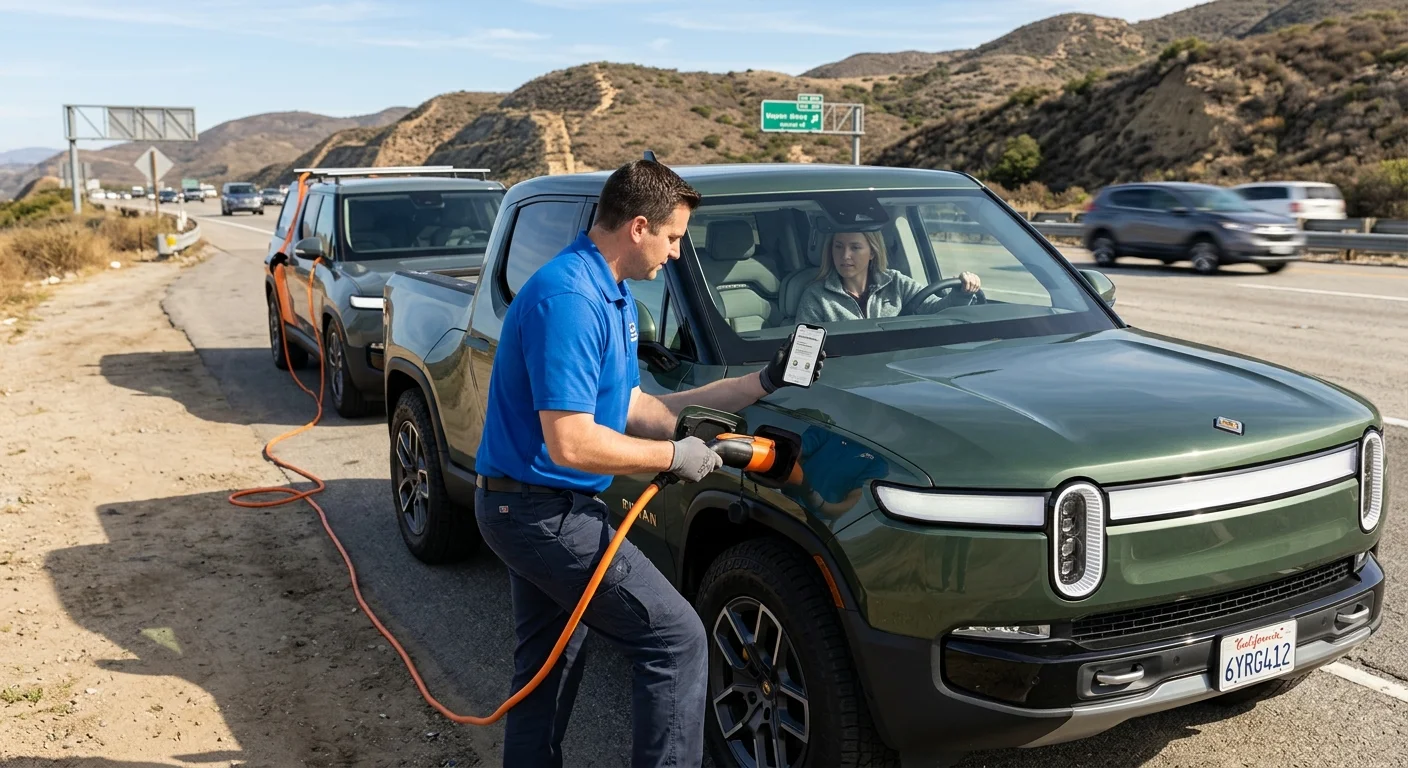
How Rivian roadside works on paper
Rivian publishes a roadside help line. The line takes calls every day. The dispatch routes to a contractor network that Rivian manages. The contractor brings what the dispatch described: a tow truck, a jump box, a tire kit, or a lockout tool.
Rivian mobile service is a separate option. The mobile tech comes to your home or office for non-emergency work. A 12V swap, a tire rotation, a software fix. Mobile service is appointment-based, not on-demand. A driver stuck at the curb today is not the mobile service use case.
Rivian roadside for emergencies is supposed to be faster. In practice the dispatch is bottlenecked through the same contractor network. Bay Area drivers report waits of several hours when service centers are slammed. None of this is on Rivian’s published roadmap. It is the working experience on the curb.
Where the gap shows up
The gap shows up in three situations that Bay Area drivers actually run into.
A dead 12V at a charger. The Rivian exposes 12V posts under the front hood. Rivian roadside can dispatch a contractor, but the contractor may show up with a gas-car jump box. The wrong tool on a Rivian can damage the body control module. The right operator with a lithium jump pack wakes the car in minutes.
An empty pack at a public post that is full or broken. The contractor Rivian sends is a tow truck, not a Level 2 charger. The tow takes the car to a charger or to the home charger. A local operator brings a 240V source to the car and adds range on site.
A flat tire on 101. Rivian roadside dispatches a tire change. The contractor may or may not have the right tire for a Rivian R1T or R1S. A local operator handles the tire or the flatbed tow to the right tire shop.
In each case the gap is the same. Rivian’s dispatch sends a contractor. The contractor may or may not know what the car needs. The driver waits. A local operator with EV-specific equipment is a separate call with a different equipment set.
What a local operator brings that Rivian’s contractor may not
A working Bay Area EV rescue rig carries a 240V Level 2 inverter, a stack of CCS, NACS, and J1772 cables, a lithium jump pack, and a small stock of 12V batteries. The rig is multi-brand by design. Rivian, Tesla, Hyundai, Kia, Ford, and the rest all see the same equipment set.
A Rivian contractor may carry none of that. The contractor is dispatched based on the reported situation, not the brand or the equipment need. A “dead battery” call gets a jump truck. A “tire” call gets a tire truck. The dispatch does not ask about EV-specific 12V or charging needs.
The result is a wait, a wrong tool, or both. The wait is the most common Bay Area complaint. The wrong tool is the second most common.
How to call Rivian roadside and what to expect
Rivian roadside is in the Rivian app under Service, then Roadside. The number is on the app and on the Rivian website. The dispatcher asks for the location, the situation, and the VIN. The dispatcher then routes to a contractor.
Confirm with the dispatcher what the contractor will bring. A 12V jump should be a lithium jump pack. A flat tire should be a Rivian tire. A dead pack should be a tow to a charger or a mobile charge. If the contractor description does not match the situation, ask for a different dispatch.
Rivian does not publish arrival windows. The dispatcher cannot promise when the contractor will arrive. The driver waits on the curb.
When a local operator is the better call
A local operator is the better call when the situation needs a specific tool that Rivian’s contractor network may not carry. A Level 2 add at the car, a Rivian-specific 12V swap, a flatbed to a Rivian-friendly service center, or a quick release of a stuck charge cable are all use cases where a local operator arrives with the right tool.
The pros we connect you with are licensed and insured. They quote before any work starts. They bill you directly. Charging time is 15 to 30 minutes, which is charging time, not an arrival window.
The work covers every Bay Area city and community, from Pacifica to Brentwood and from San Mateo to San Jose. Nobody on this line promises an arrival clock.
What Rivian roadside covers and what it doesn’t
Rivian roadside covers a flatbed tow to the nearest charging station or service center, a 12V jump, a tire change for the spec on the car, and a lockout assist. Rivian roadside does not cover a mobile Level 2 charge. It does not cover a 12V replacement on site. It does not cover a tow across the Bay Bridge to a different service center.
Confirm current terms with Rivian before you rely on them. The published coverage list changes.
How to choose between Rivian and a local operator
The choice is the same in every stranded case. Ask what tool the responder is bringing. Ask how long the wait is. Ask what the bill looks like.
A Rivian dispatch with a confirmed contractor carrying a lithium jump pack and an ETA of under an hour is a fine answer. A Rivian dispatch with a contractor carrying gas jumper cables and an ETA of “later today” is a sign to call a local operator.
A local operator with the right tool, a quote in writing, and a bill at the end is a different kind of value. The choice depends on the situation.
FAQ
What is the Rivian roadside number?
The number is in the Rivian app under Service, then Roadside, and on the Rivian website. Confirm current terms with Rivian at the time of the call.
Does Rivian roadside run all day?
Rivian publishes a roadside line that takes calls every day. The line is staffed. The dispatch that follows is a separate operation.
How long does Rivian roadside take in the Bay Area?
Confirm the ETA at the time of the call. Bay Area drivers report waits of several hours during peak times. That is not a published policy.
Does Rivian roadside bring a Level 2 charger?
No. Rivian roadside dispatches a contractor with a jump pack or a tow truck. A Level 2 add at the car is a local operator service.
When should I call a local operator instead?
When you need a Level 2 add at the car, a Rivian-specific 12V swap, or a quick fix that does not require a service center visit. Charge Pro SF matches you with operators who carry the right tool.
Call (415) 630-6268 when you need a local operator. The line quotes before any work starts. Nobody on this line promises an arrival clock.