Rivian Highway Assist is a driver assistance feature that keeps the Rivian centered in its lane and paces with traffic on selected highways. It is not a roadside service. A Rivian R1T or R1S that runs out of charge or wakes to a dead 12V on a Bay Area shoulder needs a different kind of help. The right call for a stranded Rivian is a local operator with a 240V Level 2 source, a CCS cable, and a lithium jump pack. The pros we connect you with are licensed and insured.
This post walks through what Highway Assist does, what it does not do, and what the right call is when a Rivian is stranded.
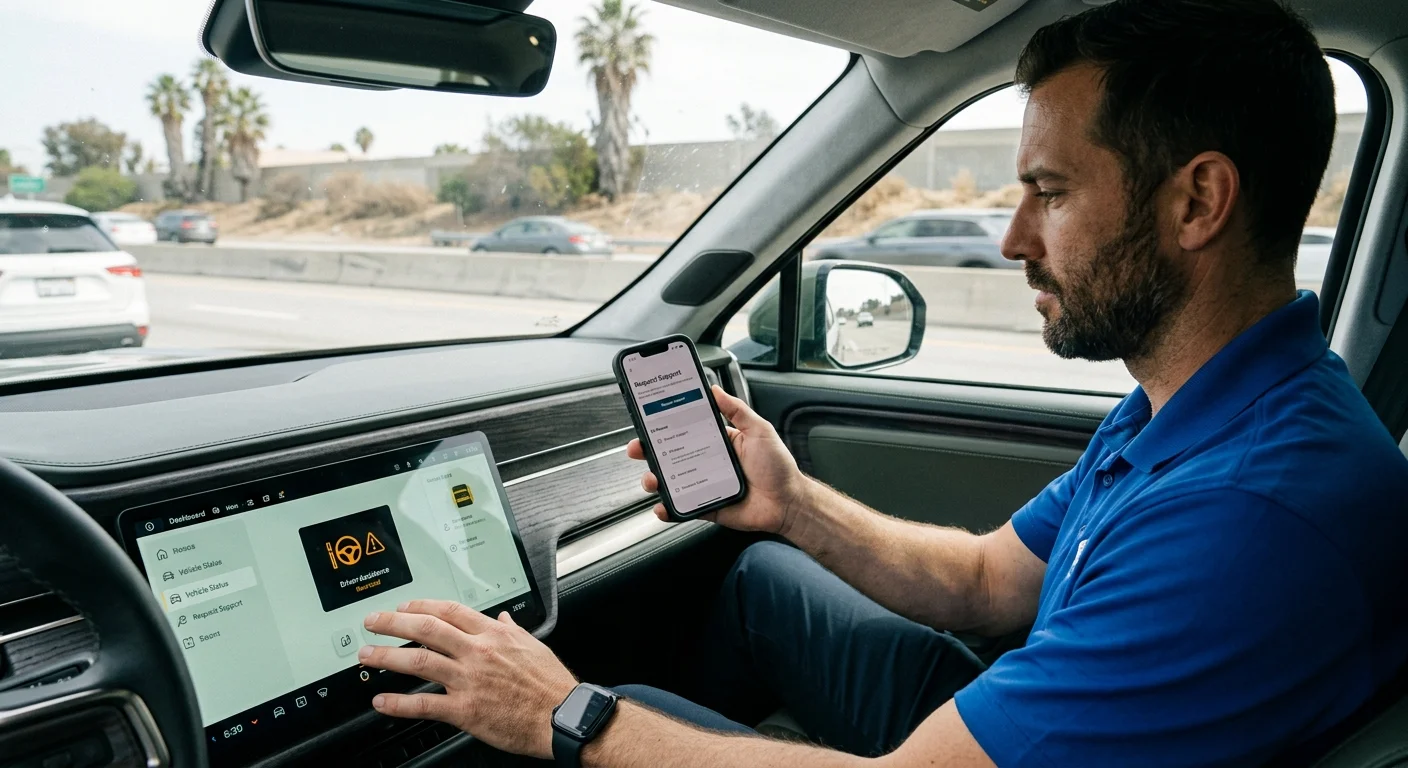
What Rivian Highway Assist actually is
Highway Assist is the Rivian driver assistance feature that combines adaptive cruise control and lane centering. It works on selected highways that Rivian has mapped. The driver monitors the road and the system. The system handles steering and speed.
Highway Assist does not drive the car. The driver remains responsible. Highway Assist does not refuel the car. Highway Assist does not jump the 12V. Highway Assist does not dispatch a tow. The feature is a comfort on long drives, not a roadside service.
What a stranded Rivian actually needs
A stranded Rivian needs one of three things.
A 12V jump if the 12V is dead. The 12V wakes the car. The traction pack is fine. The contactors will not close until the 12V is alive. A local operator with a lithium jump pack handles this on site.
A Level 2 add if the traction pack is low. A 240V source brought to the Rivian adds 10 to 20 miles of range in 15 to 30 minutes of charging time. That is enough driving room to reach a working DC fast charger, a home charger, or a garage outlet.
A flatbed if the car cannot be jumped or charged. A Rivian with a high-voltage fault, a flood incident, or a serious collision goes on a flatbed. The pros we connect you with can quote the tow in writing before they start.
What Rivian’s own roadside dispatch covers
Rivian publishes a roadside help line and an in-app button for stranded owners. The dispatch routes to a third-party contractor network. The contractor brings what the dispatch described: a tow truck, a jump box, a tire kit, or a lockout tool.
The dispatch can lag. Bay Area drivers report waits of several hours when service centers are slammed. The contractor may not know the Rivian-specific 12V access or the Rivian CCS handshake. A wrong tool on a Rivian is the wrong tool on a Rivian.
Rivian roadside does not cover a mobile Level 2 charge at the car. It covers a tow to a charger or service center. A local operator covers the mobile charge that Rivian’s dispatch does not.
When Highway Assist is the right feature
Highway Assist is the right feature on a long highway drive. It reduces driver fatigue on US-101 from San Jose to San Francisco, on I-580 through the Altamont, and on I-80 across the Bay Bridge approach.
Highway Assist does not work on every road. Local streets, mountain passes, and dirt roads are out of scope. The system hands control back to the driver on those surfaces. Drivers who treat Highway Assist as a self-driving feature will be disappointed.
When local roadside help is the right call
A dead 12V at the curb. The Rivian looks fully dead but the pack is fine. A local operator jumps the 12V and the car wakes.
A low pack on the shoulder. The Rivian ran out of range on 101 or 880. A local operator brings a 240V Level 2 source and adds 10 to 20 miles of range at the car.
A flat tire on 101. A local operator handles the tire change or the flatbed tow to a Rivian-friendly tire shop. Confirm current terms at the time of the call.
A stuck charge cable. A wet or frozen latch holds the cable. A local operator jumps the 12V first if needed, then the cable releases.
How the right operator handles a Rivian
A working Bay Area EV rescue rig carries CCS for the Rivian port, NACS adapters for newer model years, a lithium jump pack rated for 1000A peak, and a small stock of 12V batteries for on-site swaps.
The operator jumps the 12V first if the car is dark. The operator adds range with a 240V source if the pack is also low. The operator quotes the work in writing before they start. The pros we connect you with are licensed and insured.
The work covers every Bay Area city and community, from Pacifica to Brentwood and from San Mateo to San Jose.
The difference between Highway Assist and roadside help
Highway Assist is a software feature that helps you drive. Roadside help is a service that comes to your car when you cannot drive. The two are different products from different parts of the Rivian ecosystem.
Highway Assist is enabled through the Rivian app and the in-vehicle settings. Roadside help is reached through the Rivian roadside line or through Charge Pro SF at (415) 630-6268.
Drivers who try to use Highway Assist as a roadside service end up with a stranded car and no one coming. Drivers who call the right number get a real person with the right tool.
FAQ
Does Rivian Highway Assist include roadside help?
No. Highway Assist is a driving feature. Stranded Rivian owners need a separate dispatch through Rivian’s roadside line or a local operator.
What does Rivian Highway Assist do?
It combines adaptive cruise control and lane centering on selected highways. The driver monitors the road and the system handles steering and speed.
What does Rivian Highway Assist not do?
It does not drive the car, refuel the car, jump the 12V, or dispatch a tow. It is a comfort feature, not a service.
When should I call a local operator instead of Rivian roadside?
When you need a mobile Level 2 charge at the car, a Rivian-specific 12V swap, or a quick fix that does not require a service center visit. Local operators arrive with the right tool.
Will Rivian roadside bring a Level 2 charger?
No. Rivian roadside dispatches a contractor with a jump pack or a tow truck. A Level 2 add at the car is a local operator service.
Call (415) 630-6268 when the Rivian is stranded and Highway Assist is not the answer. The operator quotes a 12V jump, a Level 2 add, or a flatbed before any cable goes on. Nobody on this line promises an arrival clock.