A Nissan Ariya that won’t start is almost always a 12V problem, not a traction pack problem. The 87 kWh usable pack is the headline. The 12V that wakes the car is a small battery that lives under the hood. When that 12V dips, the Ariya looks fully dead at the curb. The traction pack can be at 80 percent and the car will still refuse to wake.
Bay Area drivers hit this on street parking in San Francisco, on long SFO sits in San Bruno and Millbrae, and on campus lots in Mountain View and Palo Alto. The Ariya is a newer Bay Area commuter and most roadside crews are still learning the access points. This post walks through what to check, what to skip, and what a local operator does when the 12V is the cause.
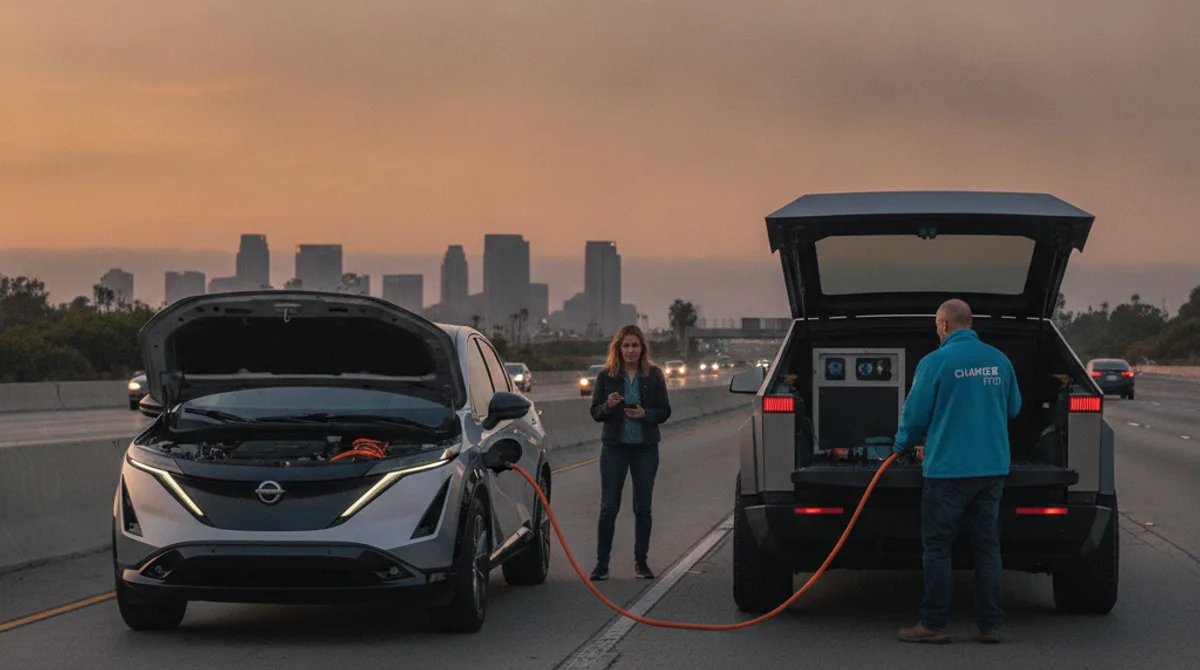
Why the 12V is the first thing to check
The Ariya traction pack does not run the contactors. The 12V does. The 12V also runs the infotainment, the door handles, the alarm, and the body control module that decides whether the car is awake. When the 12V is dead, all of that looks dead at the same time.
A 12V that has been drained by a long sit is not necessarily a bad 12V. A lithium jump pack wakes the car in a few minutes. The DC-DC converter then tops off the 12V from the traction pack. Drive for 20 minutes and the 12V is healthy again.
A 12V that is older than four years or has been through many deep drains may not hold a charge. It will jump and then die again the next morning. That is a 12V replacement, not a 12V jump. A local operator can swap a 12V on site for most Ariya model years. The pros we connect you with are licensed and insured.
The order to try when the Ariya is dark
Three steps in this order, then call.
Press the door handle. The Ariya uses a key fob passive entry. A 12V at the edge may not register a handle press. Try the physical key fob. The fob wakes the car through a different path.
Try the Nissan app. The app talks to the car over cellular. If the car is awake enough to answer, the app shows pack state of charge. A high state of charge with a dark dashboard is the 12V signature. A low state of charge means the traction pack is also low.
Open the hood and find the 12V. The Ariya keeps its 12V under the front hood. Connect a lithium jump pack to the 12V terminals. Positive first, then ground. Wait 30 seconds. Press the door handle. The car should wake.
If the jump pack has charge and the car does not wake, the body module has a fault. Move to calling a local operator.
Independent operators handle Ariya with a CCS adapter
The Ariya takes CCS at the charge port. Operators who carry CCS adapters handle Nissan in the same workflow as a Hyundai or a Ford. They jump the 12V first, then add range with a 240V Level 2 source. They do not need a Nissan-specific tool set.
The 240V source on a roadside operator vehicle is a typical 9.6 kW Level 2 unit. That is enough to add 10 to 20 miles of range in 15 to 30 minutes of charging time. That is the figure for the Bay Area rescue, not a promise about when someone arrives.
Where Bay Area drivers hit this
Street parking in San Francisco. The Sunset, the Richmond, and the Marina all see older apartment stock. Cars sit for a week at a time during long trips. The 12V drains in that window.
Long SFO sits in San Bruno and Millbrae. Travelers leave the car in long-term parking and come back to a dead 12V. The traction pack is fine. The 12V is not.
Campus lots in Mountain View and Palo Alto. The Google and Apple campuses hold cars all day in structured parking. A weak 12V does not survive a long weekend.
Garage parking in Oakland and Berkeley. Older multi-level garages see a damp cool environment. The 12V drains faster than the trunk in the sun.
Each of these is the same fix. A 12V jump, then a 12V replacement if the jump does not hold.
When it is not the 12V
Three situations look like a 12V failure but are not.
A truly empty traction pack. The app will show the pack at zero and the car will not move. The 12V may be fine. The fix is a Level 2 add at the car, not a 12V jump.
A failed public post that left the car stranded. The car sat at the post for hours with the climate on. The 12V is drained AND the traction pack is low. The order is jump the 12V first, then add range.
A flood or water intrusion. Atmospheric-river rain can push water into the underbody. If the car has been in standing water, do not try to jump it. Have it towed to a service center.
Why the right operator matters here
The Ariya is a recent model and not every roadside crew has seen one. A local operator who knows multi-brand EV work handles the 12V and the CCS plug without guesswork. The pros we connect you with are licensed and insured.
A generalist tow truck crew may not carry a lithium jump pack rated for the Ariya body control module. They may try to jump from a running gas truck, which the Nissan service manual warns against. The right operator with the right tool gets the car awake without risking the body module.
What to keep in the Ariya cargo area
A lithium jump pack rated for 1000A peak is the right tool to keep in the cargo area. It charges off any USB outlet and wakes a dead 12V in under a minute. Charge it every 90 days.
A set of gas-car jumper cables is the wrong tool. The Nissan service manual warns against jumping from another running vehicle. Use a lithium pack.
FAQ
Why won’t my Ariya start with a full pack?
The traction pack shows as full on the app but the dashboard is dark. That is the 12V signature. Jump the 12V first.
Where is the Ariya 12V?
Under the front hood. Open the hood and look for the battery on one side.
Will a jump from another car hurt the Ariya?
Yes. A running gas car puts out voltage spikes that can damage the body control module. Use a lithium jump pack, not another car.
How long does an Ariya 12V last?
Four to six years in Bay Area conditions. A 12V that has been deeply drained more than a few times may not hold charge.
Can a roadside operator replace an Ariya 12V on site?
Yes, for most model years. Confirm current terms with the operator at the time of the call.
Call (415) 630-6268 when the dashboard is dark and the door handles will not respond. The operator arrives with the right pack and quotes before any cable goes on. Nobody on this line promises an arrival clock.