Mobile EV charging and a home battery backup solve two different problems, and many Bay Area drivers confuse them. One is a service that comes to your car when you’re stranded. The other is an installation in your house that keeps your lights on when the grid goes down. Knowing which one fits your situation saves real money and avoids buying hardware that doesn’t help the problem you’re actually trying to solve.
What mobile EV charging actually is
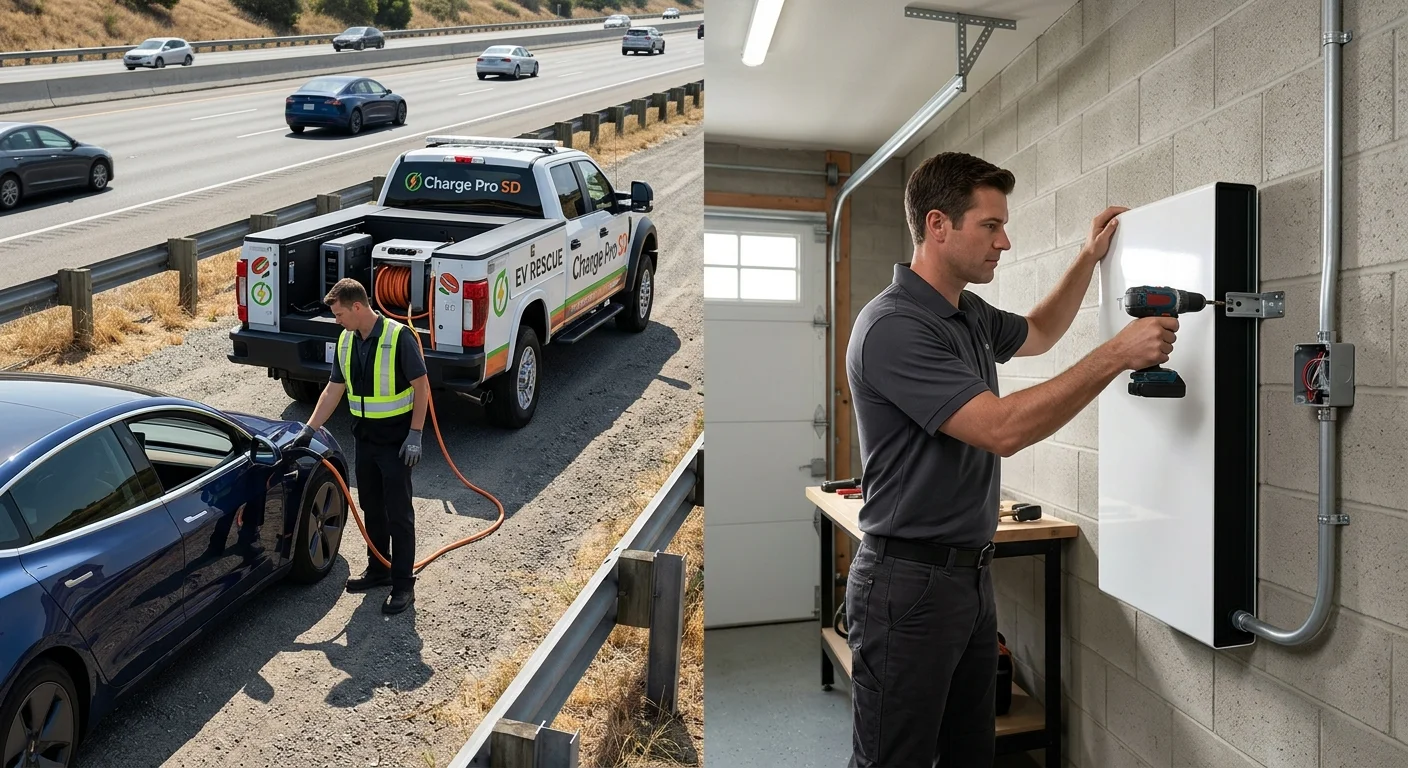
Mobile EV charging is an emergency roadside service. An independent operator brings a 240V Level 2 source to your car, plugs in with a NACS connector for Teslas or a CCS adapter for non-Tesla EVs, and adds about 10 to 20 miles of range in 15 to 30 minutes of charging. That’s enough to reach a working public charger or your home charger. The car never leaves the ground. The operator quotes you before any cable goes on, and they bill you directly.
Charge Pro SF is a referral line. We match stranded EV drivers with independent local operators serving the Bay Area. We don’t own trucks or equipment, perform the work, set prices, or promise arrival windows. The pros we connect you with are licensed and insured in California. The mobile EV charging page describes the service in more detail.
A mobile charge fits when your traction pack is low or empty and the car will drive once charged. It doesn’t fit when there’s visible damage, a high-voltage warning triangle on the dash, smoke or fluid leaks, or a charge port that won’t accept a connection. Those situations need transport, not a charge. Our out-of-charge recovery service covers that path.
What a home battery backup actually is
A home battery backup is a fixed installation at your residence. The most familiar example is the Tesla Powerwall, though several brands make similar wall-mounted systems. The battery stores electricity from rooftop solar or from the grid during off-peak hours. When the grid goes down, the battery automatically powers your home. It can run your refrigerator, your lights, your internet, and your home EV charger if the car is plugged in at home.
A home battery is a long-term investment in home energy independence. It is installed by a licensed electrician or solar contractor with permits, panel integration, and a multi-year warranty. It is not a roadside tool. It does not go to the curb when your car runs out of charge. It sits on your garage wall, doing nothing for you on the I-580 climb out of Livermore.
The Bay Area renter problem
The Bay Area has one of the highest renter shares in the country, and many of those renters live in older apartment and condo stock. Census ACS 2019 to 2023 shows pre-1980 housing shares above 70 percent in San Francisco, Oakland, Berkeley, Daly City, San Bruno, Burlingame, San Mateo, San Carlos, El Cerrito, Alameda, San Leandro, and Lafayette. Pre-1980 stock is mostly apartments, flats, and small condos with structured parking and shared electrical panels.
A renter in one of those buildings has three constraints: no private garage, no assigned home charger, and no ability to install a Powerwall or a home battery backup system on the building’s wall. They live on public DC fast charging between work, errands, and weekends. A bad week of full stations ends with a car at 4 percent on a hill. A home battery backup does nothing for that driver. A mobile EV charge does.
The suburban homeowner case
The other Bay Area is the master-planned suburb with a garage and a 240V plug. San Ramon, Dublin, Pleasanton, and the newer parts of Fremont have post-1980 housing shares above 75 percent. A homeowner with a garage and a charger can top up every night and rarely runs low. They are the candidate for a home battery, because a power outage during wildfire season or a PSPS event keeps their house lit and lets them charge the car in the garage.
Even for that homeowner, a mobile EV charge still has a job. A flat tire on I-680, a long trip that ends further from a charger than expected, a forgotten plug-in on a busy morning, none of those go away because the home has a battery. The Powerwall keeps the lights on. It doesn’t keep the car moving on the Altamont climb.
When you need mobile rescue
You need a mobile EV charge when your traction pack is low or empty and you’re away from a working charger. The Bay Area’s geography makes this specific: a SR-17 climb out of Los Gatos, a SR-24 climb to the Caldecott, a SR-92 climb over to Half Moon Bay, an I-580 climb to the Altamont. Each of those costs range the gauge didn’t predict. A mobile operator comes to the car, plugs in, adds the miles you need to reach a working charger. The operator quotes you before starting, and you weigh that against a flatbed tow.
Our EV roadside assistance page covers the broader set of situations beyond charging alone.
When you need a home battery
You need a home battery when the grid is unreliable and you want your house to keep running during an outage. PG&E’s service territory covers most of the Bay Area, with Peninsula Clean Energy, Silicon Valley Clean Energy, San Jose Clean Energy, Ava Community Energy, and MCE as the generation CCAs in their respective cities. The wires utility matters because PG&E, MCE, and the CCAs handle the billing and the outage reporting, but the battery sits behind your main panel and powers your home regardless of which entity generated the kilowatt-hours.
PG&E publishes residential EV rate schedules including Home Charging EV2-A, Electric Vehicle EV-B, and Electric Home E-ELEC, and a Residential EV Charging program for home charger rebates. Silicon Valley Power, the municipal utility in Santa Clara, has a Residential Electric Vehicle Charging Station Rebate. Alameda Municipal Power has an optional Electric Vehicle Time of Use rate and a Level 2 EV Charger rebate with standard and income-qualified tiers. None of those programs pay for a stranded-car rescue. The home charger rebate pays for the wall connector in your garage.
What Charge Pro SF does, and what we don’t
To be clear: Charge Pro SF is the connection between stranded drivers and independent local operators across the Bay Area. Our mission is to match you with the right operator for the situation, fast, and let the operator handle the work. We don’t install, service, or sell home battery backup systems, residential solar, or fixed EV charging stations. That work requires different licenses, different equipment, and different expertise. If you want a home battery, talk to a licensed solar contractor. If your car is sitting dead on the side of the road, talk to us.
When to call us
Call when your electric vehicle is stranded anywhere in the Bay Area due to a depleted traction pack, a dead 12V, or an unclear dashboard message, and you need help deciding whether a mobile charge, a jump, or a transport fits. Charge Pro SF connects you with an independent local operator who quotes before starting.
Call (415) 630-6268 and we will connect you with a local operator who quotes you before any work begins.