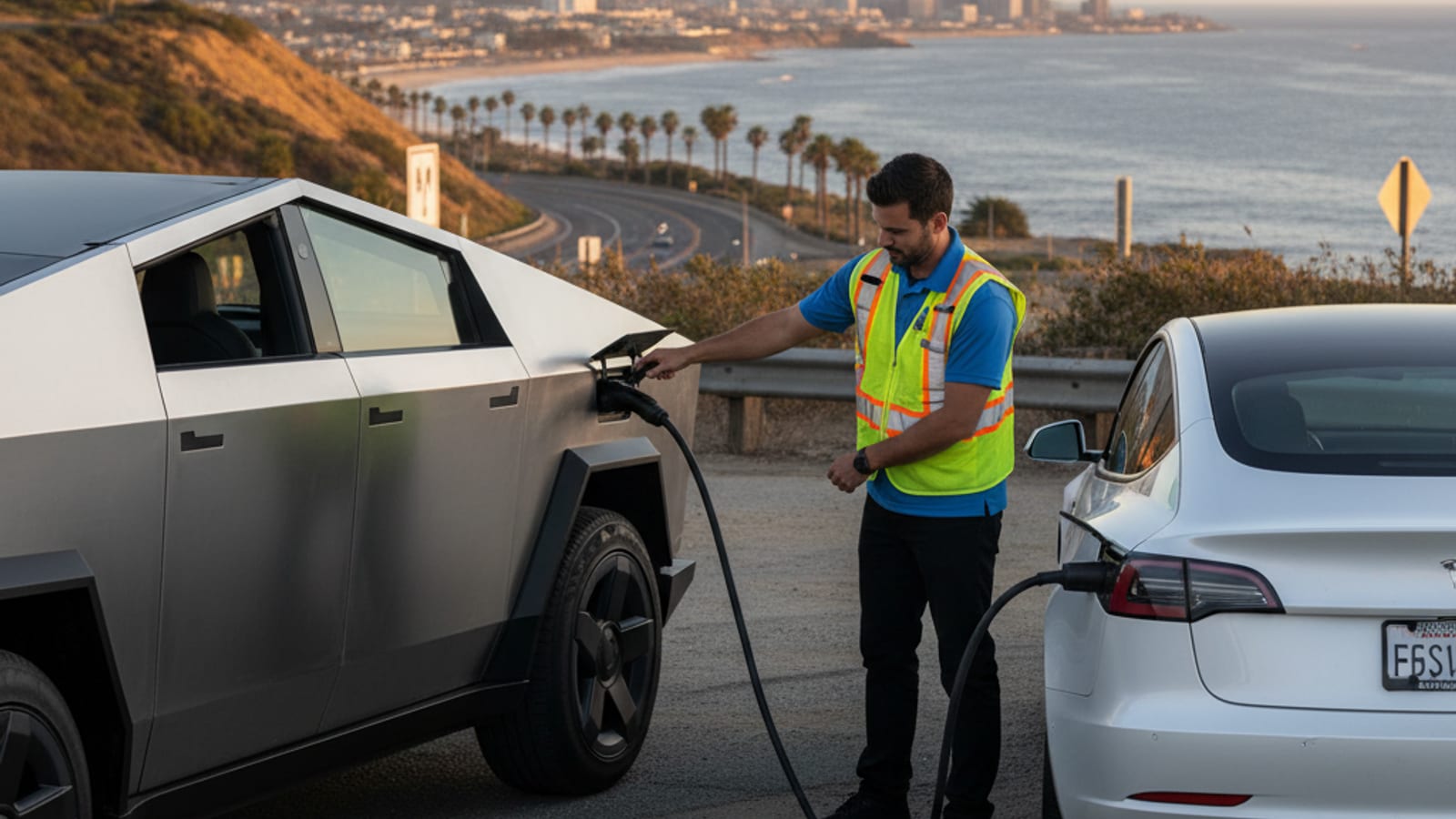
When the gauge drops near zero somewhere in the Bay Area, the search mobile ev charging near me is not a request for directions to a charger. It is a request for someone to come to your car. Charge Pro SF is a referral line. It matches stranded EV drivers with independent local operators who quote before rolling and bring a 240V Level 2 source, a NACS plug, and a CCS adapter to wherever the car is sitting.
What the referral actually does
Charge Pro SF is not the operator. We don’t own trucks or equipment, perform the work, set prices, or promise an arrival window. We connect you with an independent local operator licensed and insured in California, and they quote you before any cable goes on, then bill you directly. The pros we connect you with are licensed and insured. The model is referral, not employment, and that distinction matters because it puts the price and the service terms in your conversation with the operator, not in a script we read.
A typical session adds about 10 to 20 miles of range in 15 to 30 minutes of charging. That is enough to reach a working public charger, a Supercharger, or your home charger, not to fill the pack. The mobile EV charging page describes the service in more detail.
Bay Area geography shapes the call
The Bay Area covers five core counties: San Francisco, San Mateo, Santa Clara, Alameda, and Contra Costa. Within those counties sit 50 cities and communities, organized into eight regions: San Francisco, The Peninsula, The Coastside, South Bay and Silicon Valley, East Bay core, The Tri-Valley, Central Contra Costa, and East Contra Costa and the Delta. The calls cluster around the geography in ways that repeat.
Street-parked San Francisco dwellers with no home charging depend on public DC fast charging, and a busy weekend of full stations ends with a car at 4 percent on a hill. South Bay errand days end with a dead 12V after a long structured-parking sit at the Apple, Google, or Meta campuses. The Coastside runs, Pacifica, El Granada, Half Moon Bay, leave long-haul gaps along SR-1. The Tri-Valley climbs, I-580 east toward the Altamont Pass, I-680 over the Sunol Grade, spend range into wind and grade. Each pattern produces a different call.
The Freeway Service Patrol covers the freeway beats during weekday hours, 6 to 10 AM and 3 to 7 PM, reachable at 511 or a call box. FSP lists gas, jump-starts and radiator refills and makes no mention of electric vehicles or out-of-charge assistance. Read 2026-09-18. Outside FSP hours the CHP Rotation Tow Program assigns the truck, and the driver does not pick the company. A mobile EV operator fills the gap FSP doesn’t cover, on the shoulder, at a curb, in a parking deck, after hours.
What to share on the first call
An operator commits to a call after hearing the vehicle, the symptom, and the location. Have these ready.
- Make, model, model year. Tesla Model Y, Rivian R1S, Hyundai Ioniq 5, the connector and the acceptance rate vary by model.
- Last known battery percentage. If the gauge was at 12 percent when you pulled over, say so.
- Warning text on the dash. Read it out rather than paraphrasing.
- Location. A precise pin, cross street, or mile marker. “Somewhere near the Bay Bridge” wastes time; “eastbound I-80 just past the Treasure Island exit” doesn’t.
- Access details. Height clearance, security gate hours, whether the car is on a grade, whether you can move it to a safer spot.
Photos help if you can send them, but never share sensitive access codes in a public message. Give the gate code directly to the operator through the call.
How the call fits between empty pack and dead 12V
An empty traction pack and a dead 12V look the same from the curb, and they need different fixes. Note what still works before calling. If the screen wakes but the car won’t shift, the traction pack is the likely problem and a mobile charge is the right call. If nothing responds, the doors, the lights, the app, the 12V is the likely cause and a jump comes first. Charging the wrong system wastes time on the curb.
Operators carry a 12V jump kit and can restore power on site for most models. For Tesla cars the Tesla 12V battery jump service covers that path. For non-Tesla EVs the non-Tesla EV rescue page describes connector compatibility across Hyundai, Kia, BMW, Chevy, VW, Ford, and Rivian.
When mobile charging beats a tow
A flatbed tow to a public charger, then a charging session, then a ride back to the original car, runs longer and costs more than a single mobile visit. The car never leaves the ground with a mobile charge, which matters on lifts and low-clearance EVs. The operator can usually reach a parking deck or a residential driveway a flatbed cannot. For an empty pack and a drivable car once charged, mobile charging is almost always the faster answer.
A tow still makes sense when the car can’t take a charge, when there’s visible damage, or when the location genuinely isn’t reachable by a service vehicle. Our out-of-charge recovery service covers that path when charging on site isn’t the right fit.
After-hours and what to expect
Operators don’t publish hours and we don’t either. A call at 11 PM on a Tuesday goes through the same referral line, and the operator who takes the call decides whether to roll based on their own workload. The operator quotes you before starting, and the quote accounts for the time of day.
When to call us
Call when you are stopped anywhere in the Bay Area with a depleted battery, a dead 12V, or a vehicle that won’t respond, and you need help sorting out whether a charge, a jump, or a transport fits. Charge Pro SF connects you with an independent local operator who reviews the situation and quotes before starting.
Call (415) 630-6268 and we will connect you with a local operator who quotes you before any work begins.