A Kia Niro EV that won’t start almost always traces back to the 12V auxiliary battery, not the main traction pack. When the 12V dies, the car’s electronics go dark: no dashboard, no response to the start button, no charging communication. You can jump the Niro EV’s 12V at the under-hood posts in about ten minutes, and a Bay Area mobile rescue can reach you without a tow.
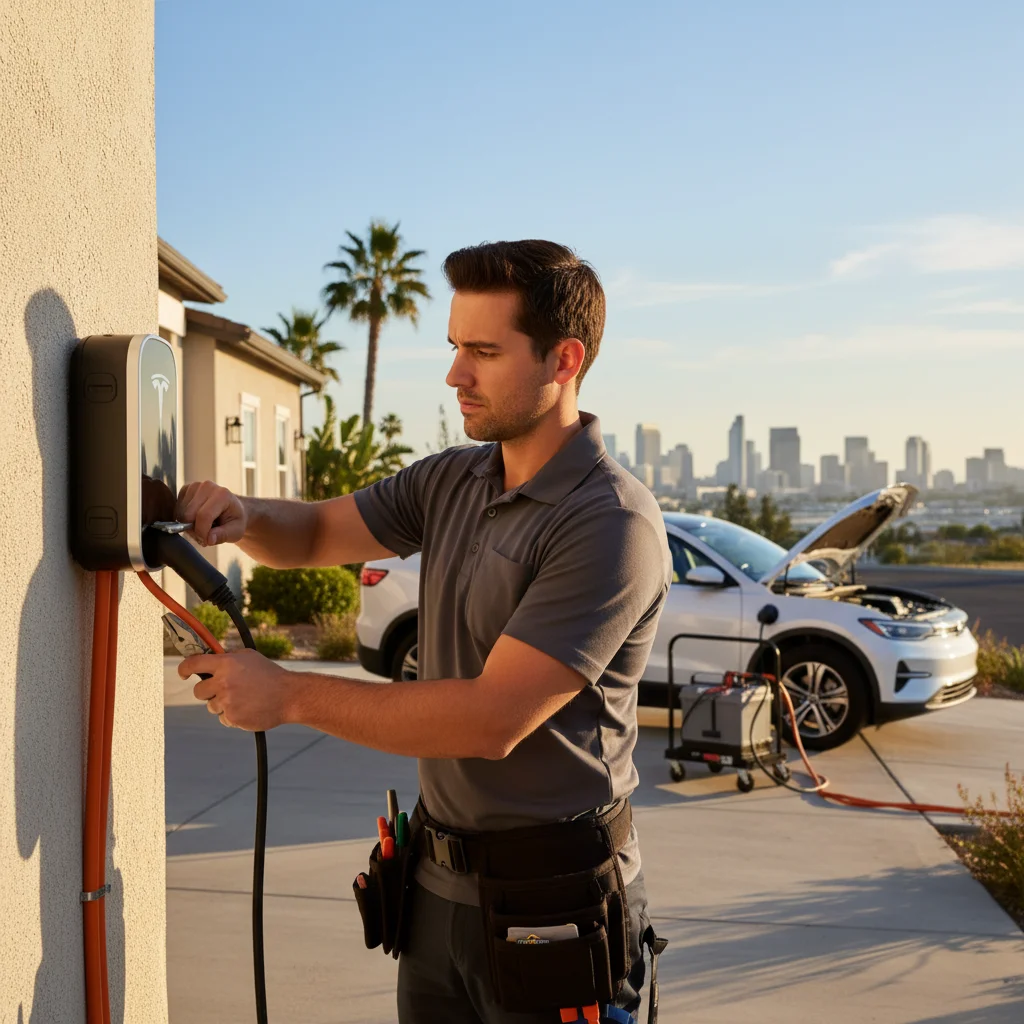
Why the Kia Niro EV won’t start
The Niro EV, sold as the 2019 to 2022 first generation and the redesigned 2023 onward, uses the same split-battery architecture as every modern EV. A large lithium-ion traction pack moves the car. A small 12V lead-acid or AGM battery powers the control modules, door locks, alarm system, and the relay that wakes the main pack. If the 12V drains or fails, the car behaves like it is completely dead even when the traction battery reads 80 percent.
Common no-start causes, roughly in order of frequency:
| Cause | Symptom | DIY fix? |
|---|---|---|
| Dead or low 12V auxiliary battery | Blank dash, no start response, no door-lock beep | Yes, jump at under-hood posts |
| Corrupted sleep mode (parasitic drain) | Car sat off for 2+ weeks, screens won’t wake | Yes, 12V jump restores normal operation |
| Faulty 12V battery saver relay | Repeated 12V drains over days | No, dealer diagnosis |
| High-voltage interlock fault | Ready mode never engages after 12V is fine | No, scan tool plus dealer |
| Corroded or loose 12V terminal | Intermittent starts, warning lights | Yes, clean and retighten terminals |
| Key fob battery dead | Car doesn’t recognize fob, won’t let you in | Yes, replace CR2032 or use the mechanical key |
Bay Area marine-layer humidity accelerates terminal corrosion on lead-acid batteries. If your Niro EV lives near the coast, Pacifica, Daly City, the Sunset, the Richmond District, and corroded terminals are worth checking before you assume the 12V is dead.
Where the 12V battery is and how to jump it
On the Kia Niro EV, the 12V auxiliary battery is under the hood, on the driver’s side near the firewall. It is tucked under a plastic cover but accessible without removing major components. The 2023+ redesign keeps the same general location.
You do not jump directly from the 12V terminals. Kia provides dedicated jump-start posts in the engine bay: a red positive cover (+) and a chassis ground point (-). Those are the only safe jump points.
Step by step:
- Park the donor vehicle or position a portable jump starter so the cables reach the Niro EV’s engine bay.
- Open the red positive cover on the Niro EV’s jump post. Connect the red cable there.
- Connect the other red cable to the donor’s positive terminal or jump-starter positive.
- Connect the black cable to the donor’s negative terminal or jump-starter negative.
- Connect the other black cable to an unpainted metal ground on the Niro EV, not the negative battery terminal directly. This reduces spark risk near the battery.
- Wait two to three minutes. Then press the Niro EV’s start button.
- If the dash lights up and the car enters Ready mode, remove cables in reverse order (negative first, then positive).
- Drive for at least 20 to 30 minutes to let the DC-DC converter recharge the 12V. Avoid turning the car off until you reach your destination.
Do not use a high-amperage diesel-truck jump starter on the Niro EV. A standard 12V jump pack rated 400 to 600 peak amps is plenty. The Niro EV’s 12V is a smaller battery than a full-size pickup’s.
The Niro EV’s 12V battery save feature
The 2023 onward Kia Niro EV includes a 12V Battery Save function in the vehicle settings menu. When enabled, it tells the DC-DC converter to keep the 12V topped up more aggressively while the main pack charges or while the car is parked plugged in.
If your Niro EV repeatedly loses its 12V, check this setting first:
- Go to Settings > Vehicle > 12V Battery Save > toggle on.
This does not fix a failing 12V, but it can extend the life of a borderline one and prevent the no-start symptom if you tend to leave the car parked for more than a week without plugging in.
If you have enabled Battery Save and the 12V still keeps dying within days, the battery itself needs replacement, or there is a parasitic draw from a faulty module. That is a dealer-level diagnosis.
Dead 12V versus empty pack
A dead 12V and a depleted main pack can feel similar from the driver’s seat, but they are different problems with different fixes.
Dead 12V symptoms:
- Completely dark instrument cluster
- No response to the start button, no relay click, no chime
- Key fob doesn’t unlock the doors or sounds weak and slow
- Hazard lights don’t activate
- Car sat for a week or more with no activity
Depleted main traction pack symptoms:
- Dashboard turns on and shows a low-battery or turtle-mode warning
- Car enters a Ready Off or Save state with a clear charge-level warning
- You can still unlock doors, turn on lights, and use the infotainment
- The car drove normally until it ran out of range
If your dash is dark and unresponsive, start with the 12V. If the dash is on and telling you the battery is low, you need a charge to the main pack, not a jump. Our mobile EV charging service delivers a CCS charge directly to the Niro EV’s port, typically 10 to 20 miles of range, enough to reach a Level 2 station or get home.
Where this happens in the Bay Area
I-880 corridor, Oakland to Hayward. Stop-and-go traffic plus AC load on a hot afternoon ends a marginal 12V. Operators cover this stretch regularly.
Parking structures, downtown Oakland and Berkeley. Level 2 stations in parking garages are frequently occupied or out of service. A Niro EV whose 12V has drained overnight in a parking garage and won’t start is a mobile-rescue call, not a tow.
North Peninsula Caltrain stations. Millbrae, Burlingame, and San Mateo hold cars all day. A 12V battery that dies during the workday is a one-call fix.
Far South Bay, Morgan Hill and Gilroy. US-101 toward the Central Coast. A driver who runs the 101 on a low battery and finds the nearest DC station full has limited options.
For a step-by-step on what a non-Tesla EV rescue looks like on the road, see non-Tesla EV rescue. For the broader pattern, see what happens when an EV 12V battery dies.
Frequently asked questions
How do you jump-start a Kia Niro EV?
Connect jump cables to the dedicated under-hood posts, red positive near the firewall and black to a chassis ground, not directly to the 12V battery terminals. Wait two to three minutes, then press start. If the car enters Ready mode, remove cables in reverse order and drive for at least 20 minutes to recharge the 12V via the DC-DC converter.
Where is the 12V battery in the Kia Niro EV?
The 12V auxiliary battery sits under the hood on the driver’s side, near the firewall, covered by a plastic panel. Kia provides separate jump-start posts in the engine bay that are easier and safer than connecting directly to the battery terminals.
Can a dead 12V battery kill the Niro EV even if the main pack is charged?
Yes. The 12V powers the modules that wake the main traction pack. If the 12V is dead, the car won’t respond to the start button or recognize a charging cable, even with a full traction battery. The fix is a 12V jump, not a charge to the main pack.
What is the Kia Niro EV’s 12V Battery Save feature?
Battery Save is a setting in the 2023 onward Niro EV that tells the car to keep the 12V battery topped up more aggressively while plugged in or while the main pack charges. It is designed to prevent the parasitic drain that caused repeated no-start events for some early Niro EV owners.
Call (415) 630-6268 when basic troubleshooting is not getting you anywhere and you want a match to a local operator who handles the Niro EV.