Dinner on University Avenue ran long. The prestige EV sat at the curb with no home plug. A Stanford lot does the same thing all day. You walk back, and the car won’t wake. Screens stay dark, or the estimate is already gone. EV roadside assistance in Palo Alto is a mobile charge. Or it’s a 12V jump at the bumper. Charge Pro SF matches stranded drivers with independent local operators. They quote you before they start. They bill you directly.
Two cities share a creek and one messy ZIP
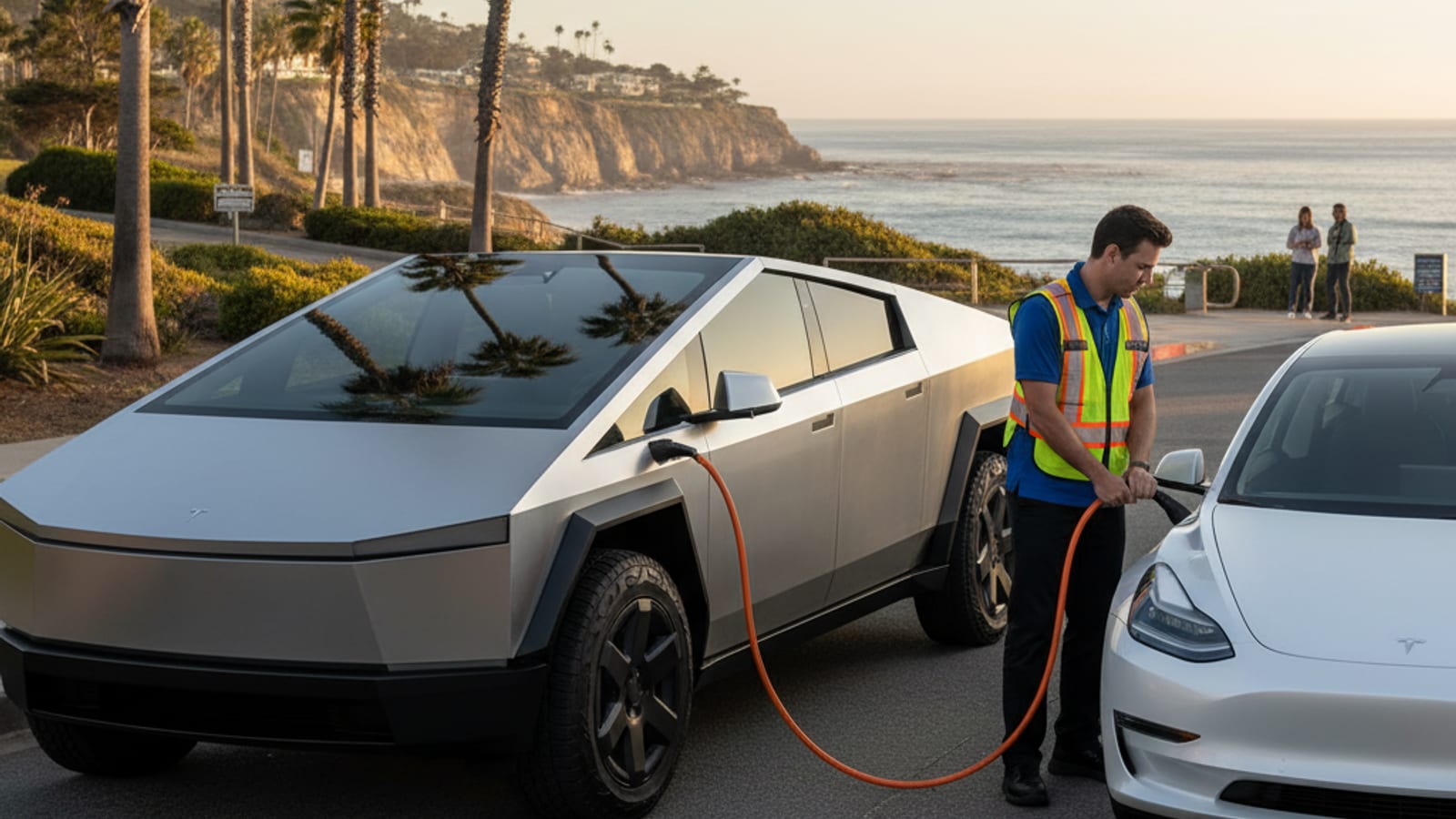
Palo Alto is Santa Clara County. East Palo Alto is San Mateo County. They sit across a creek from each other. Callers mix them because University Avenue keeps the name. ZIP 94303 overlaps the line too. A ZIP is not a city boundary. Census files list every ZIP that touches the place. Those ZIPs can run far outside city limits. Tell the operator the city and a landmark.
East Palo Alto covers about 2.5 square miles. The ACS 2019-2023 count is 29,143 people. The 2024 Census estimate is 29,296. About 70.8 percent of housing there predates 1980. A home plug is not a given on that side. PG&E delivers the wires. Peninsula Clean Energy is the community choice aggregator.
Corridors there are US-101, SR-84, Bay Road, and Woodland Avenue. SR-84 is University Avenue out to the Dumbarton Bridge. Dumbarton tolls run westbound only. Cash ended for good in March 2020. FasTrak, a plate account, or an invoice is how that bridge bills. A thin pack that aims for Fremont can stall on the approach. Stay on this side if the estimate is already low.
Ravenswood, Gardens, Woodland, University Village, and Weeks are the East Palo Alto neighborhoods. The Ravenswood Bay Trail and the Four Seasons tower are easy pins. Use the East Palo Alto charging page for that city. Don’t send a Palo Alto pin to the wrong curb.
Stanford lots, the research park, and downtown curbs
Stanford University holds cars from morning until evening. Stanford Stadium does it on game days. The Stanford Shopping Center does it on a long retail sit. The Stanford Research Park does it on Page Mill Road. Downtown University Avenue adds street parking that never sees a driveway outlet.
This page won’t map a public post in any of those lots. It also won’t guess how far the next plug sits. The problem we can name is the missing home circuit. Prestige EVs still drain while they wait. Sentry, cabin prep, and a warm afternoon all nibble. You come back to a car that looks asleep.
Palo Alto is a Santa Clara County city of about 24 square miles. The ACS 2019-2023 count is 67,231 people. The 2024 Census estimate is 67,658. This is inland Peninsula weather, not the foggy coast. San Francisco’s July normal high is 71.5F on the 1961-1990 WRCC record. San Jose sits near 82F on that same vintage. Cabin cooling on a late Page Mill exit is a real draw.
About 70.6 percent of the city’s housing predates 1980, per ACS 2019-2023. Older stock often means a shared outlet. It can also mean a skipped overnight charge. College Terrace and Old Palo Alto still have that older mix. Midtown and Barron Park do too. Some cars leave home already thin. The campus day then finishes the buffer.
City of Palo Alto Utilities serves the wires here. That’s a municipal electric utility, not PG&E. Confirm any home rate with the utility before you plan around it. A rebate on a wall unit doesn’t wake a lot car.
The 12V can fake an empty pack
Two failures look alike from the sidewalk. The traction pack can be too low to leave the stall. Or the small 12-volt battery can be dead. Hours of computers and cameras will do that. An empty pack won’t take you onto US-101. A dead 12V may not even unlock the doors.
Teslas and most other EVs still rely on that 12V. Contactors, screens, and the charge port need it. A long campus sit is a classic 12V drain. Sentry mode, scheduled preconditioning, and a hot cabin all nibble. Tesla owners have a dedicated writeup. Read Tesla 12V failure after a long park.
The operators we connect you with can jump a dead 12V on site. They can replace it on site too. They can also bring a 240-volt Level 2 source to the car. Native NACS for Tesla. CCS or J1772 adapters for everyone else. That charge typically adds 10 to 20 miles of range. That’s 15 to 30 minutes of charging time. That’s plug time, not a promise of when anyone arrives.
If the dash still has miles, start with the 12V. That’s the usual read when the car is dark. If the estimate is already in the single digits, you need pack energy. Don’t treat those as the same call. Ask the operator which job you’re buying before a cable comes out.
Tesla’s Model Y manual describes a lithium-ion low-voltage battery. Jump posts sit under the hood. Tesla says a Model Y can’t jump another car. The wires behind the tow-eye cover only release the hood. Tesla says those leads can’t charge the low-voltage battery. Disconnect them as soon as the hood unlatches. Follow the manual for your exact model.
If the car is a Tesla, you can try the factory path first. Tesla says to request roadside assistance in the Tesla app. Out-of-range help may be available. Tesla says that help isn’t financially covered. Availability can be restricted for safety or regulatory reasons. A local operator is a separate quote. See Tesla 12V battery jump if that path doesn’t fit.
101, 280, El Camino, and the campus feeders
The city’s corridors are US-101, I-280, and SR-82. SR-82 is El Camino Real. Embarcadero Road, Page Mill Road, and Oregon Expressway feed those highways. The campus-day stall often starts in College Terrace or the Research Park. Then it shows up on the first freeway slip.
US-101 is the bay-side squeeze. You leave a Stanford lot with a thin buffer. Heat, AC, and the Embarcadero merge use it up. Express lanes run on US-101. FasTrak is required. Hours are generally 5 AM to 8 PM on weekdays. If you stop in a lane, you’re in live traffic. This page won’t tell you to pull left. A median or left-shoulder claim wasn’t verified.
I-280 is the foothill side. Page Mill Road is the usual climb toward that freeway. Oregon Expressway feeds the same inland edge. El Camino Real looks easier than a freeway. Lights and a crawling dinner rush still chew range. University Avenue downtown is stop-and-go after a show or a dinner.
On a full-access-control freeway, California Vehicle Code 21718 generally bars stopping. A disabled vehicle is an exception when you’ve already summoned help. California Vehicle Code 22651(f) covers a car that can’t move. After more than four hours on that freeway, it can be removed. Stay with the car if you can do so safely. Put on hazards. Call for help before that four-hour clock becomes a tow.
The Bay Area Freeway Service Patrol is a MTC, CHP, and Caltrans partnership. Beats run Monday through Friday, 6 to 10 AM and 3 to 7 PM. Dial 511 and say “Freeway Assist,” or use a call box. FSP publishes gas, jump-starts, and radiator refills. The MTC page, read 2026-09-18, doesn’t list electric vehicles. It also doesn’t list out-of-charge help. Outside those hours, CHP’s Rotation Tow Program assigns a tow vendor. You don’t pick the company. If the car can’t restart, that program may use an approved drop. It isn’t a shop or house you choose. CHP’s FSP materials also don’t mention a mobile EV charge.
If you’re in a posted private lot, read the tow sign. California Vehicle Code 22658 governs those private-property tows. The sign must be at least 17 by 22 inches. Lettering must be at least one inch. It must say removal is at the owner’s expense. It must list the enforcement number and each tow company. The operator must notify law enforcement within one hour. California doesn’t cap ordinary private or consensual tow rates statewide. CHP sets rates only for its own rotation vendors.
CHP says to call 911 when a disabled vehicle sits in a dangerous lane. In metro areas, other roadside requests can go through 511. Say “Roadside Assistance” on that line. Caltrans District 4 covers the nine Bay Area counties. 511 SF Bay is the regional traveler line.
First minutes on the curb or the shoulder
If you can still roll a few feet, get out of a live lane. A lot, a curb, or a legal shoulder is enough. Hazards on. Stay with the car if it’s safe. On 101 or 280, call 911 first if you’re in a travel lane.
During weekday FSP hours, 511 can send a beat truck. Ask what that truck can actually do. A jump is on the published list. An empty pack charge is not. If the screens are dark, say so.
In a Stanford garage or a shopping-center stall, read the posted tow sign. Private-property tows run on a clock of their own. You want help before a hook shows up. Give the operator the garage name or the nearest gate.
What the operator brings to the bumper
Charge Pro SF is a referral line. We aren’t a fleet. We match stranded EV drivers with independent local mobile rescue operators. We own no trucks. We employ no technicians. We hold no contractor license. The operator at your bumper quotes the job, then bills you.
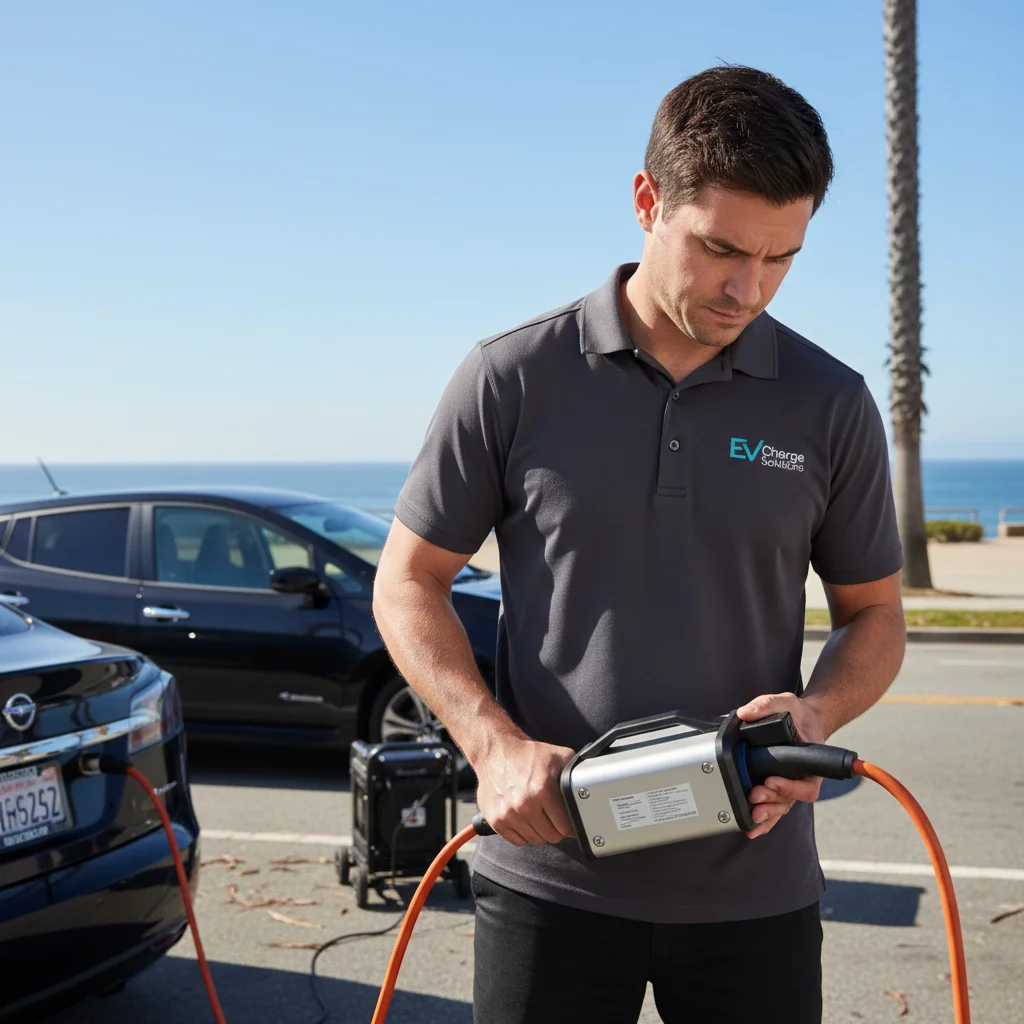
Mobile EV charging is a 240-volt Level 2 source. The operator rolls it to the stall, the curb, or a legal shoulder. The point is enough range to leave, not a full pack. Ten to 20 miles is usually enough to leave a Stanford garage. It’s also enough to leave University Avenue or a Research Park curb. From there you choose the next plug on your own map.
DOE’s Alternative Fuels Data Center describes Level 2 as 240-volt residential service. Commercial Level 2 is often 208-volt. Equipment can range from 2.9 to 19.2 kW. Charging time still depends on the pack, the onboard charger, and the hookup. A roadside session is a short Level 2 charge. It isn’t a DC fast charge.
EV roadside assistance also covers the 12V path. Jump first when the car is dark. Replace on site when the battery won’t hold. Operators handle Tesla and every major EV brand. Bring the adapter question up when they quote. NACS, CCS, and J1772 are the usual set.
Don’t expect a highway patrol truck to refill an EV pack. FSP is built for gas, jumps, and overheating. An out-of-charge EV needs a charger at the bumper. Or it needs a flatbed that can move it without spinning the motors.
Tell the operator the make. Add the plug type if you know it. Say whether the screens are on. Tell them the named road. Page Mill, Embarcadero, and El Camino all help. So does a 101 shoulder or the 280 connector. Named landmarks help too. Use Stanford Stadium, the Shopping Center, the Research Park, or downtown University Avenue.
If you only have a ZIP, say that. 94301, 94304, 94305, and 94306 often mean this city. 94303 can be either city. 94043 and 95033 may sit far outside. Give a gate, a building, or a street anyway.
When a tow is the better first call
A tow is the right call when the car can’t take a charge. It’s also the call when the port is damaged. Same if you’re in a lane CHP wants cleared now. Most AWD EVs, including most Teslas, should ride a flatbed. Wheels on the ground can stress the motors. That wait is for the right truck, not the first truck that answers.
A mobile charge leaves the car where it sits. That matters in a packed campus garage. It also matters on a University Avenue curb after dinner. A Stadium lot after a game is the same problem. You aren’t hunting a wrecker with dollies and straps. You’re adding miles and driving out.
What moves the quote isn’t a published menu. Distance the operator has to cover moves it. Time of day moves it, because 101 and 280 traffic change the run. How many miles of range you need moves it. Evening campus exodus is one kind of job. A quiet Midtown curb at noon is another. The operator quotes you before any cable goes in. If that quote isn’t a fit, ask CHP about a rotation tow.
Don’t keep cycling a 12V that dies again after a jump. That’s a replacement conversation with the operator.
Municipal power won’t start a dead car
City of Palo Alto Utilities publishes a Utility Service Capacity Fee Rebate. It also publishes a multifamily EVSE rebate. Confirm both on the city utility pages before you plan a wall unit. No dedicated residential EV rate schedule turned up on the 2026-09-18 pass. Ask the utility what you’re actually billed.
Those programs are for a house or a building. They don’t reach a car that already sits dead on campus. Don’t wait on a panel conversation when you can’t leave the lot. A licensed C-10 electrician is the person for a future wall charger.
Peninsula neighbors on PG&E plus Peninsula Clean Energy live under a different bill. East Palo Alto and Menlo Park are in that group. Peninsula Clean Energy publishes an EV Incentives Program. It also publishes an EV Ready Program for business and multifamily charging. Mountain View is PG&E plus Silicon Valley Clean Energy. Palo Alto is the municipal exception on this stretch. Don’t take bill advice from this page. Use the utility name so you call the right outage line.
Caltrain publishes no park-and-ride EV charging systemwide. Confirm a live plug on your own map. This page won’t guess a distance to the nearest one.
College Terrace, Midtown, and the next city over
College Terrace sits against the campus edge. That’s where a workday sit turns into a dark dash. Downtown and University Avenue stall after dinner or a show. Old Palo Alto and Crescent Park are the residential streets north of that core. Midtown and Ventura catch errand traffic along the middle of the city. Barron Park sits toward the south and west.
The Stanford Research Park is the Page Mill office pattern. Cars sit there all day. Then they meet I-280 or 101 with a thin buffer. Stanford Shopping Center is a long retail sit. Stanford Stadium is an event sit. None of those need a mountain grade to spend the last miles.
Mountain View has the same campus-sit pattern next door. The Mountain View roadside note covers that lot-to-freeway jump. Menlo Park is the northwest neighbor on the San Mateo side. Los Altos is the residential edge toward the hills. Start at the Palo Alto EV charging page for local charging context. Use your own map for live plugs.
When to call the referral line
Call when the car won’t start. Call if the estimate won’t cover the next merge. Call if the 12V has dropped the screens. Stay out of live lanes if you can. Roll to a shoulder, a lot, or a curb. On the freeway, you’ve already summoned help once you place the call. That’s the CVC 21718 idea.
Calls on this line play a recording notice. California Penal Code 632 requires all-party consent for a confidential recording.
Charge Pro SF serves Palo Alto and the rest of the Bay Area. The pros we connect you with are licensed and insured. They do the work. The brand doesn’t. For a Stanford lot stall or a University Avenue curb, call (415) 630-6268. An independent operator quotes the job, then comes to the car if you accept.
Frequently asked questions
What EVs can an operator help in Palo Alto?
Operators we connect you with handle Tesla and every major EV brand. That includes Model 3, Y, S, X, and Cybertruck. It also includes Rivian, Lucid, Ford, Hyundai, Kia, and BMW. Confirm the plug when they quote. Native NACS covers Tesla. CCS or J1772 adapters cover most everyone else. The operator confirms the exact make before a cable comes out.
How much range does a mobile charge add?
The goal is enough range to leave, not a full pack. A typical session adds 10 to 20 miles. That’s 15 to 30 minutes of charging time. That’s plug time. It isn’t an arrival time. Your car’s efficiency and starting state still change the result. Pick your next plug on your own map after you roll.
Is a dead campus car usually the pack or the 12V?
Both happen after a long Stanford or downtown sit. A dark car with miles still showing is often the 12V. A car that wakes and shows single-digit range needs energy in the pack. Tell the operator which one you’re looking at. Screens, locks, and the charge-port door are the clues. Don’t buy a charge if the 12V is the only thing that failed.