The fog on SR-1 doesn’t wait for a range estimate. If your EV is slowing on the Cabrillo Highway into town, EV roadside assistance in Half Moon Bay means a local operator comes to the car. Charge Pro SF is a referral line. We match stranded drivers with independent local mobile rescue operators. The operator brings a 240V Level 2 source, or jumps a dead 12V on site. They quote you before they start. They bill you directly.
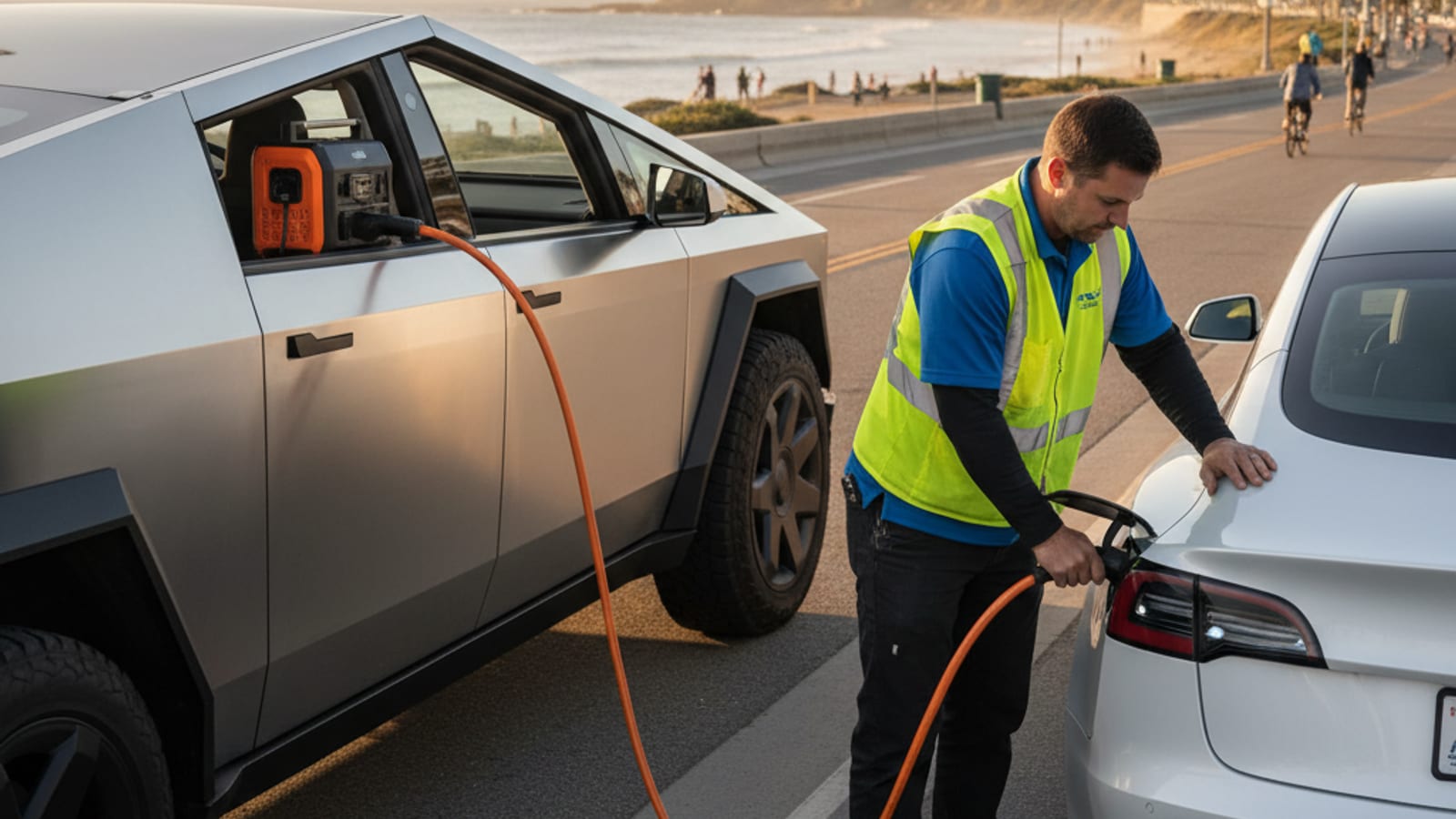
Fog on the Cabrillo Highway changes the stall
Half Moon Bay is an incorporated city in San Mateo County. ACS 2019-2023 counted 11,454 people here. The 2024 Census estimate is 11,324. The land area is 6.242 square miles. The ZIP that overlaps the place is 94019. That’s a small coastside city, not a freeway suburb.
You arrive on one of three roads. SR-1, the Cabrillo Highway, runs the coast. SR-92 climbs the coastal hills from San Mateo. SR-84 comes over from Woodside. Weekend traffic and pumpkin-season traffic use those same three doors. A low pack on that run leaves you on a town street, in a farm lot, or on a foggy shoulder.
This isn’t an inland heat stall. Cool marine fog hangs on most of the year. Air conditioning load stays low. Damp, cold nights are the 12V problem. Inland July normals show the split. Livermore’s 1961-1990 July average max is 89.7F. Antioch’s is 90.4F. San Francisco’s is 71.5F, with September at 73.1F. Bay winters rarely freeze. Coast January lows sit in the low 40s on those same normals, 41.1F at San Francisco. Half Moon Bay lives on the cool, wet side of that map. The traction pack may not cook. The small 12V can still quit.
Fog also hides the car. A dark EV on SR-1 is hard to see. Put the hazards on. Get out of the travel lane if the car will still roll. Don’t walk the fog hunting a better pin. If you can still move, confirm a public charger in an app. Then confirm the session actually starts. The California Energy Commission publishes statewide charging information. A listing isn’t a live plug. This page doesn’t guess how far a working post sits. That distance wasn’t verified.
Named neighborhoods here are small. Downtown Main Street. Miramar. Naples Beach. Arleta Park. Casa del Mar. Nearby towns are El Granada, Montara, and Pacifica up the coast. San Mateo sits over SR-92. Woodside sits over SR-84. Pillar Point is just up the shore. The Ritz-Carlton and the coastal golf links hold cars in lots for hours. Pumpkin farms do the same in season. A car that sat all afternoon can fail at dusk, when the fog thickens and the 12V is already weak.
The Coastside is two-lane highway and town streets. It isn’t I-880 with a wide shoulder and a posted freeway beat. Treat visibility as the first problem. Range is the second.
Empty pack or a car that will not wake
Two failures look the same from the sidewalk. Both leave you stuck in Half Moon Bay. They’re not the same call.
An empty traction pack means the car drove until the range hit zero. The SR-92 climb over the coastal hills uses more energy than a flat Peninsula street. Fog and slow pumpkin traffic keep climate control on while you’re barely moving. A run down SR-1 from Pacifica spends miles you meant to keep. The screens may still work until they don’t. You can’t pour fuel in. You need energy at the charge port.
A dead 12V is a different failure. Every EV still has a small 12-volt battery. It runs locks, lights, computers, and the contactors that connect the high-voltage pack. When that battery dies, the car can brick. Doors may not open. Windows may not drop. The pack can still hold plenty of energy. The car won’t wake to use it. Cool, damp Coastside nights are hard on that little battery. Cars that sit all day at the golf links, on Main Street, or in a farm lot see it first. What happens when an EV 12-volt battery dies walks through the symptoms.
Tesla, Rivian, Ford, Hyundai, Chevy, and the rest still depend on that 12V. Operators we connect you with jump or replace a dead 12V on site. They handle Tesla and every major EV brand.
Don’t jump a 12V from a guess. If the high-voltage pack is empty, a 12V jump won’t create range. If the 12V is dead and the pack is fine, a Level 2 session is the wrong first move. Tell the operator what the dash showed before it went dark. Tell them the make and model. Tell them whether the charge port still wakes. A Model 3, Model Y, Model S, Model X, or Cybertruck with a silent screen is often the 12V. A CCS or J1772 car with the same blank face is often the 12V too.
A stuck charge cable is a third stall. The pack may not be empty. The 12V may still be alive. The car won’t leave until the latch lets go. Say that clearly on the call. Don’t yank the handle in the wet.
What a mobile Level 2 visit actually does
Charge Pro SF doesn’t own trucks or equipment. We don’t employ technicians. We don’t set prices. We don’t promise an arrival time. We don’t hold a licence for the work. The independent operator does the job. The pros we connect you with are licensed and insured. They quote before they start.
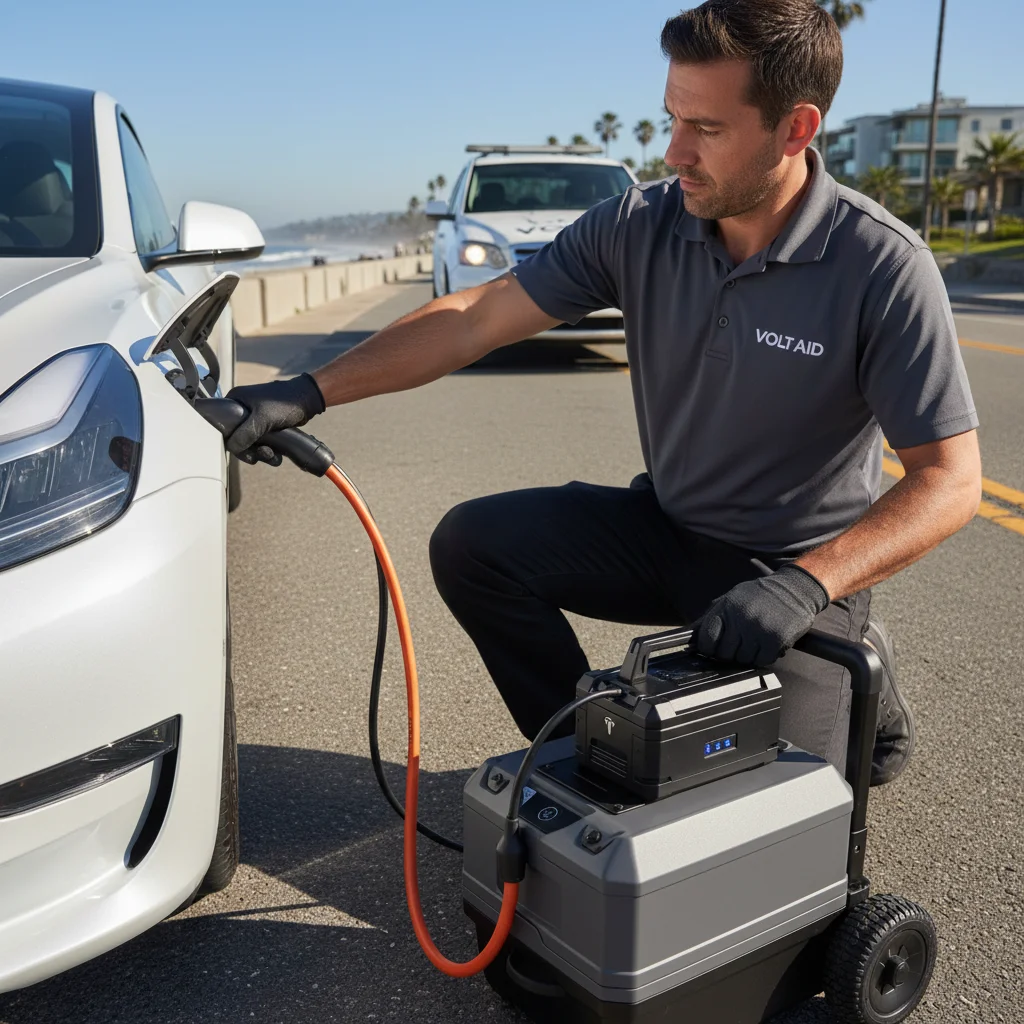
For an empty pack, the usual tool is a 240V Level 2 source at the car. Tesla and other NACS cars take a native NACS plug. Other EVs take a CCS or J1772 adapter. That session is charging time, not a clock on when someone shows up. Operators typically add 10 to 20 miles of range in 15 to 30 minutes of charging. Your car, the starting percent, and the weather change that. Ask the operator what they can deliver on this visit.
That’s enough to roll to a charger you’ve confirmed, or to get off the highway. It isn’t a full pack. It isn’t a shop repair. The U.S. Department of Energy describes Level 2 as 240V AC charging, the same family as a home wall unit. A roadside Level 2 session uses that class of AC charging. It isn’t DC fast charging. It won’t refill a long trip in a few minutes.
If you still have a few miles, try a public post first, but only one you can confirm. If the car is already a brick, the post doesn’t matter until someone brings power or a 12V jump. Mobile EV charging is the visit that brings 240V to the bumper.
Tow, 511, and a lot that can still hook the car
A mobile charge keeps the car where it sits. A tow moves a dead EV somewhere else, still empty. Many EVs need a flatbed. A wheel-lift done wrong can hurt the drive unit. Mobile EV charging vs a tow is the decision page. This page doesn’t invent a Half Moon Bay tow fee. California doesn’t cap ordinary private or consensual tow rates statewide. The operator sets that quote unless a local ordinance or a CHP rotation rate applies. Confirm the number before the car is hooked. San Mateo County and the City of Half Moon Bay weren’t confirmed here as publishing one private-tow ceiling for a driver who calls their own truck.
If you’re on a freeway, other rules apply. California Vehicle Code 21718 bans stopping on a freeway except in limited cases. One of those cases is a vehicle so disabled that stopping is unavoidable, after you’ve summoned another vehicle to assist. CVC 22651(f) allows removal after more than four hours on a full-access-control freeway when the driver can’t move the car under its own power. SR-1 through Half Moon Bay is the Coastside highway, not the 101 commute. Those freeway-only rules weren’t confirmed for every stretch of the Cabrillo Highway in town. If you’re on SR-92 toward San Mateo and it’s posted as a freeway, treat it as one. Ask CHP if you’re unsure.
The Bay Area Freeway Service Patrol is a partnership of MTC, CHP, and Caltrans. Private tow companies run the beats during published hours: Monday to Friday, 6 to 10 AM and 3 to 7 PM, per 511.org. Dial 511 and say “Freeway Assist,” or use a call box. FSP’s published help is crash and debris clearance, a free gallon of gas, jump-starts, and radiator refills. MTC’s FSP page, read 2026-09-18, doesn’t mention electric vehicles or charging an empty pack. It wasn’t confirmed that an FSP beat covers SR-1 in Half Moon Bay. The Coastside isn’t a freeway region the way the Peninsula 101 spine is. Ask 511. Don’t wait on a patrol that may not exist on your shoulder.
Outside FSP hours on a freeway, calls go to the CHP Rotation Tow Program. You don’t pick the company. That’s a tow, not a Level 2 charge.
Private lots are a separate trap. CVC 22658 governs private-property tows. It requires a posted sign not less than 17 by 22 inches, with lettering at least one inch. The sign must state removal at the owner’s expense, the enforcement phone number, and each tow company’s name and number. The operator must notify law enforcement within one hour. Overcharging beyond the approved rate in that private-property context creates liability for four times the amount charged. If you’re in a Ritz lot, a farm lot, or a Main Street stall, look for that sign. A mobile charge still needs the property’s okay if staff want the car moved. This page didn’t find a Half Moon Bay-specific posted rate. Confirm on the sign and with the lot.
Caltrans District 4 covers the nine Bay Area counties. 511 SF Bay is the traveler line. QuickMap shows highway conditions. Use those for fog and closures. They don’t send a charger.
Home power in 94019 will not reach SR-1
PG&E delivers electricity in Half Moon Bay. Peninsula Clean Energy is the Community Choice Aggregator for all of San Mateo County, including this city. PCE sets generation. PG&E still owns the wires. An outage you feel on Main Street is a PG&E distribution issue. A generation product on your bill is often PCE. Don’t treat this page as bill advice. Ask those two providers. Start at pge.com and peninsulacleanenergy.com.
PG&E publishes residential EV rate schedules by name: Home Charging EV2-A, Electric Vehicle EV-B, and Electric Home E-ELEC. Current cents per kWh weren’t pulled for this page. Check PG&E before you plan home charging around a rate. Peninsula Clean Energy publishes an EV Incentives Program for used and new EVs, and an EV Ready Program for business and multifamily charging. Those programs don’t charge a car already sitting on the Cabrillo Highway.
Almost half the housing here is older. ACS 2019-2023 puts housing built before 1980 at 46.9 percent. Older stock often means street parking, shared garages, and no dedicated 240V wall unit. If you live in Arleta Park or Casa del Mar without a home plug, you already depend on public posts and planning. A foggy SR-1 day is a poor time to learn the car is empty.
A home battery backup has the same limit. It can carry the house. It can’t reach a car two towns away. If the EV is already at zero on SR-1, you need a roadside operator, not a panel conversation. A licensed C-10 electrician is the right call for a wall charger install. That’s not this stall.
What to do when the car stops
Get the car out of the travel lane if it will still roll. Hazards on. Fog eats contrast. Keep people on the safe side of the car, away from passing traffic.
Note where you are. SR-1 near Main Street isn’t SR-92 at the hill. Miramar isn’t Naples Beach. A pumpkin farm driveway isn’t the Ritz. Operators need a pin they can actually find. 94019 helps. A neighborhood name helps more.
Name the failure. Pack at zero is one story. Car silent after a long park is another. Charge port stuck is a third. Don’t start a 12V jump if you already know the traction battery is empty.
If you can still move a short distance, check a charging app. Call the station if a number exists. If the session won’t start, don’t burn the last bar looping the block.
For EV roadside assistance through Charge Pro SF, we connect you with a local operator. Tell them the city, the road, the make, and whether you need a mobile charge or a 12V jump. They quote before they start. They bill you directly.
If you stopped between Pacifica and town, the sister note is stalled on SR-1 between Pacifica and Half Moon Bay. Pacifica is the incorporated city up the coast. Half Moon Bay is the south end of this service area’s coast run.
NHTSA publishes general roadside safety guidance at nhtsa.gov. Fog and a narrow highway make that guidance local even when the federal page isn’t.
The rest of this coast run
Pacifica sits north on SR-1. El Granada and Montara sit between. San Mateo sits over the SR-92 hill. Woodside sits over SR-84. A driver who left the Peninsula interior for the coast spent range on the climb. A driver who came down from Pacifica spent range in fog and traffic. Either way, Half Moon Bay is where this in-scope coast run ends.
The city hub is EV charging in Half Moon Bay. Use it for the place. Use this page for the foggy SR-1 stall.
Charge Pro SF serves the Bay Area, including Half Moon Bay. We don’t perform the work. We don’t promise when an operator will arrive. The operator tells you their window when they take the job.
Frequently asked questions
Which EVs can an operator charge in Half Moon Bay
Tesla and every major EV brand. The operator brings a native NACS plug for NACS cars. Non-Tesla EVs use a CCS or J1772 adapter. Confirm your port with the operator on the quote. Charge Pro SF doesn’t own the rig. The matched operator does.
How much range a roadside Level 2 session adds
Typical charging time is 15 to 30 minutes for about 10 to 20 miles of range. That’s charging time, not a clock on the driveway. Efficiency, starting percent, and the 240V source all change the result. Ask for the quote in miles or minutes before they plug in. The goal is enough movement to reach a charger you’ve confirmed, or to get off the highway.
What if the 12V is dead and the pack is not
Then you need a 12V jump or a 12V replacement on site, not a pack fill. A silent Tesla, Rivian, or Hyundai can still hold a healthy high-voltage battery. Damp Coastside nights make this more common than a summer inland cook. Tell the operator the car won’t wake. Don’t assume you ran out of electrons.
When to call
If the car won’t move in Half Moon Bay, call Charge Pro SF at (415) 630-6268. We’ll connect you with a local EV rescue operator. They quote before they start. They bill you directly.