A campus car that has been sitting all day and now shows a low pack needs the right connector, not a flatbed. Menlo Park sits at the heart of the Peninsula’s tech employment corridor, and the cars that dwell here all day at the Meta campus and the Sand Hill Road venture row are exactly the cars that need a mobile charge at the curb when the day ends. A Tesla takes a NACS plug on the port. A Rivian takes CCS. A Hyundai or Ford takes CCS. The local operator who shows up needs to carry all three, plus a J1772 adapter for older AC cars.
Why Menlo Park is a real call zone
The Meta campus on Hacker Way and the venture offices along Sand Hill Road hold thousands of EVs every weekday. A driver who parked at 8 AM at 4% is in trouble by 6 PM if the work day ran long, the on-site chargers were full, and the home charger is across town. Belle Haven, the residential neighborhood east of US-101, has a high renter share and limited assigned parking, so a lot of cars there live on public charging too.
Sand Hill Road traffic itself is light, but the commuter approach on US-101 and I-280 through Menlo Park is one of the slowest stretches in the Bay Area at rush hour. A car that shows 6% on the dashboard at Marsh Road can lose the last of the pack before reaching the next charger. The dumbarton approach on SR-84 (Willow Road) and the El Camino Real spine through downtown Menlo Park are common low-pack corridors.
Median household income in Menlo Park sits around $206,588 (ACS 2019-2023). EV density is high. When those EVs need help, the help that matters is mobile and EV-specific.
What a mobile operator actually brings
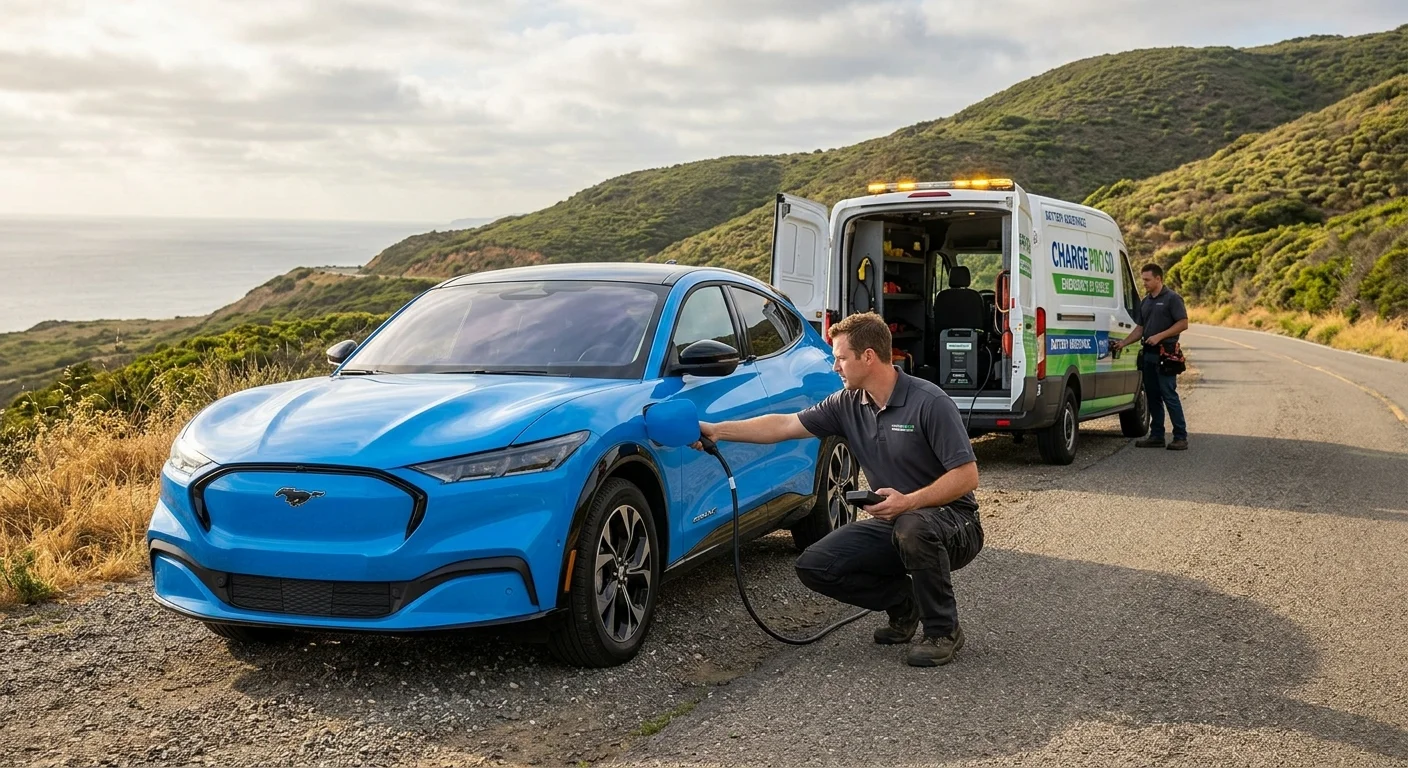
A mobile EV rescue unit is not a flatbed. The operator drives a service van with a 240V Level 2 source, a long output cable, and the adapters to fit any common EV on Bay Area roads:
- Tesla and other NACS cars plug in natively with the standard connector.
- CCS1 cars (most non-Tesla EVs built before 2025) plug in with the CCS handle.
- J1772-only older cars plug in through a J1772 adapter on the Level 2 cable.
- Newer NACS-equipped cars from Ford, GM, Rivian, Hyundai and Polestar plug in with the same Tesla-style handle.
A typical rescue session adds about 10 to 20 miles of range over 15 to 30 minutes of charging. That is enough to clear a campus garage, reach a Supercharger, or get home if you live in the next town. The operator quotes you before any cable goes on.
The same van usually carries a portable 12V jump pack. A dead 12V on a Tesla, a Rivian, or a Hyundai is a different failure than an empty pack, and a jump gets the car waking up again so the contactors can close.
What Menlo Park’s local roads cost a low pack
US-101 between Marsh Road and Embarcadero is flat to slightly downhill. I-280 over the hill toward Page Mill climbs briefly before dropping toward Palo Alto. The Sand Hill Road climb from El Camino Real is real, with a sustained grade that spends range every mile. Willow Road east toward the Dumbarton Bridge starts flat, then crosses the flatlands toward Newark. None of these is a mountain, but each one adds up at 4% pack.
Belle Haven drivers who run US-101 south toward Palo Alto sit in stop-and-go through the Ravenswood interchange. Heat load and AC load on a hot afternoon can pull a low pack faster than the dashboard predicts. The 1961-1990 NWS normals show a moderate climate here, but a parked black car in the sun at noon is a different problem than the official average.
Damp fog mornings, more common near the bay, can also pull range. A driver at the Stanford Research Park edge of Menlo Park in June sees cool morning air, no AC load, and still loses range from the humidity.
What Freeway Service Patrol covers and what it does not
The Freeway Service Patrol is a partnership of MTC, CHP and Caltrans. It runs Monday through Friday, 6 to 10 AM and 3 to 7 PM. You reach it by dialing 511 and saying Freeway Assist, or by using a call box. The MTC FSP page lists a free gallon of gas, jump-starts and radiator refills. It does not list electric vehicles or out-of-charge help. That reading is from mtc.ca.gov as of 2026-09-18.
FSP covers the freeway shoulder, not a campus parking lot or a residential street in Belle Haven. If you stall on US-101, FSP can stop. If you stall in a Meta parking structure, FSP cannot enter. Outside FSP hours, your call goes to the CHP Rotation Tow Program. The driver does not pick that company on rotation.
Caltrans District 4 covers the nine Bay Area counties.
Why a local EV operator is faster than a generalist tow
A generalist tow truck with a J1772 cable at best is not the same as an EV rescue van. The generalist truck can winch and tow, but the winch and tow take the car to a charger and the next step is waiting for a charge. A mobile operator with a 240V Level 2 source adds range at the curb in 20 minutes.
A generalist contractor typically does not carry a portable 12V jump pack rated for an EV. A wrong hookup to a Tesla’s 12V terminals can blow a fuse or, worse, damage the DC-DC converter. Operators we send are EV-specific and they know the right procedure for each model.
CVC 22651(f) allows removal of a vehicle stopped on a full-access-control freeway more than four hours when the driver cannot move it under its own power. CVC 21718 limits stopping on a freeway to limited exceptions, including when another vehicle has been summoned to assist. Knowing the rules helps when you call for help.
What to share with the dispatcher
When you call, give the operator the same clean record you would give any roadside service:
- Year, make, and model. A Tesla Model Y, a Rivian R1S, a Hyundai Ioniq 5, and a Ford Mustang Mach-E all need different connectors.
- Exact location. Building address, garage level, nearest cross street, or US-101 mile marker.
- State of the car. Pack dead only, or 12V also low. Any warning lights. Any collision damage.
- Access. Garage entrance, fire lane, or street parking. A vehicle that blocks traffic needs to move first.
That gets the right truck with the right cable to the right door.
When a local operator makes the call
Local EV operators handle dead-12V jumps on Tesla, Rivian and Hyundai across Menlo Park, mobile EV charging for empty packs at the curb, and out-of-charge recovery for cars that misjudged the trip home on US-101 or Willow Road. They also cover charge-port release for stuck CCS or NACS connectors, the rare but real problem when a latch fails on a public post.
Charge Pro SF is a referral line. We match stranded EV drivers with independent local operators. The pros we connect you with are licensed and insured. They quote you before any cable goes on, and they bill you directly. We serve every city in the Bay Area, including Menlo Park.
Call (415) 630-6268 when you want a match to a local operator.