If you are watching the gauge fall on SR-1 somewhere between Pacifica and Half Moon Bay, you are in the most isolated stretch of coast in the Bay Area launch scope. There is no second charger to hunt. The fog can drop visibility to a few hundred feet. The right next step is a mobile EV operator who knows the Coastside access constraints and quotes before rolling. Charge Pro SF is the referral line that makes that match.
Why the El Granada stretch is a real long-haul corridor
El Granada sits on the open coast in The Coastside region of the Bay Area, between Pacifica to the north and Half Moon Bay to the south. The community is an unincorporated Census designated place, not an incorporated city. Census ACS 2019 to 2023 counted 5,231 residents and there is no separate 2024 PEP estimate for unincorporated CDPs. Median household income is $226,384, the highest on the Coastside. About 49.2 percent of housing was built before 1980. The community sits on SR-1, the Cabrillo Highway, with Pillar Point Harbor, Mavericks, the Half Moon Bay Airport, and the coastal bluffs as the local landmarks.
The defining geography is isolation. The Coastside is reached only by SR-1 along the ocean or by SR-92 over the coastal hills from San Mateo. There is no freeway on the coast. Charging options between Half Moon Bay and Pacifica are thin, and an EV that misjudges the run has nowhere to top up. The Devi’s Slide tunnels on SR-1 between Pacifica and Montara opened in March 2013 and are the only inland bypass for that section, but they do not add chargers.
The fog matters too. Coastal fog cuts visibility on SR-1 in summer mornings, often below a quarter mile. A disabled car on the highway is a safety problem, not just an inconvenience. Drivers who pull over to wait for a mobile operator should treat the shoulder as an active hazard and stay in or near the vehicle with hazard lights on.
The two Coastside calls
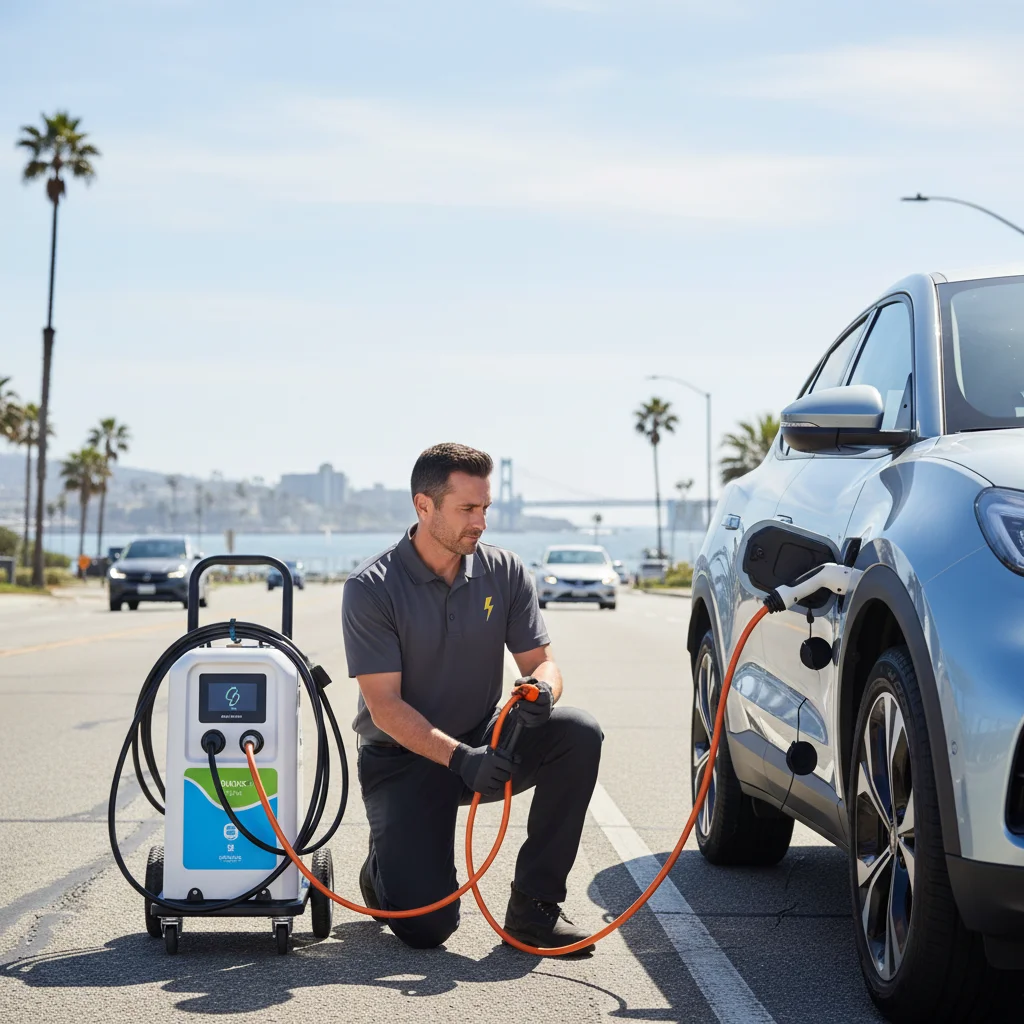
A low pack on the way to Half Moon Bay or back is the headline call. The driver left Pacifica or San Mateo with 50 percent, figured the 30-mile round trip was easy, and watched the gauge drop faster than the odometer. A mobile operator brings a 240V Level 2 source to the car and adds about 10 to 20 miles of range in 15 to 30 minutes of charging, enough to reach a working charger or home over the hill. The mobile EV charging page describes that service.
A dead 12V is the second case and it shows up more often on the Coastside than the climb numbers suggest. The 12V auxiliary battery powers door locks, infotainment, body control modules, and the contactor that lets the high-voltage system switch on. The Coastside’s damp cold nights wear down a marginal battery faster than dry climates do. After a weekend at the pumpkin farms or a long day at Pillar Point Harbor, a marginal 12V can die overnight. Operators carry a 12V jump kit and can restore power on site. For Tesla cars the Tesla 12V battery jump service covers that path.
If the dash is completely dark with no fob response, start with the 12V. If the dash wakes but the car won’t shift, start with the traction pack.
The coast weather and what it does to range
The Coastside is cool, foggy and damp most of the year. WRCC 1961 to 1990 NWS normals put nearby San Francisco at a July average high of 71.5F. Half Moon Bay runs a touch cooler. Cold mornings on SR-1 cost range: Recurrent Auto published a study showing about 22 percent range loss at 32F and about 30 percent loss at 20F. A driver who budgeted for a coastal July day at 65F may be surprised by a 50F August morning with marine layer.
Pull over safely on SR-1
SR-1 has narrow shoulders in places, and a disabled car on the foggy highway is a hazard. CVC 21718 limits stopping on a freeway; SR-1 is not a freeway but the same hazard logic applies. Move as far right as the road allows. Hazard lights on. Stay inside the vehicle if you are anywhere near a traffic lane.
The Freeway Service Patrol does not cover SR-1; FSP runs only on the named freeway beats in the Bay Area. CHP covers the highway. Outside FSP hours, CHP dispatches via the rotation tow program, and the driver does not pick the company.
What to share on the first call
An operator commits to a call after hearing the vehicle, the symptom, and the location. Make, model, model year, last known battery percentage, warning text on the dash. A precise location, “southbound SR-1 just past the Pillar Point Harbor turnoff” tells the operator where to approach from. If you can see a mile marker, an overpass name, or a road sign, share it.
Access details matter. A car in a Pillar Point Harbor parking lot is a different dispatch than one on the foggy SR-1 shoulder. A car in a residential driveway in El Granada’s Alhambra grid streets is another. If the car is in a private lot with a locked gate, give the access code directly to the operator and confirm someone authorized to approve service is with the vehicle.
When transport may be the right call instead
Some situations don’t fit mobile charging. A vehicle with visible damage, a high-voltage warning triangle on the dash, smoke or fluid leaks, or a charge port that won’t accept a connection may need transport, not a charge. The matched operator tells you that on the phone after reviewing the details. Our out-of-charge recovery service covers the path when charging on site isn’t the right fit.
For a Tesla-specific call on the coast, the Tesla roadside rescue page covers what an operator reviews before accepting the work.
When to call us
Call when you are stopped in or near El Granada with a depleted battery, a dead 12V, or a vehicle that won’t respond, and you need help sorting out whether a charge, a jump, or a transport fits. Charge Pro SF connects you with an independent local operator who reviews the situation and quotes before starting.
Call (415) 630-6268 and we will connect you with a local operator who quotes you before any work begins.