El Cerrito sits on I-80 between Richmond and Albany, with the El Cerrito del Norte BART station as the dominant commuter anchor. Drivers leave their EVs at the park-and-ride in the morning and return in the evening to a car that does not wake. The pack is fine. The 12V is dead. The same park-and-ride pattern returns a different failure every week.
This post walks through the El Cerrito-specific reasons an EV strands, the order to try at the curb, and what a local operator does when the 12V is the cause.
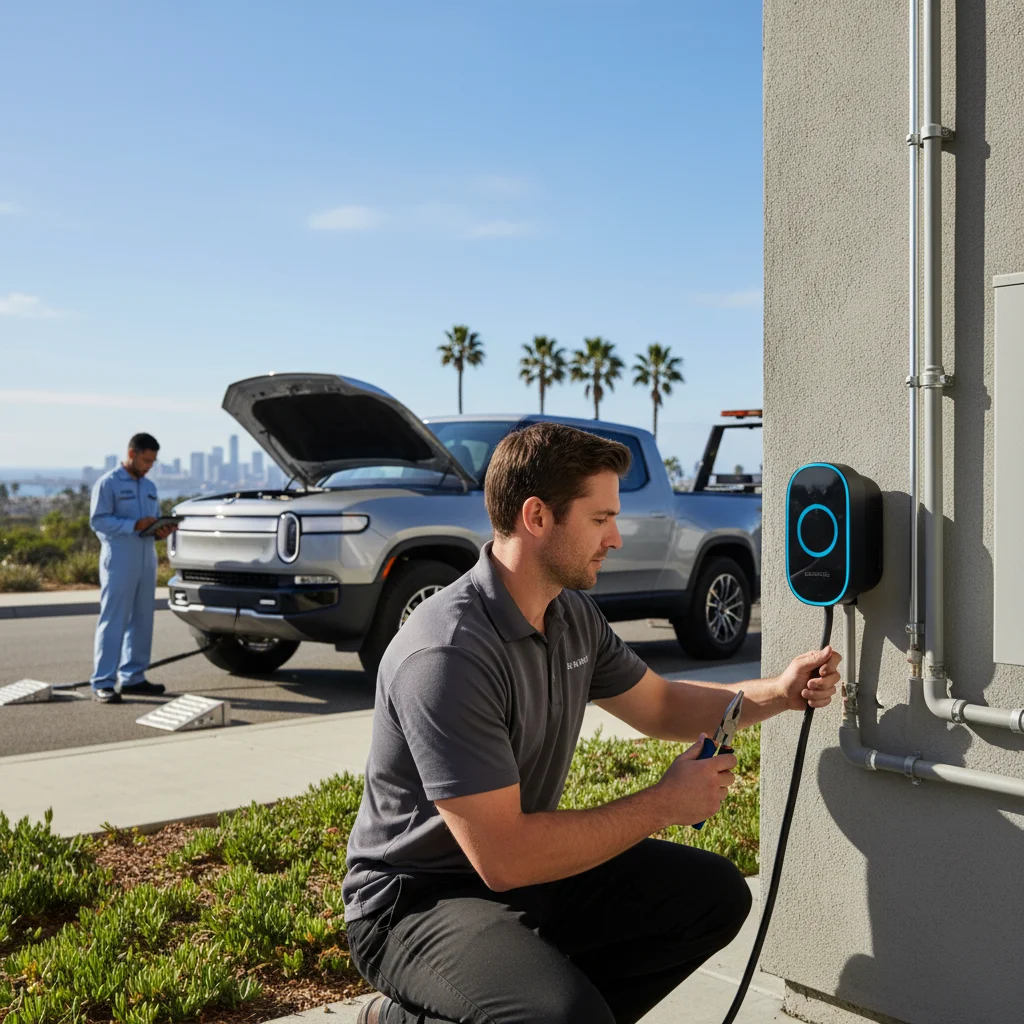
Why El Cerrito drivers hit the 12V pattern
El Cerrito del Norte is one of the busiest BART stations in the East Bay. The park-and-ride holds cars all day, every weekday. A driver who commutes from El Cerrito to San Francisco parks the EV in the structure at 7 AM and returns at 6 PM. Eleven hours of structured parking. The 12V sees constant low draw from the alarm, the body control module, and any accessories the owner left active.
The El Cerrito Plaza station is the other commuter anchor. Same pattern, slightly less dwell. The combined commuter load is the largest single source of 12V failures on the I-80 corridor.
The cool damp climate of El Cerrito’s bayside hills accelerates the drain. The garage environment stays cool year-round. A weak 12V that would survive a hot summer day in Walnut Creek does not survive an El Cerrito winter.
Street parking in the El Cerrito hills above San Pablo Avenue adds another layer. A car that sits on a hill street for a week during a trip returns to a dead 12V. The traction pack is fine. The 12V is not.
The order to try at the curb
Three steps in this order, then call.
Press the door handle. The car uses a key fob or phone-as-key passive entry. A 12V at the edge may not register a handle press. Try the physical key fob. The fob wakes the car through a different path.
Try the app. The app talks to the car over cellular. If the car is awake enough to answer, the app shows pack state of charge. A high state of charge with a dark dashboard is the 12V signature. A low state of charge means the traction pack is also low.
Open the hood and find the 12V access. Tesla exposes front pigtails under the tow-eye cover. Hyundai and Kia E-GMP vehicles expose front underhood jump terminals. Ford, Rivian, and others have posts under the hood or in the frunk. A lithium jump pack goes on the right access point for the brand.
If the jump pack has charge, connect positive first, then ground. Wait 30 seconds. Press the door handle. The car should wake. Leave the jump pack connected for another two minutes so the DC-DC converter can take over.
If the car does not wake, the 12V is more deeply drained or the body module has a fault. Move to calling a local operator.
What a local operator does in El Cerrito
A local operator arrives with a lithium jump pack rated for the right body control module, a 240V Level 2 inverter in the bed, and the standard adapter set. CCS for Hyundai, Kia, Ford, Rivian, Lucid. NACS for Tesla. J1772 for older EVs.
The operator quotes the work in writing before they start. A 12V jump is a fast fix. A Level 2 add takes 15 to 30 minutes of charging time. A 12V swap on site saves the driver a service visit.
The pros we connect you with are licensed and insured. They serve El Cerrito, Richmond, Albany, Berkeley, and the rest of the I-80 corridor. Charging time is 15 to 30 minutes, which is charging time, not an arrival window.
When the call is a Level 2 add instead of a 12V jump
The 12V jump is the right call when the pack shows real range on the app and the dashboard is dark. The Level 2 add is the right call when the pack itself is low and the car is awake.
A driver who returns from a Tahoe weekend with a low pack and a healthy 12V does not need a jump. They need a 240V source to add 10 to 20 miles of range. A local operator brings the source to the El Cerrito park-and-ride and tops the pack.
The two calls look the same from the curb. The app tells you which one fits. A high pack state of charge with a dark dashboard is the 12V signature. A low pack state with a working dashboard is the Level 2 signature.
How to avoid the next 12V failure
The El Cerrito commuter pattern is the same every week. The 12V sees 11 hours of low draw every weekday. A weak 12V does not survive a long weekend.
The fix is either a 12V replacement before it dies, or a habit of plugging in for a Level 2 top-up overnight. Most EV owners in the El Cerrito hills have a home charger. The home charger keeps both the traction pack and the 12V topped off through the DC-DC converter.
A driver who leaves the EV at the park-and-ride every day should expect a 12V failure within four to six years. Plan a 12V replacement before it strands you at the BART station. The replacement is much cheaper than a Friday night jump.
Where El Cerrito drivers charge in between failures
The El Cerrito del Norte BART station has public chargers in the parking structure. The El Cerrito Plaza station has chargers near the bus transit center. San Pablo Avenue has public posts along the corridor. I-80 has fast chargers at the El Cerrito exit and in Richmond to the north.
The local network is dense enough that a working post is rarely more than a few minutes away. The gaps show up after atmospheric-river rain. A wet morning can knock a stall offline for an hour. A driver who arrives at the post on 10 percent and finds it down is the canonical El Cerrito mobile charge call.
What to expect from a local operator quote
The operator quotes the work in writing before they start. The bill goes to you at the curb. Charging time is 15 to 30 minutes. A 12V swap is similar. A flatbed tow depends on the distance and the car.
The work covers every Bay Area city and community, from Pacifica to Brentwood and from San Mateo to San Jose. El Cerrito is in the East Bay core region. Operators serve the entire region.
FAQ
Why does my EV not wake after BART?
A 12-hour park-and-ride dwell drains the 12V. The traction pack is fine. The contactors will not close until the 12V is alive. Jump the 12V first.
Will a jump from another car hurt my EV?
Yes. A running gas car puts out voltage spikes that can damage the body control module. Use a lithium jump pack, not another car.
What if the traction pack is also low?
The operator jumps the 12V first, then adds range with a 240V Level 2 source. A typical session adds 10 to 20 miles.
Can a roadside operator replace a 12V on site?
Yes, for most EV model years. Confirm current terms with the operator at the time of the call.
How long does a roadside 12V jump take?
Most jump sessions land in 5 to 10 minutes. The operator connects the pack, waits for the body module to wake, and confirms the car is responsive.
Call (415) 630-6268 when the EV is dark at the El Cerrito BART or anywhere else in the East Bay core. The operator quotes a 12V jump, a Level 2 add, or a 12V swap before any cable goes on. Nobody on this line promises an arrival clock.