If your EV drops to a few percent somewhere on the climb out of Danville, you need roadside help that understands the Tri-Valley, not the coast. A driver searching EV roadside assistance in Danville is usually planning a trip on I-680, SR-24, or the back roads toward Mount Diablo and is watching the gauge fall faster than the miles. Charge Pro SF is a referral line that matches you with an independent local operator who reviews the situation and quotes the work before rolling.
Why Danville strands happen on the climb, not the flat
Danville sits in the San Ramon Valley at the foot of Mount Diablo. The town is in The Tri-Valley region of the Bay Area, on the inland side of the East Bay hills, between San Ramon to the south and the unincorporated Alamo to the north. Census ACS 2019 to 2023 counted 43,426 residents and a median household income of $223,206, which makes it one of the wealthiest small cities in the Bay Area. About 53.1 percent of housing was built before 1980, so home charging is common in newer subdivisions but panel-limited in older leafy streets like Sycamore and the Westside.
The reason drivers run low here is the geography. I-680 climbs north toward the Benicia-Martinez Bridge and south toward Fremont on the Sunol Grade, both real range costs. SR-24 climbs west through the Caldecott Tunnel toward Oakland and San Francisco. Diablo Road and the Mount Diablo foothills add even more grade. A driver who leaves Danville with 30 percent and assumes a flat run to Walnut Creek or Pleasanton can arrive with a warning the car didn’t show an hour earlier. The inland heat matters too: WRCC 1961 to 1990 NWS normals put nearby Livermore at a July average high of 89.7F, and a similar inland heat load sits over Danville, pushing AC draw higher than a coast run would.
PG&E delivers the wires and MCE is the generation CCA here, so the home charger rebate is the PG&E Residential EV Charging program, not a local utility incentive. That detail does not move the roadside call, but it explains why so many residents have home chargers and the calls skew toward road strandings rather than no-home-charging.
What a mobile EV operator can actually do on these roads
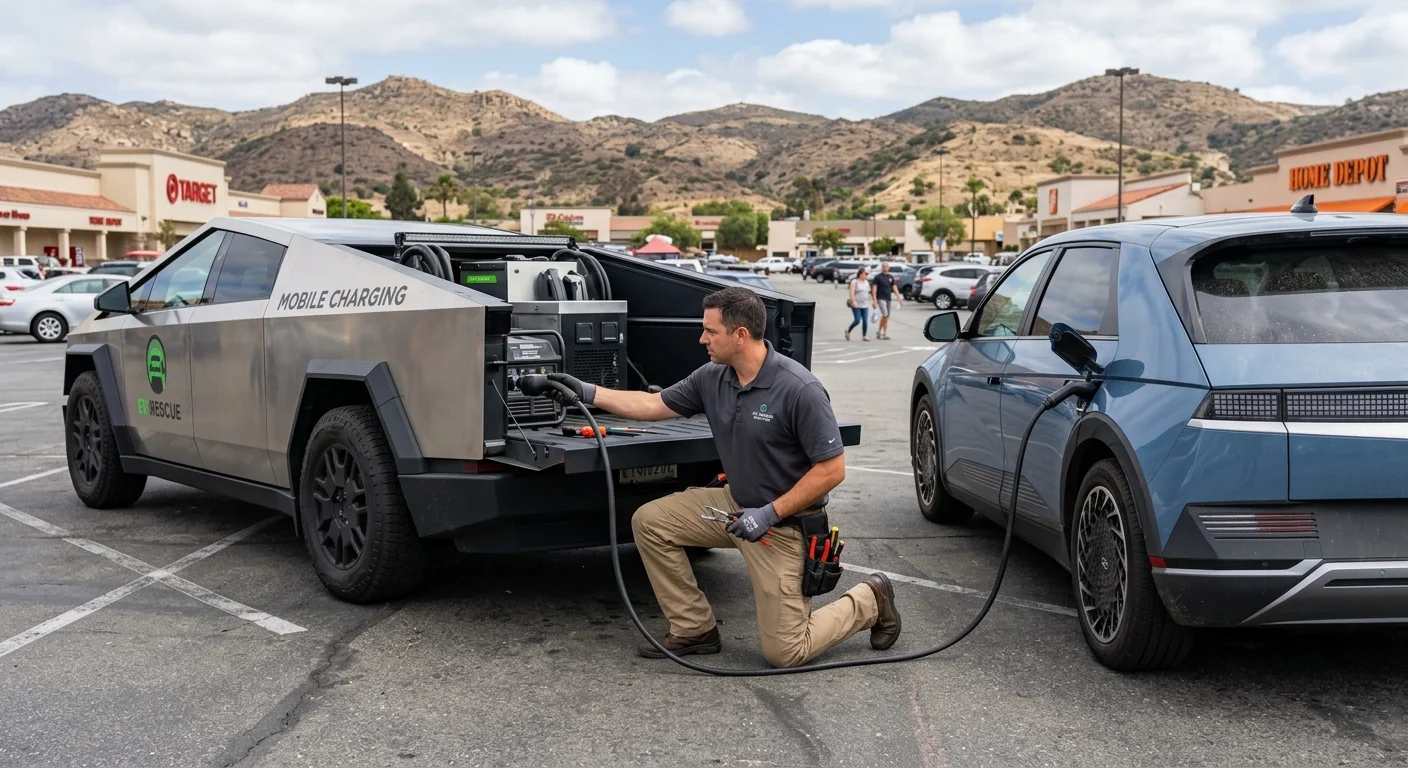
An independent operator matched through our line brings a 240V Level 2 source, a NACS plug for Tesla vehicles, and a CCS adapter for non-Tesla EVs. A typical session adds about 10 to 20 miles of range in 15 to 30 minutes of charging, which is enough to reach a working public charger, a Supercharger, or home on a Tri-Valley run. The 12V auxiliary battery is the second common failure: a damp-cold night in the hills can weaken a marginal battery, and the car wakes up dead even with range in the pack. Operators carry a 12V jump kit and can restore power on site.
The Tesla roadside rescue page covers the Tesla-specific call. Mobile EV charging is the empty-pack path. For non-Tesla EVs that take CCS or J1772, the non-Tesla EV rescue page explains connector compatibility.
The I-680 and SR-24 commutes are the same problem
Danville drivers commute in two directions. South, I-680 drops toward Fremont over the Sunol Grade, and the southbound climb eats a measurable chunk of range. North, I-680 climbs toward Martinez, and SR-24 climbs west through the Caldecott Tunnel, which has four bores and steady congestion. Both corridors share a math problem: climate control runs for an hour of stop-and-go, the climb costs range the gauge did not predict, and a driver who budgeted 20 miles of buffer arrives with five.
The Freeway Service Patrol covers the freeway beats during weekday hours. FSP runs Monday through Friday, 6 to 10 AM and 3 to 7 PM, and is reachable by dialing 511 and asking for Freeway Assist or by call box. The MTC FSP page lists gas, jump-starts and radiator refills and makes no mention of electric vehicles or out-of-charge assistance. Read 2026-09-18. That is the gap a mobile EV operator fills, on the shoulder, with a 240V source, after FSP hours or outside the FSP beat.
Two failures that look the same from the driver’s seat
An empty traction pack and a dead 12V produce the same outcome, a car that won’t move, but the fixes are different. Note what still works before you call. If the screen wakes but the car won’t shift out of park, the traction pack is likely the problem and a mobile charge is the right call. If nothing responds, the doors, the lights, the app, the 12V is the more likely cause and a jump comes first. Charging the wrong system wastes time. The operator asks about both before deciding what to bring.
Danville is in Contra Costa County and sits in The Tri-Valley. Neighboring cities include San Ramon, Alamo, Walnut Creek, Blackhawk, and Diablo. The Mount Diablo State Park entry sits at the north edge of town.
What the operator needs before accepting the call
An operator commits to a call only after hearing the vehicle, the symptom, and the location. Tesla Model 3, Model Y, Rivian R1S, Hyundai Ioniq 5, the make and the connector shape matter. “Somewhere on I-680 near Diablo Road” is not enough; “southbound I-680 just past the El Cerro Boulevard exit” gives the operator an approach and a window. If you can see an exit number, a mile marker, or an overpass name, share it.
Access details matter as much as the symptom. A car in a gated Blackhawk driveway is a different dispatch than one on an open shoulder of I-680. If the car is on a grade, mention the grade. If it sits inside a gated community, give the code directly to the operator and say whether someone authorized to approve service is with the car.
When transport may be the right call instead
Some situations don’t fit mobile charging. A vehicle with visible damage, a high-voltage warning triangle on the dash, smoke or fluid leaks, or a charge port that won’t accept a connection may need transport, not a charge. The matched operator tells you that on the phone, after reviewing your details, and bills you separately for that service. Our out-of-charge recovery service covers the path when charging on-site isn’t the right fit.
When to call us
Call when you are stopped in or near Danville with a depleted battery, an unclear dashboard message, or a vehicle that won’t respond, and you need help deciding whether a charge or a transport fits. Charge Pro SF connects you with an independent local operator who quotes before starting.
Call (415) 630-6268 and we will connect you with a local operator who quotes you before any work begins.