You left the EV at a Bayfront hotel along Old Bayshore. You flew out of SFO for two or three nights. You come back and the car is dark. Doors will not unlatch from the app. The screen never wakes. The drive pack may still hold range. In Burlingame, that pattern is usually a dead 12-volt battery. It is not always an empty pack.
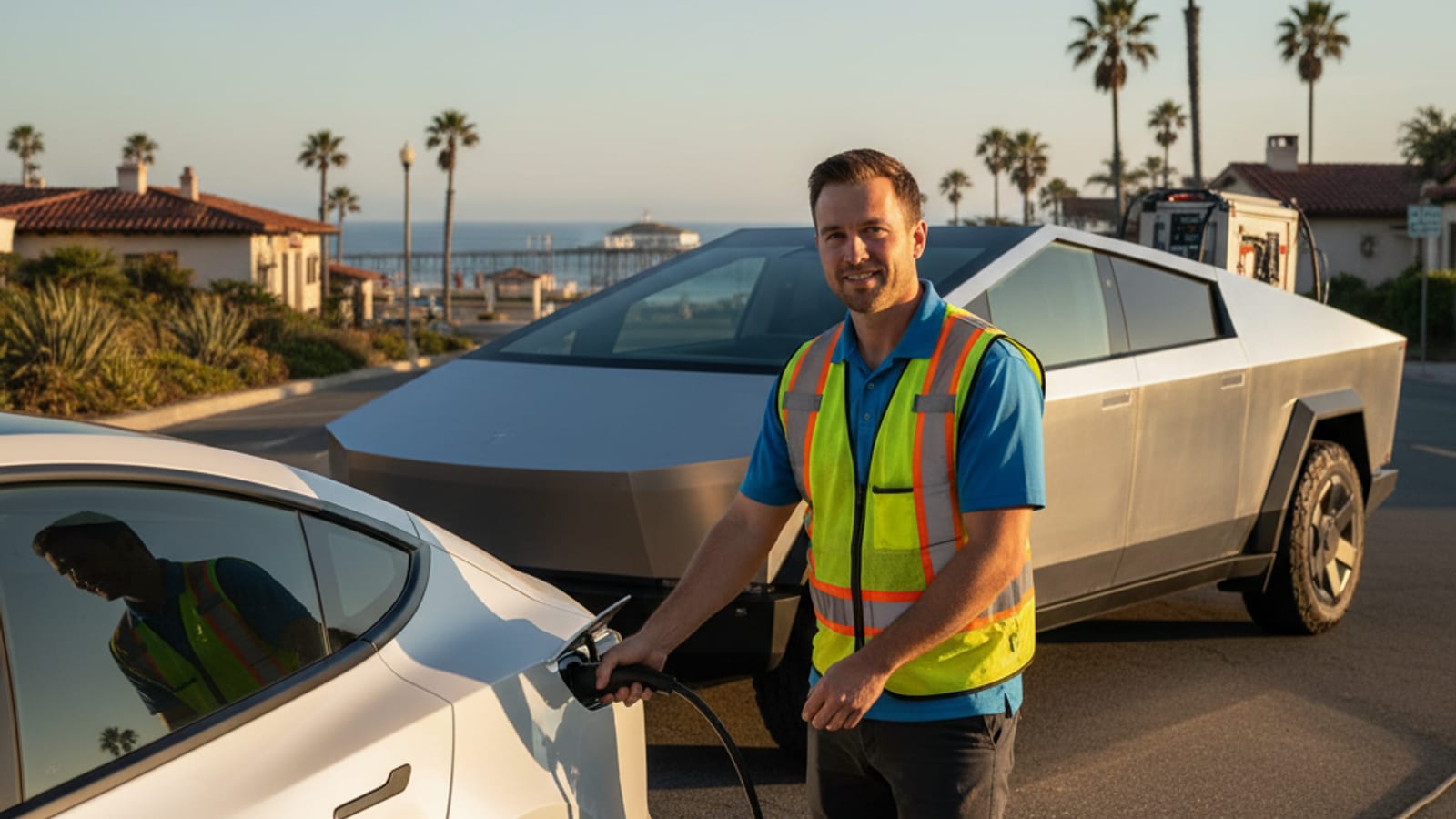
Charge Pro SF is a referral line for this stall. We match you with an independent local operator. We do not own trucks. We do not send employees. The operator quotes you before any work starts. They bill you directly.
A hotel lot can hide a 12-volt failure
Burlingame sits in San Mateo County on 4.393 square miles. About 30,526 people live here on the ACS 2019-2023 count. The 2024 Census estimate is 30,885. ZIP 94010 covers the city. The Bayfront hotels along Old Bayshore sit between US-101 and the bay. Travelers, rentals, and Peninsula residents leave cars there around a flight.
A long sit is hard on the small 12-volt battery. Cabin overheat protection draws from it. Camera security modes draw from it. Phone-app pings draw from it. After a few nights the 12-volt can drop too low to close the high-voltage contactors. The car looks fully dead. The big pack may still be fine.
That is why EV roadside assistance in Burlingame so often starts with a 12-volt check. An operator can jump the 12-volt on site. They can replace it when a jump will not hold. If the car sat through a trip, read what a Tesla 12V failure after a long park looks like.
Hotel desks cannot diagnose this. Airport pages do not publish it either. SFO has an EV charging page at flysfo.com/parking/electric-vehicle-charging. This research pass could not confirm stall counts or which lots have plugs. Check that page in a browser before you count on a plug there. A dark car in a Burlingame hotel lot is a different problem. The airport does not publish steps for a car that will not wake after a week.
Empty pack, dead 12-volt, or a stuck charge port
Three failures look the same from the sidewalk. Sort them before you call.
If the car opens and the display shows zero miles, the drive pack is empty. You need mobile EV charging, not a jump. Operators bring a 240-volt Level 2 source to the car. They use a native NACS plug on Teslas. They carry CCS or J1772 adapters for other brands. A typical session adds 10 to 20 miles of range. That is 15 to 30 minutes of charging time. It is never an arrival time.
If the car will not open and the app is silent, start with the 12-volt. Teslas still use one. So do Hyundai, Kia, Ford, Rivian, and most other EVs. That small battery runs locks, computers, and contactors. A Tesla 12V battery jump is often enough to wake the car. Then you can drive to a charger if the big pack is also low.
If a cable will not release from a public post, do not yank it. That is a charge-port latch, not a dead battery. An operator can work the release. Towing with a stuck cable still in a post makes a bad night worse.
Traditional clubs still default to a flatbed. A flatbed does not fill the pack. It does not wake a 12-volt. It also adds risk on a freeway shoulder. California Vehicle Code 21718 lets you stop on a freeway only when the car is so disabled that stopping is unavoidable and help is on the way. California Vehicle Code 22651(f) lets a vehicle be removed after four hours on a full-access-control freeway if it cannot move under its own power. Sitting on 101 is not a plan.
What Charge Pro SF does, and what it does not
We connect stranded EV drivers with independent mobile rescue operators across the Bay Area. We hold no trade license for the work. We do not keep a yard or a fleet. We do not set prices. We do not promise when someone will roll up.
The operator does the work. They quote before they start. They bill you. They handle Tesla and every major EV brand. They can jump or replace a dead 12-volt on site. They can add enough Level 2 range to reach a charger or a driveway. For a pack that is already at zero, that is out-of-charge recovery.
That split matters on a hotel property. The person who shows up is the one you pay. Ask for the quote in the lot, before cables go on.
Burlingame streets where this stall actually happens
US-101 is the spine past the Bayfront hotels. I-280 runs the ridge inland. SR-82 is El Camino Real, the historic tree-lined stretch through town. Broadway and Burlingame Avenue cut the shopping district. Old Bayshore is the hotel strip. Washington Park sits on the bay side of the older neighborhoods.
Neighborhoods change the stall. The Bayfront is rental cars, flight parking, and hotel overnight. Burlingame Hills and Ray Park are hillside streets with older houses. Easton Addition and Lyon-Hoag sit closer to El Camino and the Caltrain side of town. A car that sat on a hillside street all week has the same 12-volt risk as a hotel lot. Accessory drain does not care about the view.
Nearby cities share the same trip. Millbrae is the next SFO-edge city north. San Bruno sits against the airport. San Mateo is the larger neighbor south. Foster City is across 101 toward the lagoon. The 280-side ridge towns sit inland from the bay. If you started in Millbrae after a long SFO trip, the 12-volt story is the same. The lot just has a different name.
See the Burlingame city page for local context on this city. Do not treat a city page as a live stall map.
Older houses, panels, and why home charging is not a rescue
Census ACS 2019-2023 figures show 80.2 percent of Burlingame housing was built before 1980. That stock often means smaller electrical panels. Many driveways never got a 240-volt circuit. People here still buy EVs. The house itself may still be a 100-amp panel from decades ago.
PG&E delivers the wires. Peninsula Clean Energy is the community choice aggregator for generation in San Mateo County, including Burlingame. PG&E publishes residential EV rate schedules named Home Charging EV2-A, Electric Vehicle EV-B, and Electric Home E-ELEC. Peninsula Clean Energy publishes an EV Incentives Program and an EV Ready Program for business and multifamily charging. None of those programs wake a car that is already dark in a hotel garage. Do not treat a rebate page as roadside help. Confirm current program rules on the utility and CCA sites before you apply. This article is not bill advice.
A home Level 2 install is a later project. If the car is already sitting dead on Old Bayshore, you need an operator at the car. A panel upgrade in Burlingame Hills will not reach a rental in a Bayfront garage.
Climate on this stretch of the Peninsula
Burlingame has a mild bayside climate with more sun than the true coast. It is not Half Moon Bay fog. It is not inland summer heat either. 1961-1990 NWS normals at SFO show a July average max of 71.5 F, and 73.1 F in September. Cabin overheat protection still runs on warm parked days. That draw hits the 12-volt while you are in the terminal.
Mild weather does not protect a small battery that sat for a week. Age and state of charge matter more than the thermometer here. A 12-volt that was already weak in Ray Park will not magically hold through a hotel stay because the bay is cool.
If you stall on 101, 280, or a hotel driveway
Shoulder stalls and lot stalls are different jobs.
On US-101 or I-280, get the car as far right as you can. Hazards on. Stay with the vehicle if it is safe. The Bay Area Freeway Service Patrol is a partnership of MTC, CHP, and Caltrans. Private tow companies run the beats. Hours published on 511.org are Monday to Friday, 6 to 10 AM and 3 to 7 PM. Dial 511 and say “Freeway Assist,” or use a call box. The MTC FSP page lists gas, jump-starts, and radiator refills. It does not mention electric vehicles or out-of-charge help. After those hours, CHP Rotation Tow assigns an approved tow vendor. You do not pick the company. Caltrans District 4 covers the nine Bay Area counties on QuickMap.
An FSP jump may wake a 12-volt. It will not fill a drive pack. If the display is at zero, you still need a mobile Level 2 charge or a flatbed. Do not sit past the four-hour CVC 22651(f) window on a full-access-control freeway.
In a hotel driveway or garage, you are on private property. California Vehicle Code 22658 covers private-property tows. It requires a posted sign at least 17 by 22 inches, with lettering at least one inch, stating removal at the owner’s expense, the enforcement number, and each tow company’s name and number. The operator must notify law enforcement within one hour. Overcharging beyond the approved rate in that context creates liability for four times the amount charged. California does not cap ordinary consensual tow rates statewide. If a hotel threatens a hook, photograph the posted sign. Then call for EV help if the car still will not move.
Do not block a fire lane. Do not idle in a porte-cochere hoping the car revives. Move it with an operator, or ask the desk where a disabled vehicle can sit while you wait.
What the operator actually brings to the car
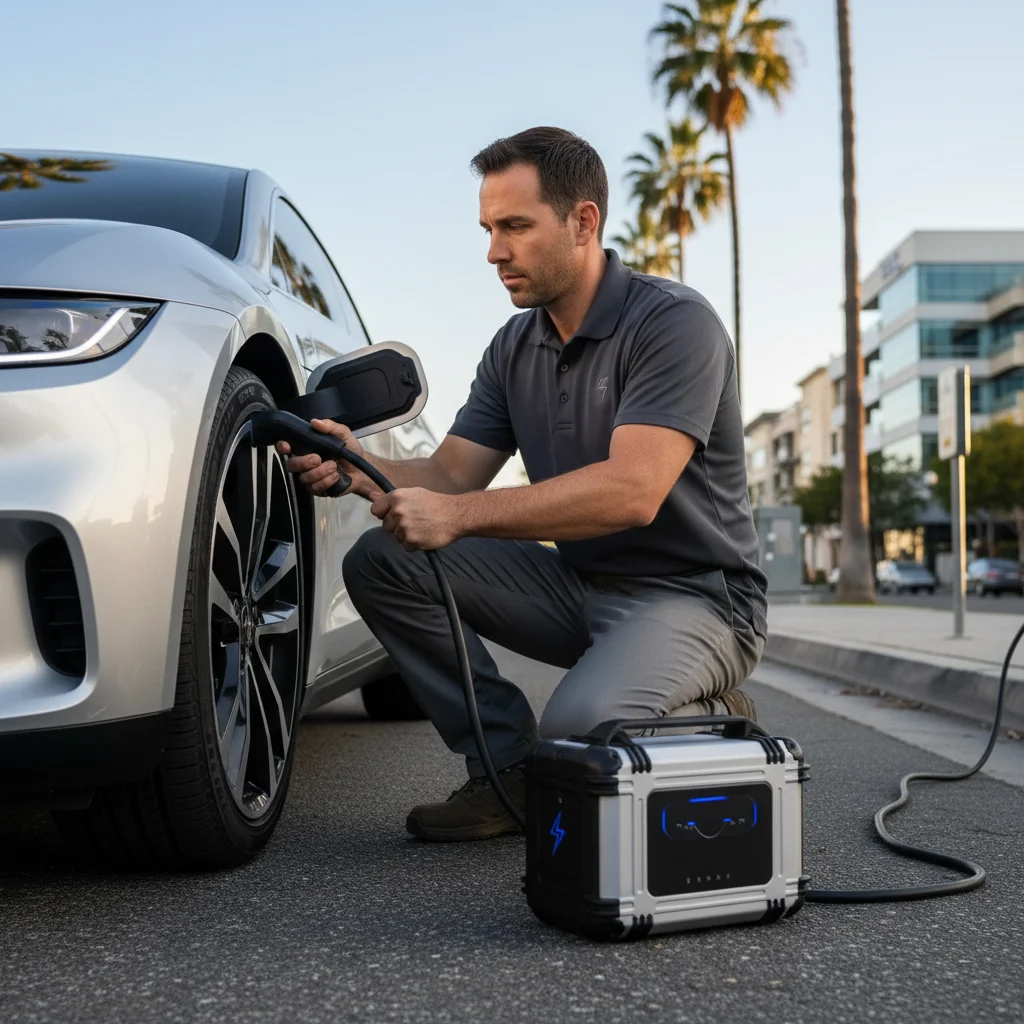
Operators in this network bring a 240-volt Level 2 source to the car. They carry a native NACS plug. They carry CCS or J1772 adapters for non-Tesla EVs. They can jump or replace a 12-volt on site. They handle Tesla and every major EV brand.
They do not fill the pack to 100 percent on the curb. They add 10 to 20 miles of range in 15 to 30 minutes of charging. That is charging time once they are connected. It is not a promise about traffic on 101. The point is enough range to reach a charger or a driveway, not a full road trip from the hotel lot.
Ask what they will do before they start. A 12-volt jump is a different job from a Level 2 top-off. A replacement 12-volt is a third job. A tow is last, and only if the car cannot take a charge.
Neighboring Peninsula trips that stall the same way
A Burlingame stall is often the middle of a Peninsula day, not a local errand.
You land at SFO, sleep on Old Bayshore, then drive El Camino to a meeting in San Mateo. You park on Burlingame Avenue for dinner, then cannot wake the car. You leave a personal EV in Ray Park, take a rideshare to the airport, and return to a silent cabin. You come off I-280 toward Broadway and realize the estimated miles were optimistic in traffic.
San Bruno has the same airport-edge pattern. Millbrae does too. Foster City adds lagoon-side parking and a different 101 exit. None of those cities magically fix a 12-volt that sat too long.
If you meant to cross the San Mateo-Hayward Bridge, remember the toll is westbound only on that span. A car that will not wake in a Burlingame hotel never makes the bridge. Solve the lot first.
What to do in the lot, in order
Stay out of traffic if you can still roll a few feet. Hazards on. If you are on 101, that is the shoulder, not the travel lane.
Try the app once. If the car is a Tesla, try Bluetooth from a few feet away. If the 12-volt is dead, the app often fails too. Do not drain your phone looping the unlock command.
Check whether doors open with a physical key or a key-card backup. Many EVs hide a mechanical release. Use the owner’s manual on your phone if the car is dark.
Do not jump the 12-volt from a gas car unless you know the exact points. Wrong clamps on an EV can damage the DC-DC converter. Let an EV-ready operator do that part.
Call Charge Pro SF when you want a local operator matched. Tell them the city, the hotel name or the nearest cross street, the make and model, and whether the car opens. That split tells the operator whether to bring a 12-volt kit, a Level 2 lead, or both.
Wait in a safe place. A hotel lobby is better than a 101 shoulder. On a freeway, stay with the car if it is safer than walking.
Prevention that actually fits this city
Plug in at home on the nights you are in town, even if the pack looks fine. The 12-volt charges from the DC-DC converter when the car is awake and the pack is available. A car that never gets a 240-volt circuit in a pre-1980 house still needs some overnight time on whatever outlet you have, or a regular Level 2 session elsewhere.
Before a flight, park the EV in a state you would trust for a week. Turn off cabin overheat if you will not need it. Turn off camera security modes if the lot is a garage you accept as lower risk. Those features drain the 12-volt while you are gone.
If you are in a rental, ask the desk whether the car has been sitting. A rental that already sat on Old Bayshore for days is a 12-volt candidate before you even leave for the terminal.
Do not plan a long 280 or 101 run on a car that just woke from a jump. Drive it to a charger and confirm the 12-volt holds. A jump that dies again in traffic is the next stall.
Tesla, other brands, and adapters in the same lot
Teslas take NACS. Many newer non-Tesla EVs take NACS now too. Plenty of cars on the Peninsula still need CCS or J1772. The operator brings the adapters. You should still know which port your car has. A locked charge port on a dark car is a 12-volt problem first. The latch is electric.
Hyundai, Kia, Ford, Rivian, Chevrolet, BMW, Mercedes, and Volkswagen EVs all show up around SFO hotels. The 12-volt story is the same family of failure. The jump points are not. That is why the operator, not a random jump pack from a gas-car kit, should do the work.
When a tow is the honest next step
Sometimes the car will not take a charge. Sometimes a 12-volt replacement still will not close contactors. Sometimes you are in a stall a truck cannot reach without a hook. Then a flatbed is the honest move. Ask for EV-safe towing. Many EVs need to be in Neutral or Transport mode. A dead 12-volt can block that. The operator and the tow driver need to talk before the winch starts.
Towing is not a charge. You will still need power at the far end.
Frequently asked questions
What usually fails after a Burlingame hotel stay?
A dead 12-volt, more often than an empty drive pack. The car sat at a Bayfront hotel, or in Ray Park, while accessories kept drawing. Locks, cameras, and the app all run on that small battery. When it drops, contactors will not close and the car looks dead. An operator can jump it or replace it on site. If the display then shows zero miles, you still need a Level 2 top-off to leave.
Can an operator help a non-Tesla in a Bayfront lot?
Yes. Operators carry a native NACS plug plus CCS or J1772 adapters. That covers Tesla and every major EV brand. Tell them the make and model when you call. A locked port on a dark Hyundai or Ford is still a 12-volt job first. The latch needs 12-volt power.
Will Freeway Service Patrol charge an empty EV on 101?
The MTC FSP page lists gas, jump-starts, and radiator refills. It does not mention electric vehicles or out-of-charge help. Hours are Monday to Friday, 6 to 10 AM and 3 to 7 PM. Dial 511 and say “Freeway Assist.” After hours, CHP Rotation Tow assigns a vendor. An FSP jump may wake a 12-volt. It will not fill a drive pack. For an empty pack you still need a mobile Level 2 charge or a flatbed.
A dark EV in a Burlingame hotel lot is a local problem with a local next step. Charge Pro SF matches you with an independent operator who can jump the 12-volt or add enough Level 2 range to move. Call (415) 630-6268 and give them the hotel, the cross street, and the car. The operator quotes you before they start, and they bill you directly.