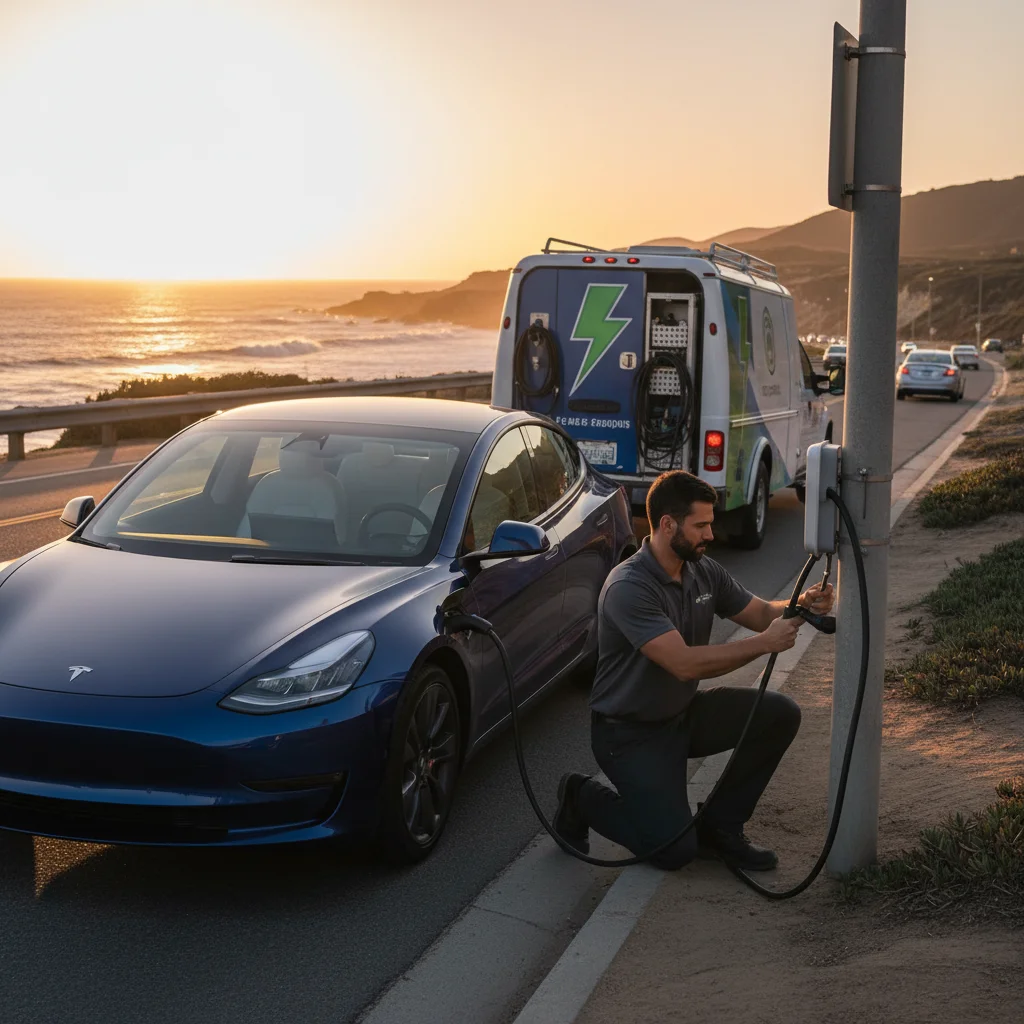
You’re parked under an I-80 ramp in West Berkeley, and the pack is already low. EV roadside assistance in Berkeley is a local operator at that curb. They bring a 240-volt source to the car. Shore apartments, marina lots, and the University Avenue ramps put many renters on public charging. The car still has to move when a session ends short.
Two climates inside one small East Bay city
Berkeley is an incorporated Alameda County city of about 10.4 square miles. The ACS 2019-2023 count is 120,223, and the 2024 Census estimate is 121,749. Fog hangs on the marina, and the Berkeley Hills run warmer. Summer cooling load stays low on most days.
The housing stock is old by Bay Area standards. About 80.8% of structures were built before 1980, from Census table B25034. That share stands in as a proxy for tight panels and plug-less apartments. Students around UC Berkeley often finish the day on a public post. Downtown renters and West Berkeley shore buildings follow the same pattern. A home rate plan doesn’t help a car that’s already empty. PG&E still owns the wires and delivers the power. Ava Community Energy, once East Bay Community Energy, supplies generation here. Ava publishes the Alameda County Incentive Project and an Ava Charge network. Those are program names, not a guaranteed open stall on your block. Confirm a live stall in the app before you spend your last miles.
A Berkeley panel upgrade won’t wake an EV that’s already dead on the street.
I-80 ramps, University Avenue, and the marina lot
West Berkeley backs up to I-80 and the water. University Avenue is the spine onto those ramps. The Berkeley Marina is a real last stop, not a cut-through. I-80 carries express lanes, and FasTrak is required. Hours are generally 5 AM to 8 PM on weekdays. MTC runs the regional express-lane network on this stretch. A primary page didn’t confirm those lanes sit in the median. Don’t pull into a lane position you can’t verify as a safe shoulder.
If the car dies on the freeway, CVC 21718 is the statute that matters. Stopping on a freeway is prohibited except in limited cases. One exception is a vehicle so disabled that stopping is unavoidable. Another vehicle has to have been summoned to assist. Get the call in, then stay out of live lanes. CVC 22651(f) allows removal after more than four hours on a full-access-control freeway. That applies if you can’t move under your own power. Waiting it out is how a rotation tow shows up without you picking the company.
The Bay Area Freeway Service Patrol is a partnership of MTC, CHP, and Caltrans. Private tow firms run dedicated beats in published windows. Those hours are Monday to Friday, 6 to 10 AM and 3 to 7 PM. They clear crashes and debris on those beats. They advertise a free gallon of gas, jump-starts, and radiator refills. MTC’s FSP page, read 2026-09-18, doesn’t mention electric vehicles or out-of-charge help. Dial 511 and say “Freeway Assist,” or use a call box. Outside those hours, the CHP Rotation Tow Program assigns the truck. You don’t choose the vendor on that rotation. Caltrans District 4 covers the nine Bay Area counties on QuickMap.
If you still have a few percent, leave the freeway at University Avenue. Stranded on I-80 in the East Bay covers the shoulder case in more depth. A travel-lane stall is a safety problem first, then a power problem.
Campus blocks, BART names, and renters on public charging
Downtown, North Berkeley, Elmwood, and Telegraph Avenue mix students, shops, and curb parking. Shattuck Avenue and the Gourmet Ghetto see the same loop. You hunt a space, then the car sits. People on the phone actually say Ashby BART and Downtown BART. BART’s published Level 2 park-and-ride charging was verified on bart.gov on 2026-09-18. Those stalls sit at Warm Springs / South Fremont and Lafayette. They aren’t listed at the Berkeley BART stations named above. Don’t drive there for a stall unless you’ve confirmed it yourself.
UC Berkeley and the Campanile sit above Downtown. A campus day is stop-and-go, then a long park. A dead 12-volt after that sit can look just like an empty pack. You get a dark dash, unhappy doors, and no start. The Berkeley charging hub maps this city in the network if you want the wider layout.
Renters here often have no overnight circuit at the building. Older stock in ZIPs such as 94702, 94704, and 94710 shows up on those calls. A ZIP can spill past city limits. Use it to describe the block, and don’t treat it as a border.
Claremont and Elmwood sit closer to the grade. West Berkeley sits closer to I-80 and the ramps. North Berkeley sits between the water and the hills. The low-pack problem is the same in each of those neighborhoods. The legal place to wait is what changes. If you’re in an apartment garage overnight, CVC 22658 may apply. CVC 22658 is the private-property tow rule that applies there. A posted sign must be at least 17 by 22 inches. Lettering has to be at least one inch. It has to name the tow company and an enforcement number. It also has to say removal is at the owner’s expense. The operator must notify law enforcement within one hour and give written notice. Overcharging beyond the approved rate in that setting creates liability for four times the amount charged. California doesn’t cap ordinary consensual tow rates statewide. Confirm any quote before a hook goes on.
SR-13, Ashby, and Tunnel Road into the hills
SR-13 is Ashby Avenue on the flats. It becomes Tunnel Road as you climb into the Berkeley Hills. Tilden Regional Park sits above that grade. The hills are warmer than the marina fog. Grade still spends range, even with a low cooling load. A charge that felt fine on Shattuck can still run out on the climb. That includes Claremont and the higher hills streets.
Don’t keep climbing on leftover percent you haven’t measured. Turn around while the car still moves under its own power. A 240-volt charge on a safe curb is the recovery that leaves you driving. A tow up Tunnel Road is a separate job with a separate quote. The operator you hire sets that number unless a local ordinance says otherwise.
What actually arrives at the car
Charge Pro SF is a referral line. We match stranded EV drivers with independent local mobile rescue operators. We don’t hold a trade license, own trucks, or employ technicians. We set no prices, and we publish no arrival time. The operator quotes you before starting and bills you directly.
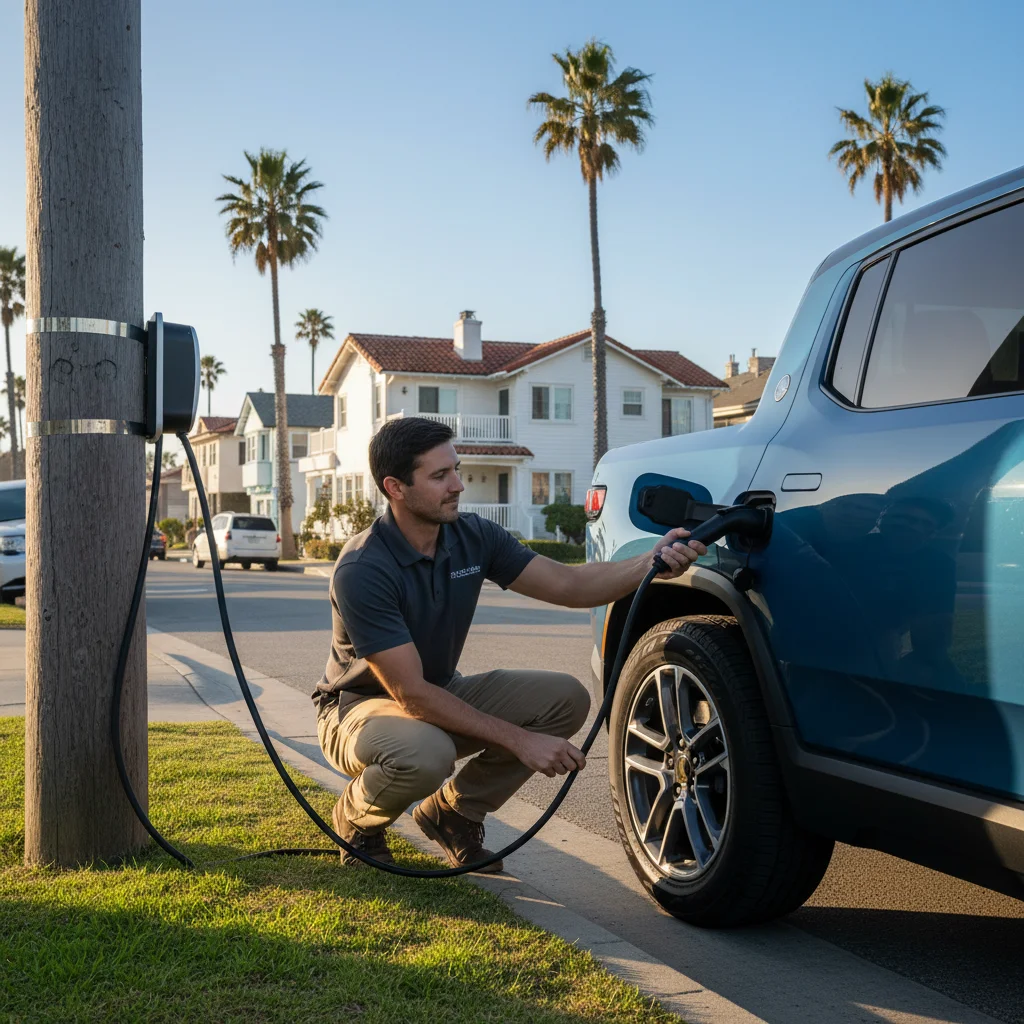
The work those operators do is narrow and concrete. They bring a 240-volt Level 2 source to the car. Teslas use a native NACS plug on that cable. Other EVs use a CCS or J1772 adapter. A typical session adds about 10 to 20 miles of range. That 15 to 30 minutes is charging time, not an arrival window. They can also jump or replace a dead 12-volt battery on site. They handle Tesla and every major EV brand.
Mobile EV charging is the right request when the traction pack is empty. It still has to be a place a van can reach. A 12-volt failure mimics that from the sidewalk. The 12-volt runs the computers, locks, and contactors that wake the pack. Tell the operator what the car is doing. A 12-volt jump won’t fill a pack at zero. A pack charge won’t wake a car whose 12-volt is dead. For Tesla 12-volt jobs, a 12-volt jump is the separate request.
Tesla’s own roadside, AAA, and insurer add-ons are separate products. Some of those plans send a tow, and some send a jump. Read the plan you actually bought before you assume a charge. The operators we connect you with are licensed and insured.
Mobile charge or tow on a Berkeley curb
The split most shore drivers face is a mobile charge, not a tow. If the car is intact and only empty, adding range on site lets you drive. You still have to confirm the charger you’re aiming at is working. You stay with the car on that curb. You skip a hook on a tight West Berkeley block.
A tow still belongs in some cases. Crash damage, a mechanical fault, or a CHP order to clear the freeway are tow jobs. During FSP hours, that truck may already be assigned. On a quiet curb with an empty pack, start with a Level 2 charge. Towing a dead EV has brand-specific handling. Transport mode, dollies, and wheel rules differ. If the only problem is energy, charging in place avoids that. If a van can’t legally sit where you are, say so on the call.
Emeryville, Oakland, and the rest of this waterfront
Berkeley doesn’t sit alone on this shore. Emeryville sits next door, and Oakland is south. Albany, El Cerrito, and Kensington follow the north edge. Richmond continues up I-80 along the same waterfront. We serve every city in the county, including those neighbors. The East Bay core shares older housing and the same freeway ramps. The city name on the pin still matters. Tell the operator the city you’re actually in.
The Bay Bridge is westbound-tolled only toward San Francisco. Cash ended on those bridges in March 2020. All seven state-owned bridges use FasTrak, a license-plate account, or an invoice. Don’t spend your last percent on a San Francisco crossing. Do it only if you already know you can finish. Confirm the charger you’re aiming at before you commit those miles.
What to have ready when you call
Put your hazard lights on and get out of live traffic. If you’re on I-80 or I-580 in FSP hours, start with 511. Say “Freeway Assist” for the disabled-vehicle path. That service doesn’t advertise an EV charge on its page. Call for a mobile rescue if the pack is the problem.
Give a street, a cross street, and the ZIP if you have it. Name the make, the model, and the plug. Say whether the dash is dark or the pack reads empty. You’ll hear a recording notice on the call. Penal Code 632 requires all-party consent to record a confidential communication. That’s why the notice plays before anyone talks.
Charge Pro SF forwards the request to a local operator. They quote before a cable goes on the car. If you want that match, call (415) 630-6268. It’s a referral to an independent pro, not a clock on the van.