Alameda is an island. EV roadside assistance here is an access problem first. You leave through the Posey and Webster tubes. You can also use the Park Street and High Street bridges. Ron Cowan Parkway is the connector to Bay Farm Island. If the car won’t roll, that crossing is the whole dispatch.
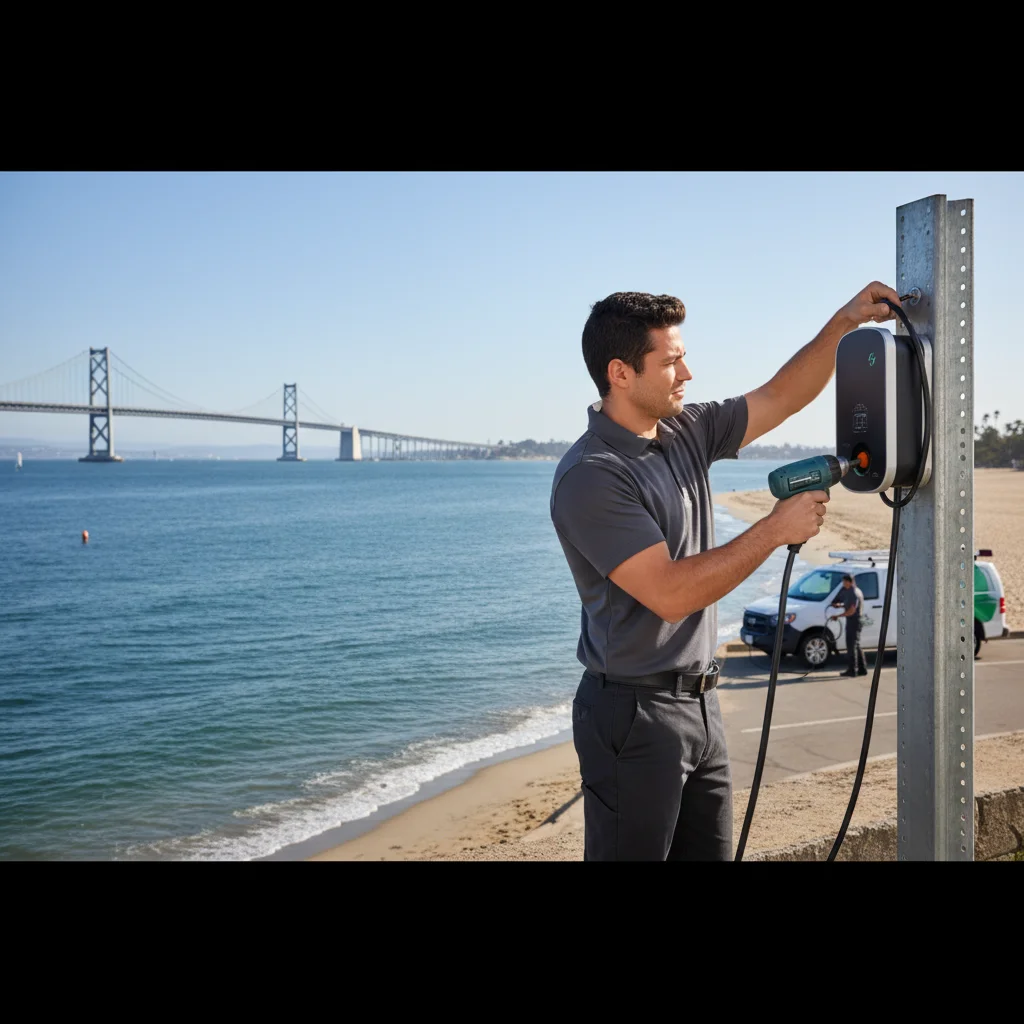
Why Alameda isn’t a mainland stall
The city sits in Alameda County, across the estuary from Oakland. ACS 2019-2023 counts 76,876 residents. The 2024 Census estimate is 78,795. Land area is 10.399 square miles. That’s a small map with a hard edge of water.
A stall on the Gold Coast still needs a tube or a bridge. The East End and West End are the same problem. Say your neighborhood when you call. Bay Farm Island is the same city, but it isn’t the same inbound path. Alameda Point is a different approach too.
San Francisco sits across the bay. San Leandro sits down the shore. Neither one shares these choke points. The operator has to plan the Posey or Webster bore. The other path is the Park Street or High Street span.
Census figures show 73.4 percent of housing here was built before 1980. Older streets mean more cars that sit overnight. A long sit is a classic 12V failure, even in this mild, breezy climate. Fog and bay wind keep AC load low. They don’t keep a weak 12V alive.
Power on the island is Alameda Municipal Power, the city’s own utility. It isn’t PG&E. Oakland next door is PG&E with Ava Community Energy. AMP lists an optional Electric Vehicle Time of Use rate. It also lists a Level 2 EV charger rebate. Confirm current terms on alamedamp.com. Those programs won’t wake a car that’s already stranded.
Empty pack, or a 12V that killed the computers
Many “out of charge” cars still have traction range. The 12V battery runs the screens, the locks, and the charge-port latch. If nothing wakes, don’t assume the pack is at zero. Tesla, Rivian, Hyundai, Ford, and GM cars all still carry that small battery.
A dark car after a long park at Alameda Point is often that 12V. Same story near the USS Hornet, or on a stall in the Park Street district. The high-voltage pack can be fine. The computers just won’t boot.
Read Tesla won’t wake: empty pack or a dead 12V before you order a flatbed. Operators the line matches you with can jump or replace a dead 12V on site. They can also bring a 240V Level 2 source if the pack ran out.
Tell the matcher what you see. Dark screens and a locked charge port point one way. A car that still rolls but shows a few percent points the other. The operator quotes before any work starts, and bills you directly.
Tesla tells owners to request roadside through the Tesla app. Out-of-range help may be available, but Tesla says it isn’t financially covered. Don’t wait on the app if the car is already dark.
If you still have a little range, check PlugShare before you enter the tubes. Confirm a live stall. Don’t treat the map as a guarantee.
Stopped in the tubes, or on I-880
The Posey and Webster tubes are the Oakland connection. I-880 sits right there on the mainland side. A stall in a travel lane is a safety call, not a charging call.
CHP says to call 911 when a disabled vehicle is in a dangerous location. Call 911 for a traffic lane too. In metro areas, other roadside requests can go through 511. Say “Freeway Assist” if you want the Freeway Service Patrol.
Vehicle Code 21718 bans stopping on a freeway except in limited cases. One case is a vehicle so disabled that the stop is unavoidable. You’ve also got to have summoned help. Vehicle Code 22651(f) allows removal after more than four hours on a full-access-control freeway. That applies if the car can’t move under its own power.
Put the hazards on and keep the phone in hand. Don’t walk the bore or the freeway lanes unless an officer tells you to. Caltrans District 4 covers the nine Bay Area counties. No specific published disabled-vehicle policy was found for the Posey tube or the Webster tube. None turned up for the Park Street or High Street bridges either. If you’re on a deck or in a tube, 911 is still first.
The Freeway Service Patrol is MTC, CHP, and Caltrans together. Weekday hours are 6 to 10 AM and 3 to 7 PM. The MTC page lists a free gallon of gas, jump-starts, and radiator refills. It doesn’t mention electric vehicles or filling an empty pack. Don’t wait on that truck for a charge. After hours, freeway tows often run through the CHP Rotation Tow Program. You don’t pick the vendor.
A mobile charge needs a legal, safe stop. Treat the tube as a 911 scene first. Our Bay Area freeway stall guide covers the shoulder sequence once you’re out of the live lane.
Island streets, from Crab Cove to Bay Farm
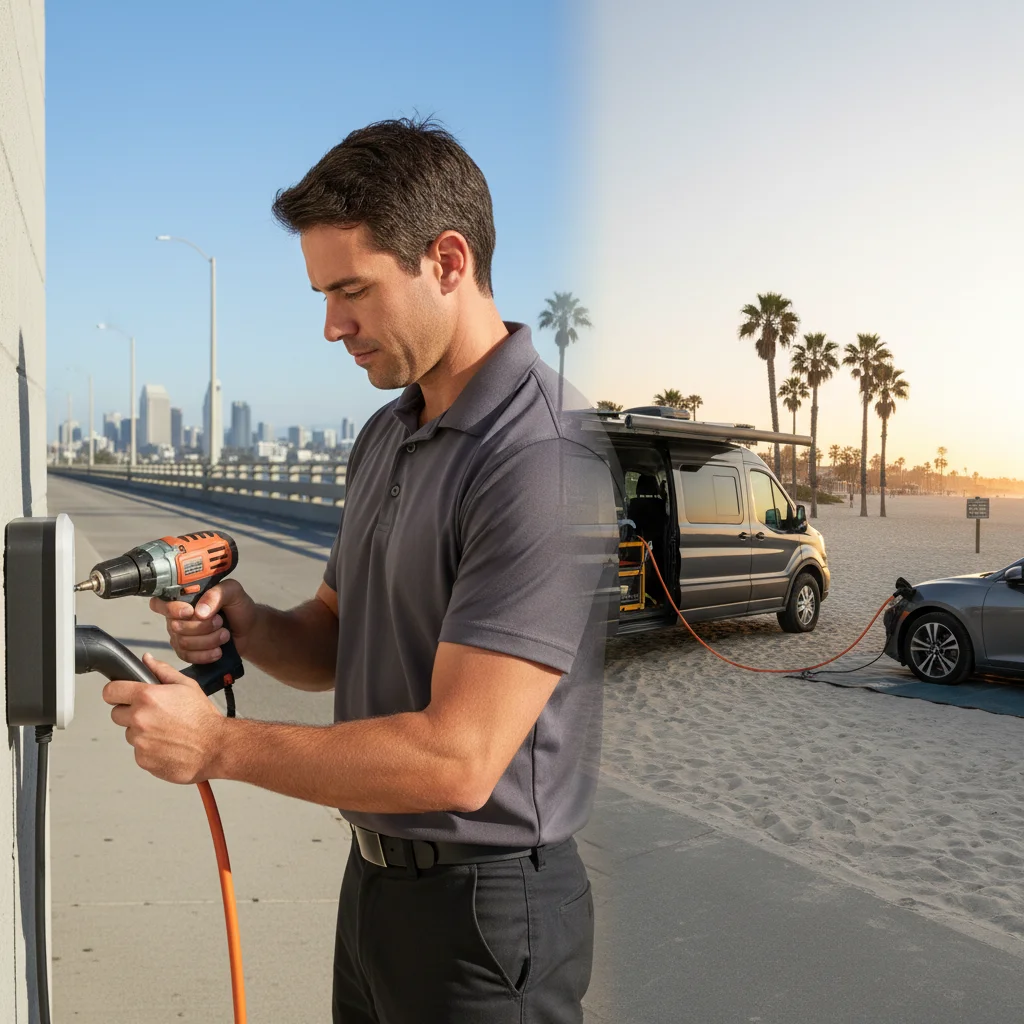
Once you’re off the crossing, the map opens up. Crab Cove, the Park Street district, Alameda Point, and Bay Farm Island are all in the city. We serve Alameda. The pros we connect you with are licensed and insured. Charge Pro SF holds no trade license and owns no trucks.
A visitor lot at the USS Hornet is a normal meet point. So is a street stall on the East End. So is a driveway on the West End. Name the nearest cross street. Say if you’re on Bay Farm. Ron Cowan Parkway is a different inbound path than the tubes.
If the car is on private property, Vehicle Code 22658 can apply. California doesn’t cap ordinary consensual tow rates statewide. No Alameda-specific tow-rate figure was confirmed. Ask for the quote before anyone hooks the car.
What the operator brings to the curb
Charge Pro SF is a referral line. It matches stranded EV drivers with independent local mobile rescue operators. It performs no work. It employs no technicians. It sets no prices and promises no arrival time.
The operator brings a 240V Level 2 source to the car. Tesla cars take a native NACS plug. Other EVs use a CCS or J1772 adapter. Typical add is 10 to 20 miles of range in 15 to 30 minutes of charging. That’s charging time, never a clock on when someone shows up.
That window is usually enough to reach a charger you’ve already confirmed on your map. It isn’t a full pack. If you want the hardware walkthrough, see what’s an EV charging truck, and who actually bills you.
EV roadside assistance covers Tesla and every major EV brand. Out-of-charge recovery is the pack-empty version of the same idea. Confirm the make, model, and port when you call. The operator has to match the plug to the car.
Charge on the island, or tow through the tubes
A tow off Alameda means a flatbed through a tube or over a bridge. That’s a longer, heavier move than a curb charge. If the car will accept electrons, a mobile charge is the smaller job. If it throws a fault and won’t charge, a tow to a shop is the honest call. Rescue isn’t repair.
Our comparison on when you need a mobile charge, not a tow lays out that fork. Use it if you’re standing next to a dark car and can’t tell which side you’re on.
Don’t let a freeway clock run to the four-hour mark while you wait. If you’re on I-880, the removal rule is already in the code. Get the car to a legal stop, then choose charge or tow.
Call the line when the car won’t move
Call when the EV is stuck in Alameda and you need range or a 12V wake. That includes a street stall or a lot at Alameda Point. It also covers Bay Farm Island, or a car that died after the tubes. For the city overview, use the Alameda charging and rescue page.
Call (415) 630-6268. You’ll get a matcher, not a promise of a clock. The operator quotes the job before starting, and bills you directly.