The screens are black and the car won’t wake. A service bay can look at that later. Tonight you need the call that puts the wheels in gear.
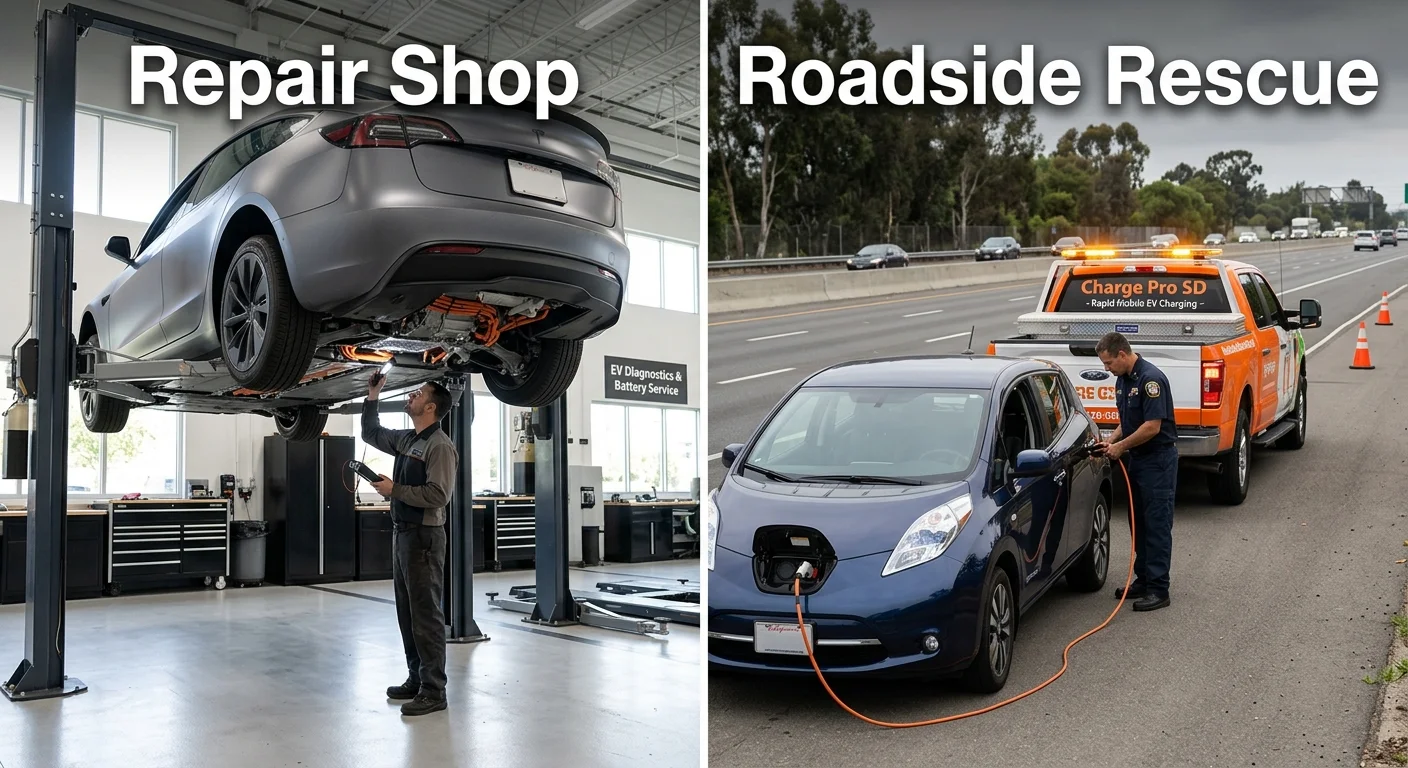
Rescue versus repair is a move-or-wait choice
Searchers type ev rescue vs repair after the car already failed. Repair is a booked bay, a lift, and a diagnostic laptop. Rescue is the curb, a garage stall, or a freeway shoulder. If the car can’t roll, the shop isn’t the moving call.
A dealer can chase a motor fault or a pack warning. That work lives on a calendar at the shop. The technician needs a hoist and a parts room. That setup doesn’t come to a San Francisco block. It doesn’t come to a Sunnyvale campus lot after dark.
Charge Pro SF is a referral line for the second job. We connect stranded drivers with independent mobile operators. Those operators bring a 240-volt Level 2 source to the car. They jump or replace a dead 12-volt battery on site. They’re not mechanics and they’re not a shop.
Shop lag is why the 12-volt call comes first
Service-center lag is common across the Bay. Tesla Service and brand dealers schedule on their own clocks. Manufacturer mobile service is still an appointment on their books. It’s not a shoulder recovery or a curb jump.
You wait because the shop is solving a different problem. They want time on a lift with a scan tool. They may order a part that isn’t in the building. Your car in a garage near SFO doesn’t fit that queue.
If the doors won’t unlock, you’re not in that queue yet. You’re stuck in place with a dark car. The moving call is a roadside 12-volt jump. Drive to the dealer later if the car still acts sick.
Tesla mobile service or a roadside charge walks that fork for Tesla owners. The same fork applies to Rivian, Ford, Hyundai, and Chevy.
A dark dash is often the small battery
Most won’t-start stalls aren’t a failed traction pack. The 12-volt battery runs locks, computers, and contactors. When it sags, a full pack can still refuse to wake. The car looks bricked, and it’s often just asleep.
That’s why a shop booking is the wrong first move. An asleep car is hard to load and hard to diagnose. A jump on the 12-volt can close the contactors. Then you may roll to a charger on your own power.
The operators we send handle Tesla and every major EV brand. Tesla takes a native NACS plug on a Level 2 top-off. Other EVs use a CCS or J1772 adapter. The jump is on the small battery only.
What happens when an EV 12-volt battery dies explains the signs. For Tesla hardware, start with a Tesla 12V battery jump.
Older street parking makes this more likely, not less. In San Francisco, ACS 2019-2023 puts 77.2 percent of housing in pre-1980 stock. Daly City sits at 78.7 percent. San Bruno and El Cerrito both sit at 81.9 percent. Those buildings often mean curb parking for days. A 12-volt that sat too long is a rescue, not a pack replacement.
Newer inland towns look different on paper. Dublin’s pre-1980 share is 21.0 percent, and Brentwood is 10.9 percent. More garages don’t cancel a dead 12-volt after a long trip.
An empty pack is still rescue, not a repair order
The other stall is a traction pack at zero. That’s not a motor failure or a recall campaign.
A mobile EV charging operator brings Level 2 to the bumper. Typical add is 10 to 20 miles of range. Charging time is usually 15 to 30 minutes. That’s plug time, never an arrival time. It’s enough to reach a Supercharger or a charger you already know.
Don’t wait on a dealer to service an empty pack. A booking screen can’t push energy into the port. A lift can’t meet you on the San Mateo-Hayward Bridge approach. If a fault drained the pack, book the shop after the car can move.
Freeways, tows, and who actually lists EV help
On a Bay Area freeway, the Freeway Service Patrol is the name people know. MTC, CHP, and Caltrans run it with private tow vendors. Hours on 511.org are Monday to Friday. That’s 6 to 10 AM and 3 to 7 PM. You reach it by dialing 511 and saying Freeway Assist.
The MTC page lists a free gallon of gas, jump-starts, and radiator refills. As of September 18, 2026, that page doesn’t mention electric vehicles or out-of-charge recovery. Confirm with 511 what the beat truck can actually do. Don’t assume an empty EV is on that menu.
Outside those hours, disabled freeway calls often go to the CHP Rotation Tow Program. You don’t pick the company on that list. Caltrans District 4 covers the nine Bay Area counties on QuickMap. California Vehicle Code 21718 lets a disabled vehicle stop when help is summoned. Code 22651(f) allows removal after four hours on a full-access-control freeway. That’s if the car can’t move under its own power. Those clocks are why a moving call beats a waiting-room repair.
No published disabled-vehicle policy turned up for the state-owned toll bridges. Eastbound only on Antioch, Benicia-Martinez, and Carquinez. Westbound only on Dumbarton, Richmond-San Rafael, the Bay Bridge, and San Mateo-Hayward. The Golden Gate Bridge is a separate district, with tolls southbound into San Francisco. If you stall on a span, call CHP and follow the officer.
CVC 22658 requires a posted sign at least 17 by 22 inches. The operator must notify law enforcement within one hour. A dead EV in a stadium or mall garage can be removed. Waiting on a dealer slot doesn’t pause that rule. Check the posted board if you’re in a garage at Chase Center or Oracle Park.
Heat, hills, and lots that sit all week
The coast and the interior aren’t the same car. 1961-1990 WRCC normals put San Francisco’s July high at 71.5 F. Oakland Airport sits at 70.4 F. Livermore is 89.7 F, and Antioch is 90.4 F. Inland heat plus a grade on I-680 or I-580 is a range problem. SR-24 up to the Caldecott is the same story. It’s also hard on a weak 12-volt. That still isn’t a shop-first event if the car already died. Get the car awake, then drive it to a bay that can repair it.
Airport lots are the other quiet stall. SFO’s EV parking page couldn’t be verified in this research pass. Confirm charging there in a browser on flysfo.com. OAK and SJC parking pages were read on September 18, 2026. They don’t show EV charging on those parking lists. None of the three airport sites explain a car that won’t wake. A week in a garage is a classic 12-volt stall. Call for a jump at the stall. Book the dealer after the car can roll.
Peninsula cities around the airport include San Bruno, Millbrae, Burlingame, and South San Francisco. Campus lots in Palo Alto, Mountain View, and Santa Clara sit through a long day. None of those scenes are a reason to skip the 12-volt check.
What roadside rescue will not fix
The pros we send don’t replace a traction pack. They don’t run warranty campaigns or flash module software on a lift. If the car still drives and a light stays on, book the dealer. If you hear a new noise on El Camino in Redwood City, drive it in. Rescue is for a car that won’t move.
Charge Pro SF holds no license and owns no trucks. We employ no technicians, set no prices, and publish no hours. The operator quotes you before work starts and bills you directly.
EV roadside assistance is the bucket for a stall. Charge, jump, or tow is the three-way split when a jump isn’t enough. Hub context for the metro sits at EV charging in the Bay Area.
Pick the call from what the car is doing
Start with one fact: whether the car can move under its own power.
If it shifts and rolls, and you only have a warning, that’s repair. Drive to the brand store or an EV-capable independent. Don’t summon a charge truck for a rattle.
If the dash is dark and the doors are dead, that’s a 12-volt rescue. Ask for a jump or an on-site 12-volt replacement. Then go to a shop if it dies again.
If the car is on and the range is zero, that’s a mobile charge. That’s the call when you can’t reach a plug. You still book real service later if a fault drained the pack.
If there’s smoke, a crash, or a leak, that’s 911 and CHP. A charge truck isn’t that call.
We connect drivers across San Francisco, the Peninsula, and the South Bay. We also cover the East Bay, the Tri-Valley, and East Contra Costa. Local geography changes the stall, but it doesn’t change the fork. Move the car first, then repair it after it can roll.
To get connected with a local operator, call (415) 630-6268. You’ll get a quote from the operator before any work starts. No arrival time is promised on that line.