A battery dying after jump start is a new failure. It’s not leftover from the first jump. If the car woke, then died again on a Bay Area hill, the 12V wasn’t the only fault. Copy the exact warning. Skip another jump until your model’s official steps allow one.
The hill tests a car the first jump never tested
A jump can restore locks, screens, and the 12V bus. It doesn’t refill the traction pack. Bay Area grades make that split obvious. The SR-24 climb toward the Caldecott from Lafayette asks the car to work after it already failed. So does the I-580 rise toward the Altamont outside Livermore. So does the SR-17 pull out of Los Gatos. If power drops again as the road tilts, leave the cause open. The pack, a charging fault, or a 12V that won’t hold may all be involved. Don’t pick the label yourself.
Inland heat can make a weak 12V look fine at the curb, then fail on the grade. Livermore’s 1961-1990 July average high is 89.7F. Antioch’s is 90.4F. The SFO cooperative station is 71.5F in July. A car that sat in Concord or San Jose can wake once. Then the same battery sags when you climb.
Read what happens when an EV 12-volt battery dies if the dash mentioned low voltage. For the pack split, see Tesla won’t wake: empty pack or a dead 12V. Those pages help you ask better questions. They don’t replace the owner’s manual for your year.
Read the screens, not your diagnosis
Stop calling it a dead battery. That phrase hides which system failed. Copy the exact line from the dash, center screen, app, or key alert. Keep 12V, low voltage, propulsion, charging, or high-voltage pack if those words appear. Don’t rewrite them into a cause.
Then log what still works. Note door locks, displays, the charge screen, shifting, and the app connection.
Use the printed manual, the official app, or the maker’s support page for your model year. Skip steps written for a different EV. A Tesla, a Rivian, and a Hyundai don’t share jump points.
City name isn’t a location. Give the street, garage level, gate instructions, or freeway direction. A car on I-880 in Hayward needs different access than a driveway in Daly City. A stall in a Palo Alto garage isn’t the same handoff as the Bay Bridge approach.
Write the sequence while it’s still clear
Power that returned and then left is information. Capture it before it blurs.
- What the car was doing before the first blackout
- The exact warnings, in the order they appeared
- Who did the first jump, and what they used
- Whether they followed your model’s published steps
- What functions came back afterward
- Whether the car moved, tried to charge, or stayed parked
- What happened in the minute before power failed again
Leave gaps as gaps. Don’t fill them with converter talk or wiring theories. Nobody here has tested this vehicle. The signs that an EV 12V needs replacement can shape a later shop visit. They don’t prove you need a new battery today.
If another person did the first jump, ask what they used. Write the answer down. Don’t restage the clamps to check their work.
A second jump is a decision, not a reflex
Check the official procedure for your make, model, and year. The next person has to support that vehicle. This page doesn’t give repeat-jump steps. Access panels, clamp points, and allowed tools change by model. Generic clips can hurt the car in front of you.
If the manual says stop, stop. If you can’t confirm the procedure, don’t improvise. Tell the next operator that power already returned once and failed again. Hand over the timeline and the warning photos. Ask whether they handle your exact model before any work starts.
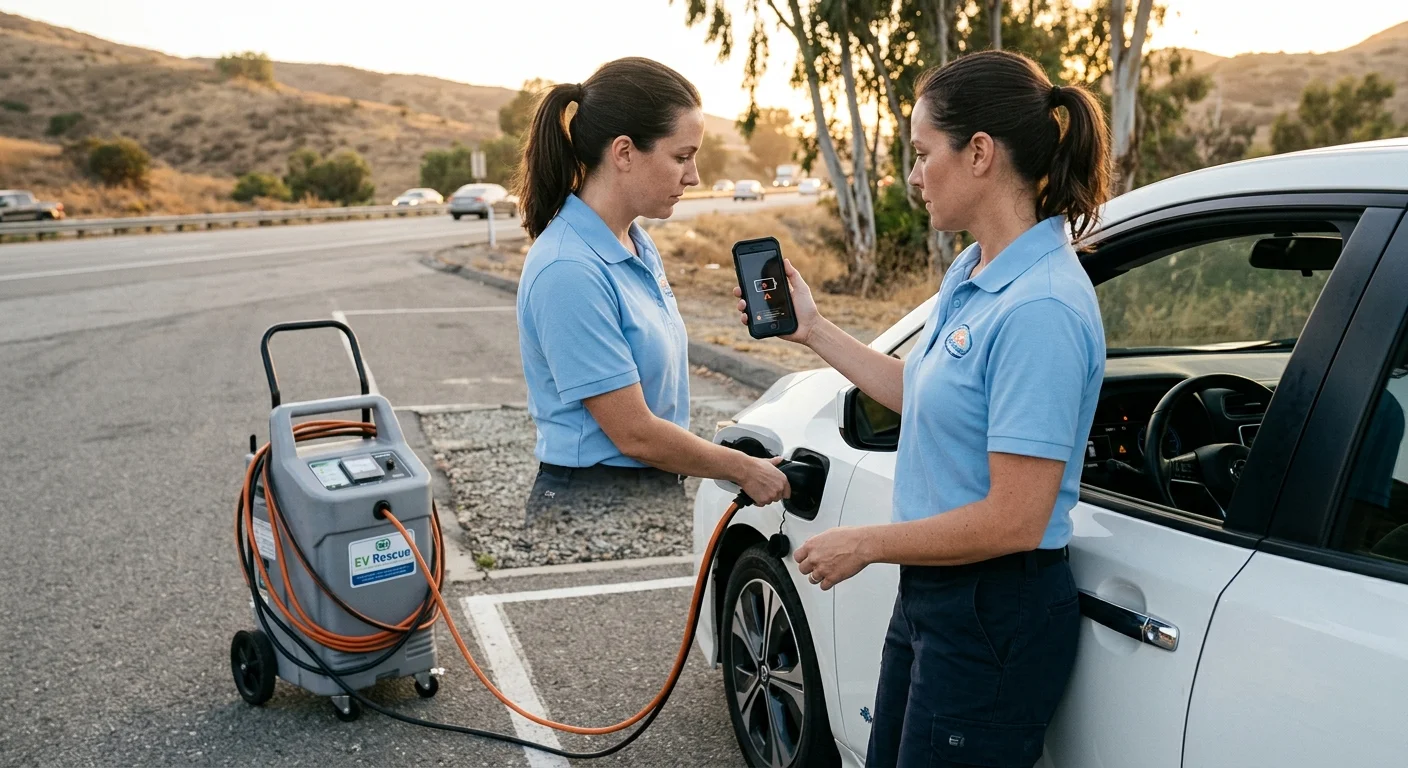
A matched operator may jump the 12V on site. They may also bring a 240V Level 2 source to the car. Independent pros in this network use a native NACS plug. They carry a CCS or J1772 adapter for non-Tesla EVs. A roadside Level 2 session typically adds 10 to 20 miles of range in 15 to 30 minutes of charging. That window is charging time. It isn’t an arrival estimate. The operator quotes you before starting and bills you directly.
For the 12V path, see how to jump start an electric car without hurting it. Tesla drivers can also use Tesla 12V battery jump. For a car that won’t move, start with EV roadside assistance. Other brands can review non-Tesla EV rescue. Charge Pro SF connects you with licensed, independent local operators. The brand doesn’t own trucks. It doesn’t employ technicians. It doesn’t perform the work.
If you see smoke, a damaged pack cover, or leaking fluid, stop. Call emergency services. Don’t let a bystander invent a workaround.
The shoulder, the garage, and the four-hour clock
On a full-access-control freeway, California Vehicle Code 21718 bars stopping except in limited cases. One exception is a vehicle so disabled that stopping is unavoidable, with another vehicle already summoned to assist. California Vehicle Code 22651(f) allows removal after more than four hours on that kind of freeway. That applies if the car can’t move under its own power. Don’t treat the shoulder as a waiting room.
The Freeway Service Patrol is a partnership of MTC, CHP, and Caltrans. Published hours are Monday to Friday, 6 to 10 AM and 3 to 7 PM. Dial 511 and say “Freeway Assist,” or use a call box. The MTC page lists gas, jump-starts, and radiator refills. It doesn’t mention electric vehicles or an empty traction pack. Confirm what the arriving truck can actually do. Outside those hours, the CHP Rotation Tow Program assigns an approved vendor. You don’t pick the company. Caltrans District 4 covers the nine Bay Area counties on QuickMap.
No published disabled-vehicle policy for the state-owned toll bridges turned up in the 2026-09-18 check. That includes the Bay Bridge, the San Mateo-Hayward, and the Dumbarton. Tolling is all-electronic. The Golden Gate Bridge is a separate district, southbound only into San Francisco. If you’re stopped on a bridge approach, tell CHP the span and the direction. Don’t guess a pull-over rule that wasn’t posted.
In town, access is the whole job. San Francisco’s ACS 2019-2023 housing is 77.2 percent built in 1979 or earlier. Daly City is 78.7 percent. Those older buildings often mean street parking and gated lots. Brentwood is 10.9 percent pre-1980. Tell the operator the gate code, the level, and how a truck reaches the stall.
A car that won’t wake after a long stay at SFO, OAK, or SJC is a situation the airport pages don’t cover. SFO’s EV charging parking page couldn’t be verified in the 2026-09-18 automated check. Confirm current stalls in the airport’s own tools. BART lists Level 2 charging at Warm Springs / South Fremont with 42 plugs, and at Lafayette with 4 plugs. If you’re in a BART lot, name the station and the aisle.
Don’t call the PG&E outage line for a car that won’t start. The wires utility doesn’t diagnose a 12V that failed twice.
Pick the call that matches what you need now
Roadside help fits when the car is locked, dark, or stuck where it sits. Ask whether the operator supports your model and the help you want. A service center fits when you need testing, a repair plan, or follow-up after a repeat failure. Send the same timeline and photos either way.
You may need both. An operator can get the car off a shoulder or out of a garage. The shop still has to find why it died twice. Confirm the plan before anyone starts. If a tow comes up, follow the manufacturer’s current tow steps for your model. Don’t choose based only on the last range number you remember. Report that number as one observation, next to the warnings.
Before you agree to work, ask who will do it and what they propose. You contract with that independent pro. You pay that pro directly.
When the car won’t stay awake
If low-voltage power fails a second time and the car stays dark, a mobile EV rescue operator is a practical first call. Share the make, model year, exact warnings, the street or freeway pin, and what followed the first jump. Call (415) 630-6268 and we’ll connect you with a local operator. Charge Pro SF is a referral line. The operator on scene quotes you before any work begins.