A Chevy Blazer EV that won’t start is usually a flat 12-volt battery. That’s the usual East Bay apartment story, even with range still in the pack. The car looks fully dead because the computers never woke. Locks, the center screen, and Ready mode all run on that small 12V. Oakland and Berkeley housing is still mostly pre-1980 stock. A Blazer left on the street or in an older garage sits for hours. That sit flattens the auxiliary battery. It doesn’t empty the traction pack.
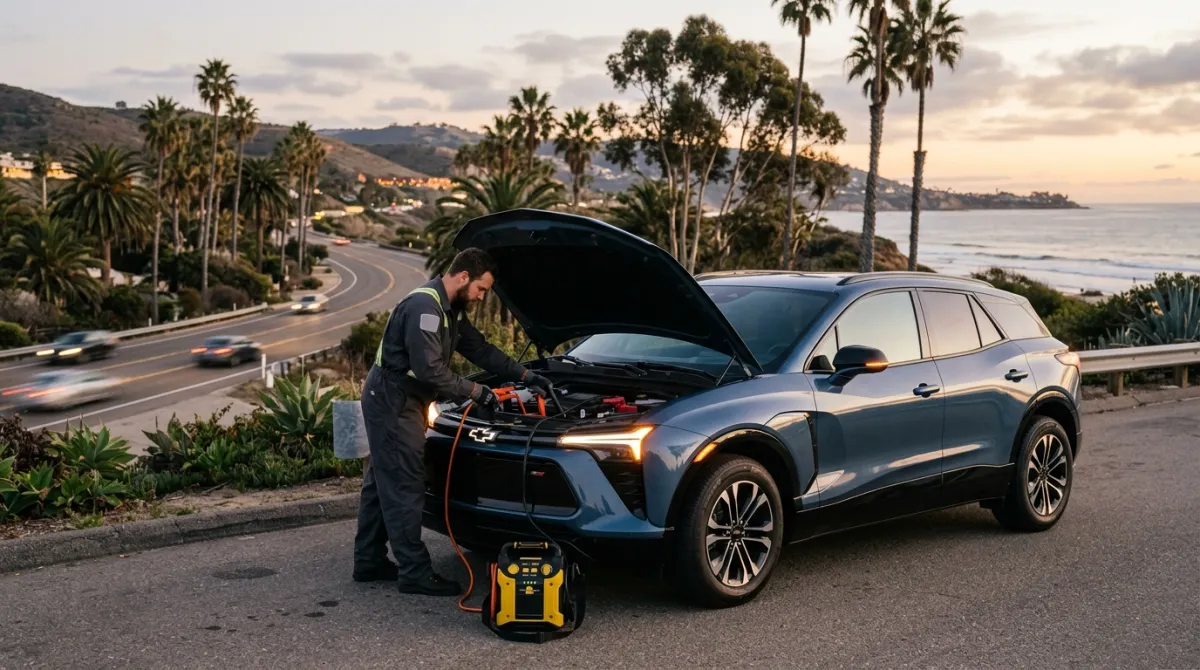
Why East Bay apartments keep killing the 12V
The Blazer EV sits on GM’s Ultium platform, like the Equinox EV. The Lyriq shares the same layout. Two batteries split the work. The pack turns the motors. The 12V feeds modules, latches, and the computers that let high voltage come online. When the 12V dies, the car won’t boot. Pack percentage in the myChevrolet app can still look fine.
Oakland had an ACS 2019-2023 population of 438,072. Census table B25034 puts 77.9 percent of its housing in 1979-or-earlier buildings. That older stock is the usual proxy for apartments and tight garages. Berkeley is higher, at 80.8 percent pre-1980, on a city of 120,223. El Cerrito, just north, is 81.9 percent pre-1980. San Leandro is 76.8 percent. Richmond is 67.2 percent. Concord, inland in Central Contra Costa, is 74.7 percent on 124,260 residents. Hayward is larger, at 159,201 people, with 64.1 percent pre-1980.
Those figures don’t tell you where to plug in. They show why a Blazer EV sits all night on the curb. Modules stay awake. Early Blazer software had extra parasitic drain through always-on connectivity. A fresh 12V can ride that out. A tired one in an Oakland, Richmond, or Concord stall often can’t.
The East Bay isn’t one climate. Oakland Airport’s 1961-1990 July normal high is 70.4F. Livermore’s July normal high is 89.7F. Antioch’s is 90.4F. A weak 12V ages faster once you leave the marine layer. A Hayward sit in inland air isn’t a Berkeley overnight. Fremont is newer on average, at 55.2 percent pre-1980. It’s much larger, 228,518 people across 78.1 square miles. The 12V still dies there when the car sits. The parking pattern is just less old-apartment than Oakland’s core.
Alameda is its own island city, with 73.4 percent pre-1980 housing. A Blazer in an Alameda garage still dies the same way. Tubes and bridges don’t change a flat 12V.
PG&E delivers the wires in Oakland, Berkeley, Hayward, and Fremont. Ava Community Energy supplies generation in those cities. Concord, Walnut Creek, and Richmond take MCE for generation. Alameda is Alameda Municipal Power, with no CCA. None of that wakes a Blazer that already won’t boot. Don’t wait on a home rate or a rebate while the car is dark.
Apartment lots add a tow risk that freeways don’t. CVC 22658 governs private-property tows. The property needs a posted sign at least 17 by 22 inches. Lettering has to be at least one inch high. The sign has to warn that removal is at the owner’s expense. It has to list the enforcement number and each tow company’s name. The operator must notify law enforcement within one hour. Overcharging past the approved rate creates four-times liability. California doesn’t cap ordinary consensual tow rates statewide. If a complex is circling your Blazer, get a quoted operator rolling.
Sort a dead 12V from a pack or software fault
Don’t start with a charger hunt. Read what still works. A silent fob and a dark dome light mean the 12V is gone. A black center screen with no other life is the same tell. Doors that still unlock with a dark screen mean the 12V is low. A jump pack on the front bus bar is the next step. A screen that flashes on and dies looks like a module boot loop. A 12V power cycle is the field reset for that. A screen that loads and shows a Service warning is an Ultium fault. If it never reaches Ready, stop after one power cycle. A locked charge-port icon is a latch problem. Don’t yank the cable.
The Blazer EV can refuse to drive with a full pack. That’s software or a latch, not range. Trust the car in front of you more than the app. myChevrolet can show a normal percentage while Ready never arrives.
Watch the message text. “Service EV System” is a high-voltage flag, not a 12V grave. “Service High Voltage Charging System” is the same class of warning. Common triggers include a botched over-the-air update. A failed charge session can do it too. So can a BMS lock after a deep 12V drain. Try the 12V disconnect reset first. If the warning returns after a start, it’s a Chevrolet dealer scan. Don’t keep stacking public sessions on an active Ultium fault.
GM’s launch on this nameplate was rough. In late 2023 and into 2024, GM stopped sale on new Blazer EV inventory. That software could block a start, drop power, or kill charging. Over-the-air updates followed. Some early VINs still needed a dealer flash. If your build is from that window, ask the store about your VIN.
Open the frunk, then jump the bus bar
There’s no engine bay to lean over. The 12V sits in the front trunk under a plastic cover. If the 12V has a little charge left, the frunk still opens. Use the cabin switch or the fob. If it’s fully dead, the latch is electric. Use the manual emergency release in the owner’s manual. Don’t pry the lid.
Jump terminals live on a dedicated bus bar in that front compartment. They aren’t the battery posts. The positive post has a red cap. The negative is a nearby chassis bolt. Connect a jump pack to those bus terminals. Wait 60 to 90 seconds. Then press start. That pause lets the modules sequence.
The same front layout shows up on the Cadillac Lyriq. The Chevy Equinox EV follows the Ultium pattern too. A general 12V jump on an EV is the same rule. Wake the small battery. Leave the traction pack alone.
If lights return and Ready still doesn’t, pull a full 12V power cycle. Disconnect the negative 12V cable. Leave it off for two minutes. Reconnect and wait for relays to click. Then try a normal start. That clears sticky memory in the body modules. It lets the BMS initialize again. It’s the usual field fix for a software hang.
Stop if high-voltage warnings stay on after that. That’s dealer diagnostic work. A roadside operator can still jump a flat 12V. They can also add a short 240V CCS top-up if the pack is empty. They shouldn’t probe Ultium internals on the street.
Charge-port latch faults keep some Blazers out of Ready with a live 12V. Use the in-car unlock and the app lock status first. If the cable is trapped, don’t force it. Ask the operator for GM charge-door help rather than bending the latch.
If you’re already stuck on I-80, I-880, or SR-24
A silent Blazer on I-80 through Richmond is a disabled vehicle. So is one on I-880 through Oakland and Hayward. SR-24 toward Lafayette counts the same way. CVC 21718 bars random freeway stops. It allows a stop when the car can’t move and help is already summoned. CVC 22651(f) is the removal clock. A vehicle left more than four hours on a full-access-control freeway can be towed. That applies if you can’t move it under its own power.
The Freeway Service Patrol runs those beats Monday through Friday. Hours are 6 to 10 AM and 3 to 7 PM. MTC, CHP, and Caltrans partner on it. Private tow companies bid the beats. Dial 511 and say “Freeway Assist,” or use a call box. FSP publishes a free gallon of gas, jump-starts, and radiator refills. The MTC page, read 2026-09-18, doesn’t mention electric vehicles or an out-of-charge fill. Ask the driver what they can actually do on a Blazer EV. Outside those hours, the CHP Rotation Tow Program assigns the truck. You don’t pick the company. Caltrans District 4 covers the nine Bay Area counties. 511 SF Bay is the traveler line.
A restored Ready mode may get you to a post you already planned. BART publishes Level 2 charging at Warm Springs / South Fremont with 42 plugs. Lafayette has 4 plugs. Those lots only help after the Blazer can move. If the pack is empty, a post still needs a live 12V.
Choose a 12V jump, a short CCS charge, or a dealer
Match the call to the failure. A dark, silent Blazer needs 12V power first. Independent operators on the referral network can jump that battery on site. They can replace it if it dies again. They bring a 240V Level 2 source and a CCS adapter for GM cars. Operators typically add 10 to 20 miles of range. That’s 15 to 30 minutes of charging time. That’s charging time, never an arrival time.
If Ready never comes after a healthy 12V, stop chasing energy. Get a Chevrolet dealer scan. If the pack is at zero and the 12V is fine, you need pack energy. That’s out-of-charge recovery, not another jump.
Charge Pro SF is a referral line. It matches stranded EV drivers with independent local mobile rescue operators. It doesn’t hold a contractor license, own trucks, or set prices. The operator quotes you before work starts, then bills you directly. The pros we connect you with are licensed and insured. For GM Ultium cars, start with non-Tesla EV rescue.
If the Blazer still won’t start after an East Bay night, call (415) 630-6268. Tell the operator if the screen is dark or Ready drops out. That split decides a 12V jump versus a CCS top-up.
Frequently asked questions
How do you jump start a Chevy Blazer EV?
Open the frunk with the cabin release or the fob if it still works. Under the plastic cover, find the bus bar, not the battery posts. Clip the jump pack positive to the red-capped post. Clip the negative to the chassis ground bolt. Wait 60 to 90 seconds, then press start. If the frunk won’t open, use the manual release in the owner’s manual.
What does a dark Chevy Blazer EV screen mean?
A fully dark screen with no dome light means the 12V is dead. The center display runs on that small battery, not the Ultium pack. Restore 12V at the front bus terminals. Then see whether Ready returns. A screen that boots and shows a Service warning is a different path. Power-cycle the 12V. If the fault holds, it’s a dealer scan.
Can a Blazer EV refuse to start with a full charge?
Yes. A BMS hang can block Ready even when the app shows a full pack. Early builds had documented no-start software. Disconnect the 12V negative for two minutes, reconnect, and retry. If the warning stays, go to a Chevrolet dealer for a scan. Ask whether your VIN already has the 2024 software work.