Your EV shouldn’t jump a gas car from a Bay Area freeway shoulder. The big traction pack never feeds jumper cables. Only the small 12V battery can share current. That surge can leave you stuck too.
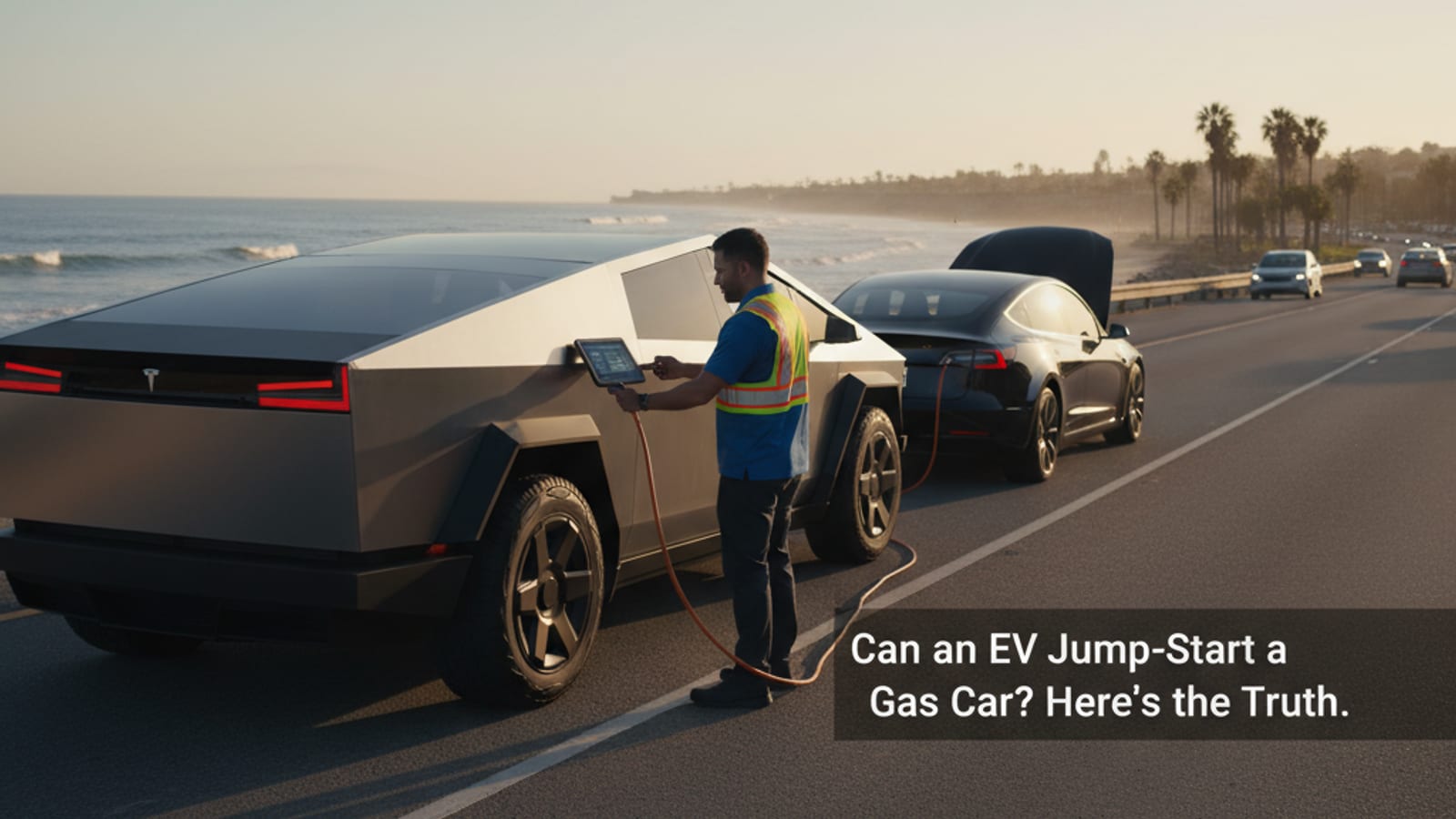
A gas car dies on I-880 through Hayward or I-80 near Richmond. Someone in a Tesla or another EV pulls over. The same scene shows up on US-101 through San Mateo. That instinct is kind, and it’s still the wrong tool. Now two cars sit in the same live lane.
The pack you see isn’t the battery that jumps
An EV keeps two electrical systems on board. The high-voltage pack moves the wheels, and a smaller 12V runs lights, locks, and screens. It also runs the computers that wake the pack. Jump cables only ever see that 12V system.
In a gas car, the 12V battery cranks a starter motor, then the alternator takes over. In an EV, the 12V doesn’t crank an engine. It only boots the computers and relays. A DC-DC converter later tops it up from the main pack. That happens while the EV is on or charging.
That’s why a full Tesla on a San Francisco street can still refuse to wake. The pack can be fine while the 12V is empty. That’s the job behind a Tesla 12V jump, not a reason to use your car as a donor.
What a gas starter actually asks for
A jump doesn’t power the engine for long. It only feeds the dead 12V so the starter can spin. That first pull can demand a huge current burst. A healthy gas-car battery is built for that hit. An EV’s 12V usually isn’t.
Many EVs still use a compact lead-acid 12V. Newer Teslas and some other brands use a lithium 12V. Lithium units in that role are lighter. They cut off faster under a hard load. A starter-size draw can sag, trip, or damage either chemistry.
Tesla’s published owner guidance generally says not to jump other cars from a Tesla.
NHTSA still treats jump-starting as a high-caution job on any vehicle. Clamp positive to positive. Put the negative on a ground away from the dead battery. A reverse clamp can spark or fry electronics. Those steps don’t make an EV a safe donor.
Two cars on a Bay Area shoulder is the real risk
California Vehicle Code 21718 already limits freeway stopping. A disabled vehicle is one of the narrow exceptions. You’ve got to have summoned another vehicle to assist. The code doesn’t invite a second car to sit there with the hood up.
CVC 22651(f) allows a tow after four hours on a full-access-control freeway. If the driver can’t move it under its own power, that clock applies.
The Bay Area Freeway Service Patrol is built for a dead gas battery. MTC, CHP, and Caltrans run it as a partnership. Private tow companies cover assigned freeway beats. Hours are Monday through Friday, 6 to 10 AM and 3 to 7 PM. Dial 511 and say “Freeway Assist,” or use a call box. FSP publishes a free gallon of gas, jump-starts, and radiator refills. MTC’s page doesn’t mention electric vehicles or an empty traction pack. So FSP can often wake the gas car. It isn’t the plan for your EV if you drain your own 12V.
Outside those hours, the CHP Rotation Tow Program assigns a vendor. You don’t pick the truck. Caltrans District 4 covers the nine Bay Area counties.
Express lanes run on I-80, I-580, I-680, I-880, US-101, and SR-237. A stall there still puts you in moving traffic. No published disabled-vehicle policy turned up for the state-owned bridges. That includes the Bay Bridge and the San Mateo-Hayward Bridge. Don’t treat a bridge shoulder as a workshop.
A Coastside stall on SR-1 through Pacifica differs from I-680 in San Ramon. Inland heat makes a weak 12V a worse spare power bank. Livermore’s July normal high is 89.7F on the 1961-1990 NWS normals. Antioch sits at 90.4F, and San Jose sits around 82F. San Francisco’s July normal high is 71.5F. A hot I-580 or SR-4 shoulder is a poor place for two dead electrical systems.
Jumping an EV is a different job
Using your EV as a donor is the risk, not a favor. Getting your own EV jumped is a different, narrower task. That work happens only on the 12V, with the right posts. Read how to jump-start an EV on the 12V only before you clamp anything. Can roadside help jump-start an EV covers what a typical truck actually does.
If the gas car is dead, let FSP or a conventional jump handle it. If your EV won’t wake, that’s a 12V or pack problem. Don’t solve it by becoming the donor. Why you shouldn’t jump a gas car with a Tesla covers the Tesla-specific version.
Charge Pro SF is a referral line. It matches stranded EV drivers with independent local mobile rescue operators. It doesn’t send its own trucks. The operator quotes you before work starts and bills you directly. The pros we connect you with can jump or replace a dead 12V on site. They can also bring a 240V Level 2 source to the car. That’s a native NACS plug, or a CCS or J1772 adapter. That charge typically adds 10 to 20 miles of range in 15 to 30 minutes of charging time. That’s charging time, not when someone arrives.
For a dead EV on the freeway, start with what to do when you run out of charge on a Bay Area freeway. For broader help, see EV roadside assistance.
Stay with the dead car only as the Vehicle Code allows. Call 511 for FSP if it’s a gas battery during patrol hours. If it’s your EV, don’t turn it into a jumper pack. Call (415) 630-6268 and get a quote from a local operator who works on EVs.