You parked a BMW i5 in a BART garage for the workday. You come back and the car won’t wake. The iDrive stays dark, and the handles ignore the fob. That’s almost always a dead 12V battery, not an empty drive pack. The high-voltage pack can still hold plenty of range. The 12V is what boots every computer in the car. Without it, a BMW i5 won’t start, and neither will an i7.
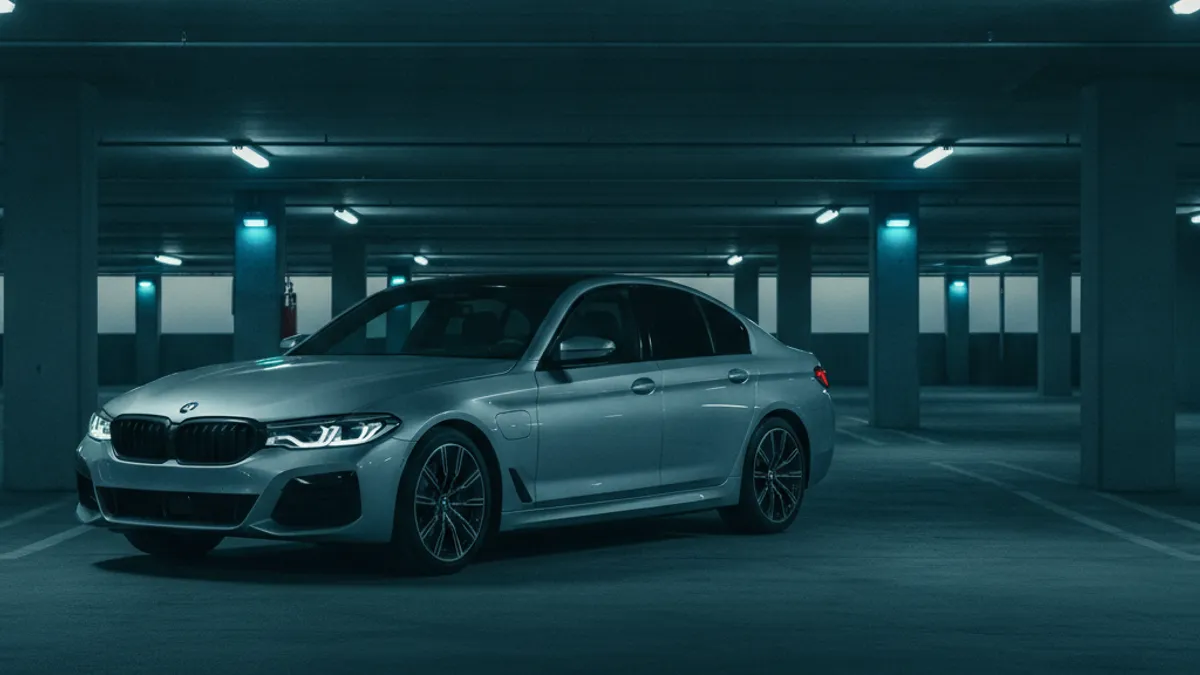
The i5 (G60) and the i7 (G70) share one 12V layout. They fail the same way after a long sit. A park-and-ride stall in Fremont or Lafayette is a typical stage for it. The body looks fine from the aisle, but Ready never comes on.
A long BART sit hits the 12V first
These cars keep drawing 12V the whole time they sit. The i7 is harder on that battery at rest. Powered door latches, the rear screen, the modem, and the alarm all sip power. The i5 carries a smaller version of that load. Hours in a garage are enough when the 12V is already tired.
You didn’t need an empty pack for this. You needed a weak 12V and a long wait. BART lists Level 2 charging at Warm Springs / South Fremont, with 42 plugs. Lafayette’s BART lot lists 4 Level 2 plugs. Those posts only help a car that can still wake. A dark i5 can’t close the contactors or start a charge session. The plug in the next stall doesn’t revive a dead 12V.
If the dash is black, skip hunting for a DC fast charger. Start with the 12V auxiliary battery instead. What happens when an EV 12V dies is the same cascade on any brand. BMW just tucked the battery behind trunk trim.
How to tell the pack isn’t the problem
Treat a black-screen no-start as a 12V fault until you prove otherwise. The 12V runs the computers that close the high-voltage contactors. It also lets you shift out of park. When voltage falls too far, nothing in the car answers. Miles of range left don’t change any of that.
Two other stories look the same from the driver’s seat. The car sat long enough to flatten a marginal 12V. Or the 12V is worn and finally collapsed under load. You still get a silent cabin, and a jump can wake it once. A worn battery will drop you again within days.
If the car does wake and shows zero miles, that’s the pack. Then you want a non-Tesla EV rescue, not only a 12V jump. From the aisle of a BART garage, those two failures look alike. The screen is the tell: no screen means 12V. A living screen with no range means the pack.
What the replace-battery message actually means
BMW isn’t talking about the high-voltage drive battery. The usual wording is “increased battery discharge when stationary, continued driving possible, replace battery.” That banner is the 12V auxiliary battery, not the pack. The car no longer trusts it to hold a park.
“Continued driving possible” is true while you’re moving. The high-voltage system tops up the 12V as you drive. Parking is the trap, not the drive itself. Overnight drain can leave you with no iDrive the next morning. Finish the trip, then replace the 12V before you park overnight again. Don’t treat the banner as extra dashboard clutter.
Once the car has already gone dark, that warning is why you’re stuck. The same family of warning shows up on the BMW i4. The 12V path on that car is the same.
A weak AGM can still start on a cool San Francisco morning. It can quit after a stretch of inland heat. Livermore’s 1961-1990 July average max is 89.7F, and Antioch’s is 90.4F. San Francisco’s July average max is 71.5F. San Jose sits near 82F in July. That inland gap is real, and heat is hard on a tired 12V.
The 12V is in the trunk, the jump posts are not
BMW put the 12V AGM in the rear on both the i5 and the i7. It sits in the luggage compartment behind a trim panel. People pop the hood, see no battery, and freeze. You often don’t need to touch that rear battery to wake the car.
The trunk release is electronic, so a dead 12V can ignore the fob. It can ignore the interior trunk switch too. Use the metal key blade hidden in the fob. Open the driver’s door with that blade. Fold the rear seat if you must reach the battery from the cabin.
Most drivers shouldn’t dig into the trunk in a crowded garage. BMW put jump posts under the hood for this exact failure. Use the underhood posts before you strip trunk trim.
Jump from the red post under the hood
The hood release inside the cabin is mechanical and works with zero 12V. Pull it, then go to the engine bay. Look for a red cap near the strut tower or the fuse box. That’s the positive jump post, and ground is unpainted metal on the chassis.
Connect a jump pack to the red post first. Then clamp the negative lead to chassis ground. If you use another car, keep the same order. Wait two to three minutes, then try to wake the i5 or i7. Give iDrive another 30 to 45 seconds after the 12V returns.
You’re only feeding the 12V system with this jump. Don’t try to jump the high-voltage pack. Read the guide to jump starting an EV on the 12V.
Stand close with the fob before you reach for cables. Passive entry can fade before the battery is fully dead. A few inches from the handle sometimes still unlocks. If it doesn’t, the key blade needs no power at all.
Signs your 12V is already failing
The i7 loads the 12V harder at rest. Theater glass, executive seats, and powered door latches all add draw. The i5 is milder, but it isn’t immune.
| What you see | What it usually means |
|---|---|
| No iDrive, no chime, cabin stays dead | 12V is flat |
| Fob still unlocks, Ready never appears | 12V is too low to boot |
| Powered door latches and handles quit | Voltage fell under the threshold |
| Random warnings, then a shutdown | 12V is sagging under load |
| It starts, then dies again in seconds | 12V can’t hold a load |
Two deaths in a few months means replacement, not another jump. BMW wants the new AGM registered to the VIN. That takes ISTA or a compatible tool. Skip registration and the car may not charge the new battery right. EV 12V battery replacement signs walks the pattern across brands. We’re not publishing a parts price on this page. Ask the shop for a current quote before you pay.
Bay Area patterns that strand an i5 or i7
The commute garage is the first pattern on these cars. An i5 or i7 sits at BART while you ride. Dublin sits on the BART line and the I-580 junction. Warm Springs / South Fremont is a major South Bay park-and-ride. Lafayette is the smaller East Bay lot with four Level 2 plugs. Hours of standby current plus a tired 12V is enough. You return to a car that looks locked and lifeless.
Peninsula riders see the same sit in Daly City, San Bruno, and Millbrae. Those cities run on PG&E wires with Peninsula Clean Energy for generation. They don’t wake a car that’s already dark in the station garage. Mountain View, Sunnyvale, and Cupertino sit in Silicon Valley Clean Energy territory. The same limit applies there, because the CCA can’t jump a 12V.
The second pattern is a long trip away from the car. Leave the i7 in a driveway or an airport-area garage for a week. The modem and alarm keep sipping current the whole time. SFO publishes an EV charging page at flysfo.com/parking/electric-vehicle-charging. We couldn’t confirm stall counts or hours from a readable copy of that page. Check the airport site yourself before you count on a post. A post still won’t start a charge if the 12V is dead. No airport page we read covers a 12V that won’t wake.
San Francisco’s ACS 2019-2023 population count is 836,321. About 77.2% of its housing predates 1980. Daly City’s pre-1980 share is 78.7%, and San Bruno’s is 81.9%. Berkeley is 80.8% pre-1980, and Oakland is 77.9%. That older stock means a lot of tight garages and street parking. A dark i7 in a cramped stall is a poor place to work. Powered door latches and the powered tailgate won’t help you.
If you’re in Cupertino, Palo Alto, Lafayette, or Danville, the failure mode doesn’t change. The 12V still boots the car, and the pack still doesn’t. Concord and Walnut Creek see the same sit after an SR-24 commute. EV roadside help in Lafayette covers the Caldecott climb side. Fremont covers the Warm Springs park-and-ride end.
Freeway rules if you leave the garage dead
A garage stall is frustrating, but a freeway shoulder is a legal clock. California Vehicle Code 21718 bars stopping on a freeway except in narrow cases. A disabled car waiting for summoned help is one of those cases. Code 22651(f) lets a vehicle be removed after more than four hours. That applies on a full-access-control freeway if it can’t move under its own power. Don’t sit there hoping it will reboot.
The Freeway Service Patrol is an MTC, CHP, and Caltrans partnership. Private tow firms run dedicated beats on those freeways. Hours are Monday to Friday, 6 to 10 AM and 3 to 7 PM, per 511.org. Dial 511 and say “Freeway Assist,” or use a call box. FSP lists a free gallon of gas, jump-starts, and radiator refills. The MTC page doesn’t mention electric vehicles or out-of-charge recovery. A 12V jump sits inside their published jump-start work. An empty pack isn’t on that list. Confirm with the driver what they can actually do.
Outside those hours, CHP’s Rotation Tow Program assigns the truck. You don’t pick the company they send. Caltrans District 4 covers the nine Bay Area counties on QuickMap. None of that replaces a planned 12V replacement. It only keeps you off I-680 or SR-24 past the four-hour mark.
What to do in the garage, in order
Try the fob against the handle, then the key blade in the driver’s door. Then pull the mechanical hood release and find the red jump post. If you have a pack, wait those two to three minutes. If you don’t have one, stop forcing the car.
Charge Pro SF is a referral line, and we don’t own trucks. We connect you with independent operators who work on BMW EVs. The operator can jump the 12V on site. They can replace a dead 12V when that’s the right call. If the pack is the real problem, they bring a 240V Level 2 source. Use NACS native, or a CCS or J1772 adapter on other EVs. Typical add is 10 to 20 miles in 15 to 30 minutes of charging. That is charge time, not a promise of when someone arrives.
The operator quotes you before they start, and they bill you directly. If the 12V won’t hold a charge, don’t keep driving it around the block. That’s how you end up on a shoulder under CVC 22651(f).
Frequently asked questions
Why won’t my BMW i5 start if the drive battery is charged?
The pack you watch on the range display isn’t what boots the car. The 12V auxiliary battery is what powers the computers. Those computers close the contactors to the high-voltage pack. If the 12V is dead, the i5 stays dark even at 80 percent. The i7 fails the same way if the 12V is dead. A 12V jump is the usual way to revive it.
Can I keep driving with the replace-battery message?
For the rest of that drive, you can. The car can keep the 12V up while you’re moving. Don’t park for the night and assume it will wake. A weak 12V can go flat sitting still. Finish what you’re doing, then replace the AGM. Have the new battery registered to the VIN.
Where is the 12V in a BMW i7, and how do I jump it?
The AGM sits in the rear luggage area behind trim on both cars. Don’t start there if you only need a jump. Pull the mechanical hood release and go to the engine bay. Positive clamp first, then the chassis ground. Wait two to three minutes before you wake the car. Let iDrive finish booting before you shift.
Call Charge Pro SF at (415) 630-6268 if the car is still dark. We’ll connect you with a local operator who can jump or replace the 12V. They’ll quote before they start any work.