The Audi Q4 e-tron 12V battery can leave a campus car fully dark. The traction pack may still have range. The MMI stays black. The flush handles never pop. The fob goes quiet. That pattern is the 12V, not a pack at zero.
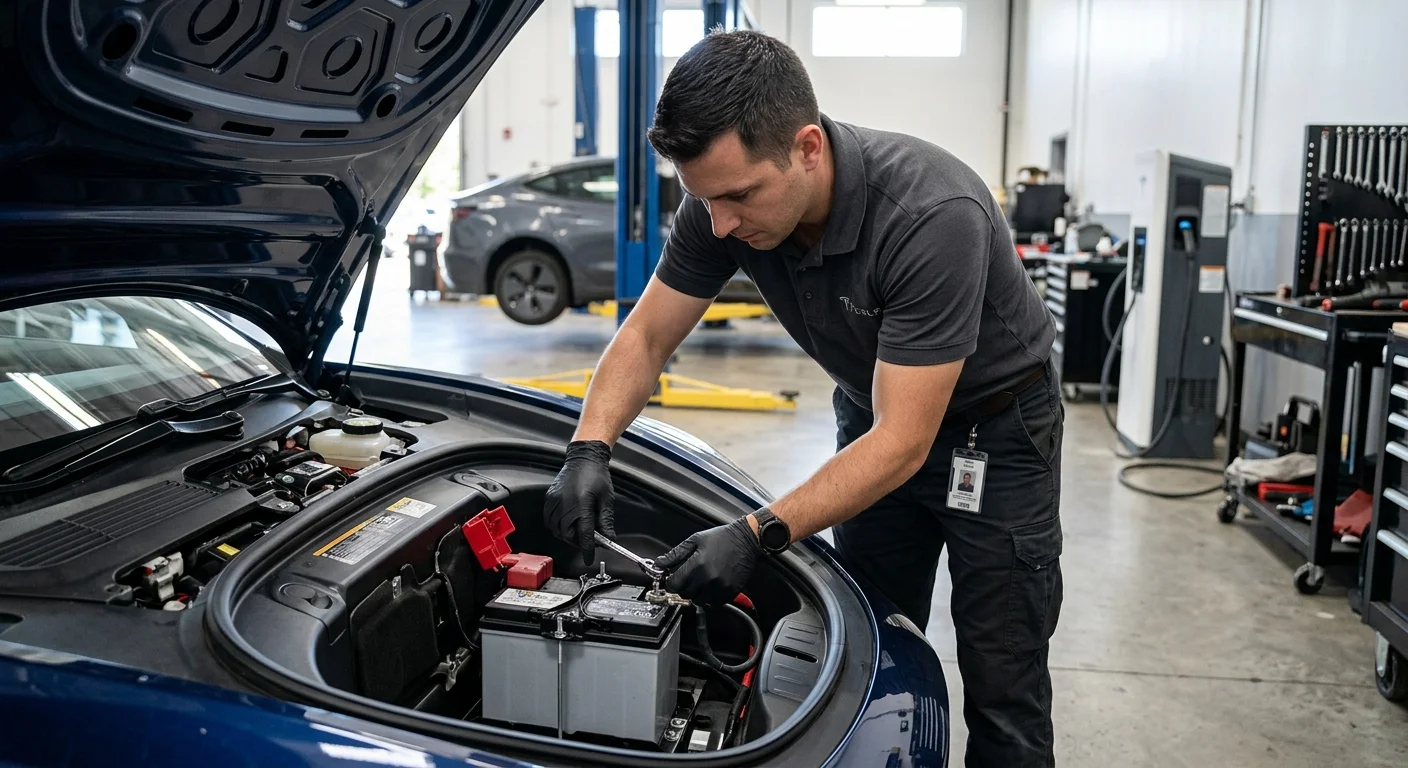
Silicon Valley Q4s sit all day, then they won’t wake
Mountain View, Sunnyvale, Palo Alto, and Santa Clara fill with EVs before standup. The Q4 often sits until the evening 101 crawl. While it waits, low-voltage modules stay alive. Telematics keep a heartbeat. The connectivity stack doesn’t fully sleep. The 12V AGM battery is what pays for that idle.
This isn’t a mystery unique to Audi. It’s the MEB platform. The Q4 e-tron and Q4 Sportback e-tron sit on it. The older e-tron SUV doesn’t. The Q8 e-tron doesn’t. The e-tron GT doesn’t. Jump points follow the platform, not the e-tron name. Check the badge first.
The VW ID.4 uses the same bones. A dead 12V keeps the high-voltage contactors open. The traction battery can’t feed the motors. You have a charged pack and a car that won’t roll. Read the broader stall pattern in what happens when an EV 12-volt battery dies. The ID.4 version lives in VW ID.4 12V failures.
Older Peninsula housing, then a campus stall
Palo Alto’s ACS 2019-2023 count is 67,231 people. About 70.6% of its housing was built before 1980. Mountain View is 82,363 people, with 62.0% pre-1980. Sunnyvale is 153,455, at 58.6%. Santa Clara is 129,239, at 59.9%. Census treats that pre-1980 share as older housing, often with tighter panels. This page can’t see your garage. It can’t confirm whether your building has an EV circuit. Many Q4s still spend the workday unplugged in a campus stall.
Cupertino adds another 58,886 people on the west side of that commute. Menlo Park, just up the Peninsula, has 32,775. A Q4 that lives in Menlo Park and works in Palo Alto can sit twice in one day. Long sits drain the 12V. Short hops between sites may not put much back.
South Bay heat isn’t the coast’s weather. San Jose’s July normal high is about 82F, from 1961-1990 NWS normals via WRCC. San Francisco’s July figure is 71.5F. Livermore’s July normal is 89.7F. A closed cabin on a Santa Clara or San Jose lot runs warmer than a foggy Peninsula morning. The research doesn’t publish a 12V failure rate by temperature. Treat the heat as local context. Don’t treat it as a statistic.
Generation providers differ by city, and they don’t jump a dead battery. Mountain View, Sunnyvale, and Cupertino sit with Silicon Valley Clean Energy. Santa Clara is on Silicon Valley Power, a municipal utility with no CCA. Palo Alto runs City of Palo Alto Utilities. Menlo Park is Peninsula Clean Energy over PG&E wires. San Jose has San Jose Clean Energy. Confirm any home rate or rebate with that provider. Don’t use this page as bill advice.
What a dead Q4 12V looks like from the driver’s seat
The instrument cluster is black. The MMI never boots. There’s no splash screen. A crashed infotainment system still has power. A dead 12V doesn’t.
Door handles stay flush. They’re electric actuators. No 12V means they never extend. The door looks blank. New owners often think the handle snapped off.
The key fob doesn’t unlock the car. The fob still transmits. The car’s receiver needs 12V to listen. The myAudi app fails the same way.
Some cars showed a 12V charge-low message first. Others showed a start-system fault. If that warning is on the screen now, get the battery tested before the car goes fully dark.
Get in, then jump the front terminals, not the trunk
The 12V AGM battery sits under the trunk floor on the right, under trim. You don’t jump it there. You don’t strip that interior in a campus lot.
Audi routes remote jump terminals to the front for this exact stall.
If the handles won’t extend, use the metal key blade inside the fob. A release on the back of the fob frees the blade. The driver’s handle has a small cover on the lower edge of the recess. Open it. Turn the blade. The door unlocks.
Inside, pull the hood release under the dash on the left. Raise the hood and set the prop.
On the driver’s side near the windshield, look for a red cap. That’s the positive jump post, usually by the brake-fluid reservoir. The negative is a bare metal bolt or a marked ground strap on the same side. Those are the only points you clamp. Leave the trunk battery covered.
The ID.4 puts its remote terminals on the passenger side near washer fluid. The Q4 doesn’t. If you jump from an ID.4 diagram, you’re on the wrong side of the car.
See how you jump start an electric car for the general method.
The jump sequence that actually wakes the Q4
Use a donor vehicle or an operator who already knows MEB jump points.
- Clamp red to the donor positive.
- Clamp the other red lead to the Q4’s red-capped positive.
- Clamp black to the donor negative.
- Clamp the other black lead to the Q4 ground point, not the battery case.
- Let the donor idle about ten minutes before you try the Audi.
- When the MMI wakes, disconnect in reverse order.
Handles should extend. The cluster should light. A jump is a wake-up, not a repair. Drive to a shop that can load-test the 12V. Plan on replacement if it fails the test. Cars that only get jumped often go dark again. That loop is in EV battery dies again after a jump.
Charge Pro SF doesn’t do this work. It’s a referral line. It matches stranded EV drivers with independent local mobile rescue operators. It owns no trucks. It employs no technicians. It holds no license. The operator quotes before starting and bills you directly. The pros we connect you with jump a dead 12V on site. They can also replace one on site when that’s the right call.
If the traction pack is low too, ask for a charge as well. Operators bring a 240V Level 2 source to the car. For a non-Tesla they use a CCS or J1772 adapter. That charge typically adds 10 to 20 miles of range in 15 to 30 minutes of charging. That clock is charging time. It isn’t an arrival time. Confirm the plug with the operator before they leave.
Non-Tesla EV rescue is the service page for a Q4. For a Mountain View campus stall, see EV roadside help in Mountain View. Sunnyvale drivers can start from the Sunnyvale city page.
If the car dies on 237, 101, or a lot aisle
SR-237, US-101, and I-880 carry a lot of that campus commute. Express lanes run on SR-237 and US-101. FasTrak is required there. Hours are generally 5 AM to 8 PM weekdays, per regional FasTrak notes read 2026-09-18. If the Q4 dies, get out of live traffic. The research didn’t confirm that those express lanes sit in the median. Don’t assume a left-shoulder pull is the rule. Use a real shoulder if you have one.
California Vehicle Code 21718 bars stopping on a freeway except in limited cases. A vehicle so disabled that stopping is unavoidable, with help already summoned, is one of those cases. California Vehicle Code 22651(f) covers a later risk. A car can be removed after more than four hours on a full-access-control freeway. That applies when it can’t move under its own power. Don’t sit that clock out on 237.
The Freeway Service Patrol is a partnership of MTC, CHP, and Caltrans. Hours are Monday to Friday, 6 to 10 AM and 3 to 7 PM, from 511.org. Dial 511 and say “Freeway Assist,” or use a call box. FSP lists jump-starts, a free gallon of gas, and radiator refills. The MTC page also notes more than 100,000 incidents a year. That same MTC page, read 2026-09-18, doesn’t mention electric vehicles or out-of-charge help. A jump-start may be on the menu. An MEB remote-terminal jump may not be what the truck is set up to do. Ask before anyone clamps a cable.
Outside FSP hours, CHP’s Rotation Tow Program assigns the tow. You don’t pick the company. Caltrans District 4 covers the nine Bay Area counties. 511 SF Bay is the regional traveler line.
A campus garage isn’t a freeway. Private-property tows follow CVC 22658 when a proper sign is posted. The sign has to be at least 17 by 22 inches, with lettering at least one inch. California doesn’t cap ordinary consensual tow rates statewide. Confirm the quote before a hook goes on. This page doesn’t publish a rate for that.
San Jose Clean Energy and Silicon Valley Power won’t send a truck to a dead Q4. Neither will City of Palo Alto Utilities. Those agencies set power programs. They don’t do roadside 12V work.
After it wakes, skip another long unused sit
Get the 12V tested as soon as the car will roll. Replace it if it fails. Plug in at home when you have a cord. Owners on this platform often keep the 12V healthier by charging the car, not by letting it sit. Confirm that in your owner’s manual for your year. If the manual is silent, ask the shop. This site couldn’t confirm a public Audi campaign, TSB, or software update tied to Q4 12V drain. Ask Audi or a dealer about your VIN. Don’t install a rumor.
Fremont, Newark, and Milpitas sit on the East Bay edge of that same job market. Fremont’s ACS count is 228,518. Milpitas is 78,216. A Q4 that crosses the Dumbarton or the San Mateo-Hayward Bridge is still an MEB car. It can still die in a lot on the other side. Westbound is the tolled direction on those two spans, per bayareafastrak.org. Cash ended in March 2020. That fact doesn’t jump a 12V. It only tells you the commute those cars actually run.
If you can’t jump it from a donor car, call (415) 630-6268. We’ll connect you with a local operator. That number isn’t a promise of when they arrive. The operator quotes the job first.
Frequently asked questions
How do you jump an Audi Q4 e-tron 12V battery?
Use the metal key blade if the handles stay in. Open the hood. Jump the red-capped positive on the driver’s side near the brake reservoir, plus the nearby ground. Skip the trunk battery. Let the donor idle about ten minutes, then wake the Audi. Disconnect in reverse. Have the 12V tested at a shop.
Why won’t the Q4 door handles extend?
They’re electric flush handles. A dead 12V leaves them flush, so the door looks blank. The fob blade still opens the driver’s door through the slot in the handle recess.
Is the Q4 e-tron 12V issue the same as the ID.4?
They share the MEB platform and an AGM 12V under the right trunk floor. The stall looks the same. Jump terminals aren’t on the same side. Audi is driver’s side. VW is passenger’s side.