Jumping a gas car with a Tesla is a bad idea for both cars. The Tesla’s 12V rail is not designed to deliver the cold-cranking amps a gas engine needs to turn over. The gas car’s alternator can spike the Tesla’s 12V rail back. Either direction risks a voltage spike or a current surge that damages the body control module on either car. A driver who tries this on a Bay Area street often ends up with two disabled cars instead of one.
The right tool is a dedicated lithium jump pack. The NOCO GB40 and similar packs are rated for the cold-cranking amps a gas engine needs and the controlled voltage a Tesla body control module expects. Both cars get the right tool, and neither car ends up with a damaged 12V rail.
This post walks through why the cross-jump fails, what the right alternative is, and what to do when both cars are dead.
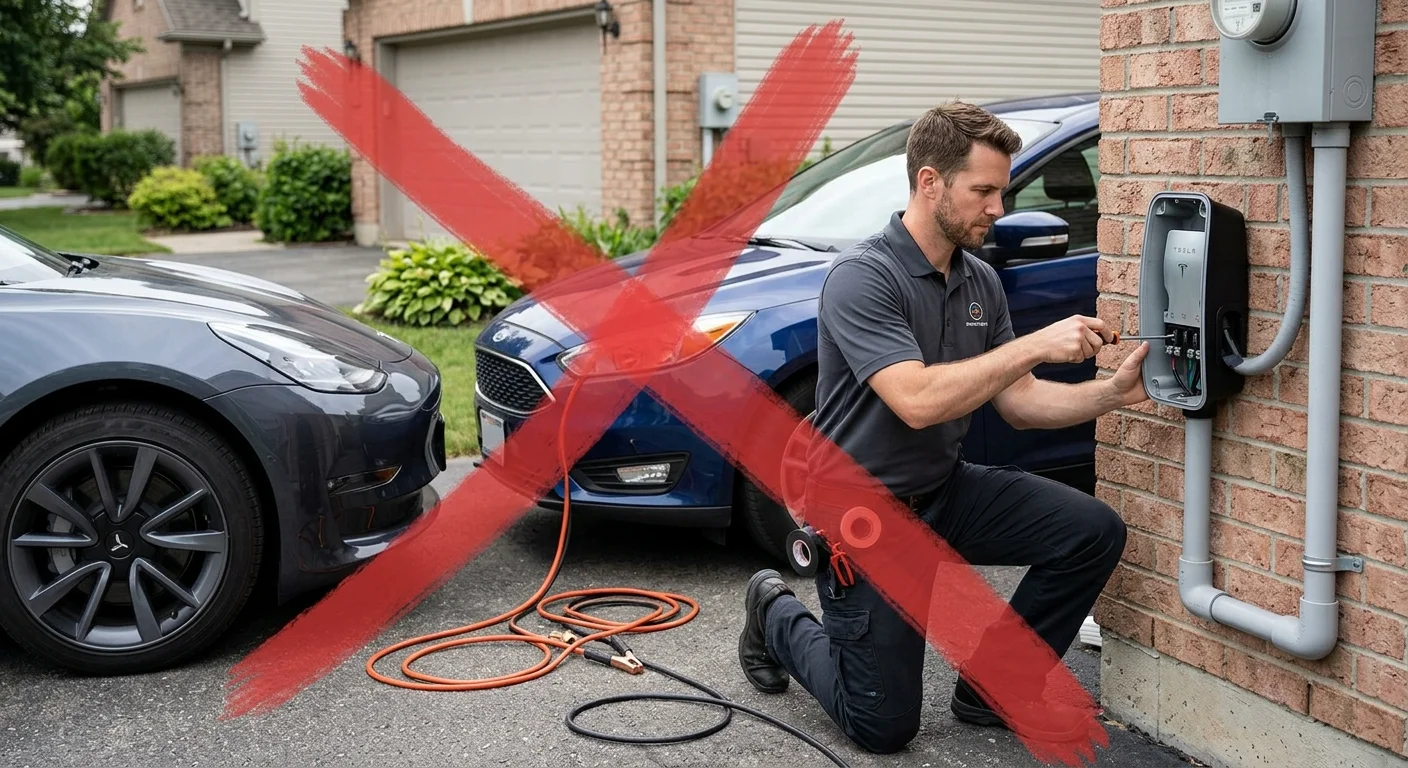
What jumping actually does to a 12V rail
A gas car alternator puts out 13.8 to 14.8 volts under normal operation. The voltage can spike higher momentarily under load changes. A running gas car with the cables connected to a dead Tesla will push that voltage into the Tesla 12V rail through the jumper cables.
The Tesla body control module runs on tightly regulated 12V. A spike above 15 volts can damage the DC-DC converter, the body control module, or the infotainment. The repair bills start in the four-figure range.
The reverse direction is worse. A Tesla 12V rail is not designed to deliver the 200 to 600 amps a gas engine needs to crank. The Tesla battery management system will see the load as a fault and shut down. The gas car does not start, and the Tesla is now in a fault state.
Either way, both cars end up worse than before the jump attempt.
Why people try this anyway
Three situations push drivers to try a cross-jump.
The gas car is dead and no other help is around. A driver on a San Francisco side street with a dead battery may not have a working gas car nearby. The Tesla parked next to them looks like a candidate.
The Tesla driver thinks of the 12V as a regular battery. The Tesla 12V is small and the temptation is to treat it like a 12V battery on any other car. It is not. The Tesla 12V is a wake signal, not a cranking battery.
A bystander is helping. The good-Samaritan instinct pushes a bystander to grab cables and connect. The bystander may not know the Tesla 12V is not a cranking source.
In each case, the right answer is a dedicated jump pack. The pack is portable, charges off any USB outlet, and delivers the right voltage and amperage for both kinds of car.
The right tool to keep in the Tesla
A lithium jump pack rated for 1000A peak is the right tool to keep in the Tesla frunk. The NOCO GB40 is the working standard. It weighs a few pounds, fits in the cargo net, and charges off any USB outlet.
The pack is rated for both EV 12V wake-ups and gas engine cold cranks. A driver who keeps the pack in the Tesla can help a gas car without risk to either vehicle. The voltage is regulated, the polarity is protected, and the pack shuts down on a fault.
Charge the pack every 90 days. A pack that sits for six months at 30 percent state of charge may not deliver full amps when you need it.
What to do when both cars are dead
The two-car failure is the worst case. A driver tried a cross-jump, both cars are now in fault state, and neither will start. The recovery is two separate service calls.
Call Charge Pro SF at (415) 630-6268 for the Tesla. The operator arrives with a lithium jump pack, wakes the 12V, and gets the Tesla moving again. If the body control module took a spike, the operator can quote a 12V replacement on site or a flatbed tow to a Tesla-friendly service center.
For the gas car, call a roadside service that handles gas cars. AAA, a tow operator, or a mobile mechanic. The gas car 12V is a standard flooded or AGM battery that any jump pack can wake.
What Tesla’s manual actually says
Tesla’s manual warns against using the 12V to jump another vehicle. The warning is in the jump-start section of every Tesla model year. The language is similar across models: do not connect a Tesla 12V to another vehicle’s 12V. The risk is bidirectional.
The Tesla manual also warns against jumping from a running gas car. The same spike risk applies in reverse. Both directions of cross-jump are off the table.
The right tool per Tesla’s manual is a lithium jump pack. The pack connects to the Tesla front pigtails or to the 12V posts under the hood on newer model years. The pack wakes the 12V without risk to either car.
Where Bay Area drivers hit this
Street parking in San Francisco. The Sunset, the Richmond, and the Marina all see street-parked cars of every brand. A dead gas car on the block is a regular occurrence. A bystander with a Tesla and jumper cables is the wrong answer.
Long SFO sits in San Bruno and Millbrae. Travelers leave gas cars and Teslas in long-term parking. A weak gas car battery can fail to start after a long trip. The Tesla parked next to it looks like a candidate.
Garage parking in Oakland and Berkeley. Multi-level garages see dead gas car batteries more often than single-family garages. The same cross-jump temptation applies.
Each of these is the same fix. A lithium jump pack per car, not cables between cars.
The exception
A modern gas car with start-stop technology often has a smaller 12V battery that does not need 600 cold-cranking amps. A Tesla 12V can sometimes wake that battery without risk to either car. The car with the smaller battery starts, and the Tesla 12V is not stressed.
The exception is not the rule. Without knowing the gas car’s battery spec, do not cross-jump. Use a lithium pack.
FAQ
Can I jump a gas car from my Tesla?
Tesla’s manual warns against this. The risk is bidirectional: voltage spikes from a gas alternator can damage the Tesla 12V rail, and the Tesla 12V is not designed to crank a gas engine.
What tool should I use instead?
A dedicated lithium jump pack. The NOCO GB40 and similar are rated for both EV 12V wake-ups and gas engine cold cranks.
What if both cars are dead?
Call a local operator for the Tesla and a separate service for the gas car. The pros we connect you with are licensed and insured.
Will my Tesla warranty cover damage from a cross-jump?
Cross-jump damage is user error in most cases. Confirm current terms with Tesla at the time of the call.
Can I jump my Tesla from another Tesla?
Use a lithium jump pack, not another Tesla’s 12V. The same bidirectional risk applies.
Call (415) 630-6268 when the Tesla 12V is dead and you need a wake-up. The operator arrives with a lithium jump pack and quotes before any cable goes on. Nobody on this line promises an arrival clock.