A VW ID.4 that won’t start is almost always a failing 12V auxiliary battery, not the main traction pack. That small lead-acid battery powers the low-voltage electronics that wake the car up. Once it dips below the voltage the contactors need, the traction battery stays locked out even with a full charge on the dash.
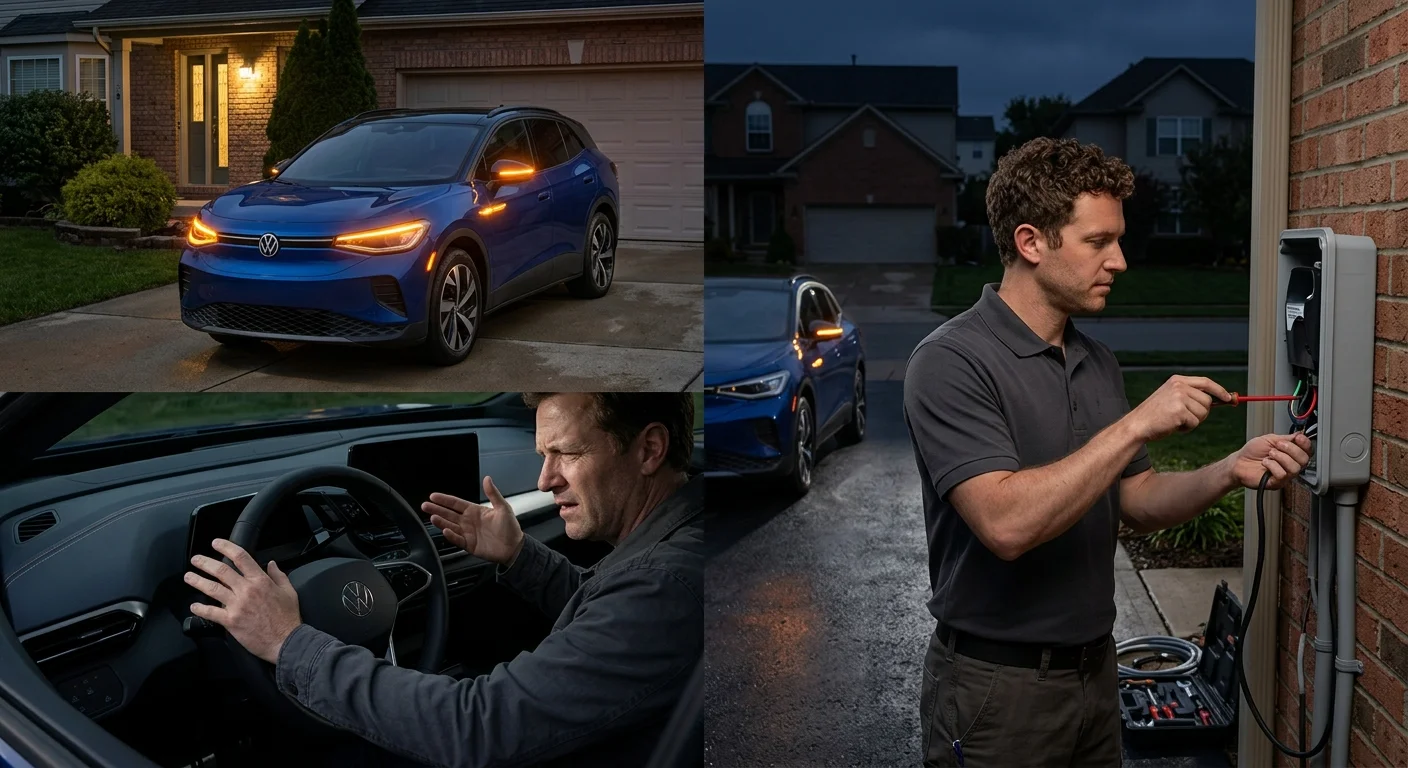
ID.4 owners hit this early and often, especially on cars that sit outside on Bay Area streets or in apartment parking. The 12V is small for the load it carries, and VW’s software updates have softened the problem without fully solving it.
Why the ID.4’s 12V is the weak link
The ID.4’s 12V runs the infotainment, door locks, power windows, headlights, and the contactors that close to connect the high-voltage pack to the drive system. That last job is the one that strands you. If the 12V drops, the contactors stay open, and the main battery can’t push current to the motors. The car goes dark. The fob stops unlocking. The screen won’t wake. To the driver, it looks like a dead EV, but the traction pack is fine.
The 12V also keeps drawing current while the car is parked. Background systems, the alarm, keyless entry standby, and battery management all sip from it. A battery that’s already undersized can drop below the boot threshold in a week or two of sitting. Add Bay Area heat in places like Concord, Walnut Creek, or Livermore, where garages run warm much of the year, and the wear shows up faster than owners expect.
Warning messages to watch for before you’re stranded
The ID.4 usually tries to warn you before the 12V gives up. Watch for these messages on the cluster or infotainment screen:
- “12V Battery Low”
- “Electrical System Fault”
- “12V System Malfunction”
- “Stop Safely Now” combined with other electrical warnings
Beyond the messages, the symptoms often show up first as small annoyances. The infotainment screen boots slowly or glitches. Power windows move sluggishly. Door locks hesitate or fail to respond. The car might even drop into Park on its own while stationary. None of these are good signs on a battery that’s already small for its job.
What happens when the 12V fully fails
A complete 12V failure looks like this from the driver’s seat: the dashboard is dark, the fob won’t unlock the doors, the windows won’t drop, and the car won’t shift into Drive. The traction battery is fully charged but inaccessible. Every system that needs low-voltage power is dead.
This is also when lockout becomes a real risk. If the mechanical key blade stored in the fob doesn’t open the driver’s door manually, you can’t get to the hood release, can’t pop the frunk, and can’t reach the 12V. Street parking in San Francisco or Berkeley often means just that: a car with no easy physical entry and no jump points you can reach without first getting in. Understanding what happens when an EV’s 12V battery dies is the first step in recognizing the lockout risk before it happens.
How to safely access the battery for a jump start
The 12V battery isn’t directly accessible in most ID.4 configurations. VW put remote jump-start terminals under the hood for this reason. You’ll find a red cap over the positive (+) terminal on the passenger side of the engine bay, near the windshield washer reservoir, and a clearly marked metal ground point next to it for the negative clamp.
To get to those terminals when the fob is dead:
- Use the physical key blade hidden in the fob to manually unlock the driver’s door.
- Pull the hood release latch inside the car, usually in the driver’s footwell.
- Lift the hood and locate the red cap and ground point on the passenger side.
Once you’re in, jump the ID.4 the way you’d jump any car with remote terminals:
- Connect the red clamp from your jump source to the ID.4’s positive post.
- Connect the black clamp to the donor’s negative terminal, and the other black clamp to the ID.4’s designated ground point. Do not connect directly to the 12V battery’s negative terminal if you can see it.
- Let the donor run five to ten minutes so the ID.4’s 12V picks up enough charge.
- Try to power the car on with your foot on the brake.
- Disconnect in reverse order once the dashboard wakes.
A jump start is a temporary fix. The underlying battery still needs replacing if it’s failing. VW requires the new 12V to be coded to the vehicle, so this is a service-bay job, not a driveway job.
What a mobile 12V jump looks like in the Bay Area
If your ID.4 won’t start in a downtown San Francisco garage, at a curb in Oakland, or in an apartment lot in San Jose, a mobile operator with the right jump pack and ID.4 know-how can wake the car on site. Charge Pro SF matches stranded EV drivers with independent local operators across the Bay Area, and the operator prices the job before they start.
The pros we connect you with carry 12V jump packs sized for EV low-voltage systems, so they can wake a dead ID.4 without risking a voltage spike that damages the car’s electronics. If the car wakes and stays awake, you can drive it to a service bay for a real 12V replacement. If the 12V takes a charge and dies again within minutes, the operator will tell you that on the phone so you can plan the next step.
Our non-Tesla EV rescue page is the catch-all for ID.4 and other VW EVs, and our Tesla 12V battery jump page covers the same problem on Tesla models. For a broader view of how the ID.4 compares to its sibling, read our guide on the VW ID.Buzz 12V.
When a jump isn’t enough
A jump that takes but won’t hold means the 12V is past saving. The next stop is a service bay, not another jump. Repeated jump-starting a battery that won’t hold a charge wears the contactors and risks a fault code that has to be cleared with a scan tool.
If your ID.4 sits outside on a Bay Area street, a garage-level charger or a maintenance charger on the 12V is the cheaper long-term answer than waiting for the next dead morning. Charge Pro SF doesn’t install chargers, but the operators we connect you with can tell you on the phone whether a service call or a tow to a shop is the right next move.
Frequently asked questions
Are Volkswagen ID.4 12V battery failures common?
Yes. The 12V auxiliary battery is one of the most reported weak points on the ID.4, and the failures often hit early models hardest. The battery is small for the electrical load it carries, so it wears faster than owners expect. VW has pushed software updates to manage charging better, but a lot of cars still go dead, especially ones that sit unused or live in heat.
Why does the ID.4’s 12V battery drain prematurely?
The 12V runs the infotainment, locks, contactors, and standby electronics, and it keeps drawing current while the car is parked. On a battery that’s already undersized, that parasitic draw adds up. A car that sits for a week or two, or that lives with a battery a few years old, can drop below the voltage the car needs to boot. Bay Area heat in the inland valleys speeds the wear up.
What are the warning signs before an ID.4 12V battery dies?
Watch for “12V Battery Low,” “Electrical System Fault,” or “Stop Safely Now” messages, an infotainment screen that boots slowly or glitches, sluggish power windows, and door locks that hesitate. Any of these means the 12V is failing. Have it tested before it leaves you stranded.
Call (415) 630-6268 when you want a match to a local operator.