Figuring out the exact cost of Tesla’s roadside assistance can feel confusing, especially when your car is outside its initial warranty. For 2026, the fee structure has seen a few updates, and knowing what to expect can mean the difference between a quick fix and a surprise bill. We have compiled the latest fee information so you can understand every potential charge for your Model 3, Y, S, or X.
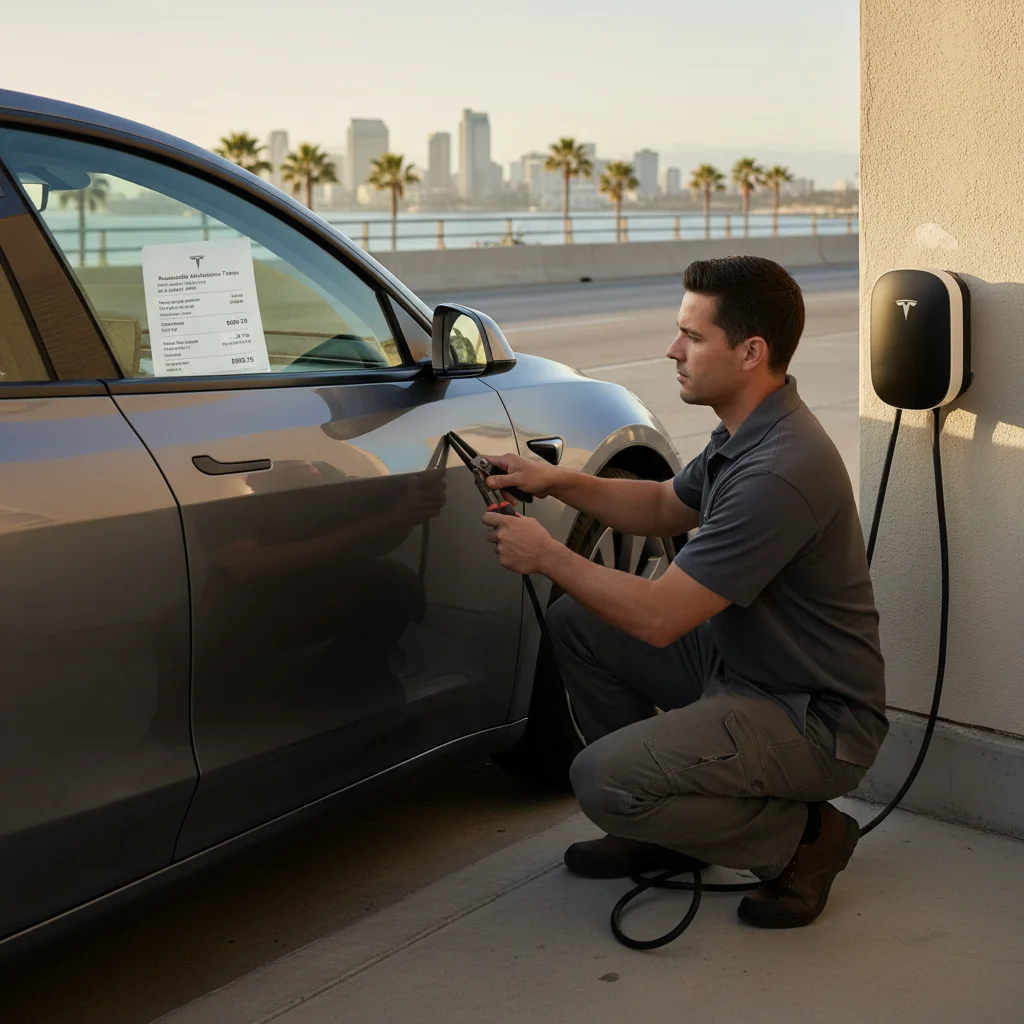
What Tesla roadside costs in 2026: the short answer
If your Tesla is outside its Basic Vehicle Limited Warranty (typically 4 years or 50,000 miles), you will pay for roadside services. While costs can vary based on your location and the specific third-party provider Tesla dispatches, we have gathered the most common fees for 2026. Tesla itself sets the dispatch and the per-service fee schedule.
Here is a quick-glance table of expected out-of-pocket costs for common roadside issues. These figures are based on industry trends and reports from Tesla owners across Northern California. Your final invoice will come from the local service provider dispatched through the Tesla app, so the final numbers can fluctuate. The key takeaway is that once your warranty expires, roadside assistance is no longer a free perk but a billable service.
| Service Request | Typical 2026 cost (out of warranty) | Notes |
|---|---|---|
| Dispatch fee | A base fee charged for most service calls | Set by Tesla’s contracted provider |
| Towing (non-warrantable) | Per-mile rate after a base distance | Billed by the dispatched local operator |
| Flat tire (loaner wheel) | Service fee plus tire cost | You handle the tire repair or replacement |
| Lockout assistance | Service fee plus mileage | Tesla’s app unlock is usually free in warranty |
| 12V battery jump or replacement | Service fee plus parts | Includes the cost of any new 12V battery |
| Out of charge service | Towing costs apply | Tesla’s policy is to tow you to the nearest charger, not provide a mobile charge |
Tesla’s exact fee schedule for the Bay Area could not be confirmed from this site’s approved sources at the time this page was written. Confirm the current schedule in the Tesla app for your specific vehicle before you rely on any number.
Free during warranty, billed after, what changed this year
Tesla’s roadside assistance is a valuable benefit during the initial warranty period. For most new vehicles, this covers you for 4 years or 50,000 miles, whichever comes first. During this time, breakdowns, flat tires, and key-fob or phone-as-key failures due to vehicle malfunction are generally covered at no cost. This includes a tow to the nearest service center, up to a published mileage limit.
However, the major change clarified for 2026 involves “driver-caused” incidents. Even under warranty, issues like running out of charge, losing your key fob, or getting a flat tire from road debris are increasingly being categorized as non-warrantable events. In these cases, you may be charged for the service call, even if your car is relatively new.
The post-warranty landscape is much clearer: you pay for what you use. The service functions as a dispatch, connecting you with a local tow or service company that bills you directly. This is a significant shift from the all-inclusive feel of the warranty period. For a complete understanding of what is and is not covered under the new terms, it is worth reviewing the updated Tesla support documentation. That source is the ultimate source of truth for coverage specifics and can help you avoid unexpected charges.
Per-mile tow fees, jump fees, and tire fees compared
When you are stuck on the shoulder of US-101 near San Carlos or in a parking lot in SoMa, the last thing you want to do is haggle over prices. Understanding the breakdown of fees helps you know if the quote you receive is fair. Let us look closer at the common charges for 2026.
Towing costs
Tesla’s out-of-warranty towing is billed per mile. For 2026, expect a rate that kicks in after a short base distance. This is competitive with many independent tow services, but the critical factor is the distance to the nearest functioning charger or service option. If you are in a more remote part of the Bay Area like the Tri-Valley, a tow to a charger across the Altamont can result in a longer bill.
Flat tire service
A flat tire is one of the most common roadside issues. Tesla’s service has two main outcomes:
- Tire repair or plug. If it is a simple puncture, the technician may be able to plug it on-site. This is often the quickest and cheapest solution.
- Loaner wheel. More commonly, the service provider will install a temporary loaner wheel. You will pay a service fee and be responsible for getting your original tire repaired or replaced and returning the loaner.
This is a convenient service, but it is not free. The real cost comes later at the tire shop.
12V battery jump
If your Tesla’s 12V battery dies, the car will not start, and you cannot even open the frunk easily. A jump-start for a 12V battery is a straightforward job, but the dispatch fee and labor can add up. If the battery needs to be replaced, you will also pay for the new battery, which can push the total higher. For a more detailed look at the general costs, our guide on how much Tesla roadside assistance is provides additional context.
How Bay Area dispatch fees stack up against local mobile rescue
Using the Tesla app for roadside assistance is convenient, but it is essentially a call center that dispatches a contracted local provider. In the Bay Area, this could be any number of tow companies. While this system works, it does not always guarantee the fastest or most specialized service, especially for EV-specific problems.
Here is where a dedicated mobile EV rescue referral line offers a distinct advantage. At Charge Pro SF, our focus is exclusively on electric vehicles. When you call us, you are not getting a generic tow truck that might not have experience with a Tesla’s unique needs.
Let us compare a common scenario: you run out of charge on El Camino Real in San Carlos. Tesla Roadside (Out of Warranty) will request service through the app. They will dispatch a local tow truck. You will pay a dispatch fee plus a per-mile fee to be towed to the nearest Supercharger, which might be in Redwood City or Belmont. Your total cost can be high, and you will have lost significant time waiting for the tow and then waiting again to charge.
Charge Pro SF mobile rescue. We match you with an operator who brings a mobile charging source to your location. They bring enough charge to get you to the next Supercharger or all the way home. The service is often faster and more direct than a tow, getting you back on your journey with minimal downtime.
Our Tesla roadside rescue referral service is designed to be a more efficient solution for charge-related emergencies. We know the specific challenges of driving an EV in the Bay Area, from the traffic on the Bay Bridge to the climb up I-280 through the Skyline hills.
When paying out of pocket actually makes sense
It might seem counterintuitive to pay a third party when Tesla offers its own branded service. However, there are several situations where calling a local specialist through Charge Pro SF is the smarter, more cost-effective choice, especially after your warranty has expired.
-
You have run out of charge. This is the most obvious one. Tesla’s official solution is a tow truck. A tow is time-consuming, expensive, and puts unnecessary wear on your vehicle. A mobile charge skips the flatbed entirely and lets you drive away from where you stopped. Why pay for a tow to a charger when the charger can come to you?
-
You need a faster response. Tesla’s dispatch system relies on the availability of its third-party contractors. During peak times or in certain parts of the Bay Area, wait times can be long. As a dedicated local referral service, we match you with operators who can be specific with you about timing, especially for common issues like a dead 12V battery or an out-of-charge event.
-
You are just outside the free tow radius. If a tow is unavoidable but you are 55 miles from the nearest service option, you will be paying for those extra 5 miles out of pocket with Tesla’s service. It is worth getting a quote from a local provider, as their all-in price might be lower than Tesla’s per-mile rate for that distance.
-
You prefer specialized expertise. The operators we connect you with work exclusively on EVs. We understand the intricacies of the 12V system, how to properly handle the vehicle without causing damage, and the fastest way to resolve common electrical issues.
Ultimately, having options is key. The Tesla app is a great tool, but it is not your only one. For Bay Area Tesla owners, knowing there is a local, specialized alternative can save you time, money, and stress when you need it most.
When to call us
When you are out of charge or dealing with a dead 12V battery, you need a fast and reliable solution, not a tow truck. We specialize in mobile EV charging and roadside support for Tesla owners throughout the Bay Area. Call (415) 630-6268 and we will connect you with a local operator who quotes you before starting.
Frequently asked questions
Does Tesla roadside cost the same for every model?
The dispatch and per-mile towing fees are the same across Model 3, Y, S, and X. Where it diverges is the 12V battery and tire costs, since S and X parts run higher than 3 and Y. Budget the higher end of any range for S and X.
What is the average Tesla roadside bill in 2026?
For a single out-of-warranty visit, expect the dispatch fee plus whatever the specific service costs, tow mileage, a tire loaner, or a 12V jump. Most single-issue calls land in the mid-hundreds all in once mileage and labor stack.
Is a local mobile rescue cheaper than Tesla’s dispatch for an out-of-charge event?
Often, yes. Tesla’s in-app dispatch tows you to the nearest Supercharger, which bills a base fee plus per-mile towing. A mobile charge from a local operator brings the electricity to you instead, typically for less than a tow and without the wait for a flatbed. See our full cost guide for the comparison.
Does the fee change based on where in the Bay Area I am stranded?
Yes, mainly through towing mileage. A stall in a dense area like Downtown San Francisco keeps tow distance short. Outer spots like the Tri-Valley or the Delta can push a Tesla-arranged tow higher once mileage stacks up.