EV roadside assistance in Castro Valley is help at the car. You’re on the I-580 hill towns, at the I-238 interchange. That’s the gateway toward the Tri-Valley climb. Hillside canyon homes already spend range on the way up. If the pack is thin, don’t burn those last miles. Charge Pro SF matches you with independent local operators. They bring a 240-volt Level 2 source or a 12V jump. EV roadside assistance is the path for that stall.
Castro Valley is unincorporated Alameda County
Castro Valley is an unincorporated Census designated place in Alameda County. ACS 2019-2023 puts the population at 65,389. There’s no separate 2024 Census PEP estimate for this CDP. The land area is 16.848 square miles on the 2023 Gazetteer. ZIP areas that overlap the place include 94541, 94546, 94552, 94577, and 94578. A ZIP on that list can run past the CDP line. Treat it as a caller clue, not a hard boundary.
Castro Valley sits between the East Bay core and the Tri-Valley. Hayward and San Leandro sit downhill toward the bay. Dublin sits east on I-580, and Oakland sits northwest. San Lorenzo is next door, outside this CDP. Name the neighborhood when you call. Downtown Castro Valley isn’t Palomares Hills. Five Canyons isn’t Proctor, and Jensen Ranch isn’t Cull Canyon.
PG&E delivers the wires, and Ava Community Energy supplies the generation. That’s the same pairing as Hayward, Dublin, Pleasanton, and Livermore. Outage reports still go to PG&E. This page won’t interpret your rate, including EV2-A, EV-B, or E-ELEC. None of that puts energy into a car that’s already stopped.
The I-580 hill towns sit on a climb
I-580 is the east-west spine through this CDP. Castro Valley is the gateway to the Tri-Valley climb. Eastbound, you’re pointing at Dublin, Pleasanton, and then Livermore. That’s grade plus highway speed on a thin pack. In-car estimates from a bay-plain run often don’t hold. The hillside canyons cost range on the way home too. Palomares Hills, Five Canyons, and Cull Canyon sit above the valley floor. A leftover number from Castro Valley Boulevard doesn’t survive that last pitch.
Drivers often treat this town as the last easy stop before they climb. Confirm any public post in your charging app before you spend those miles. This page won’t name a site we didn’t verify. It also won’t guess how far the next one sits.
If you’re already empty on the freeway past town, use the corridor page. Out of charge on I-580 over the Altamont covers that eastbound stall near Livermore. Surface streets, park lots, and canyon driveways sit here.
Alameda CTC runs the I-580 express lanes, and FasTrak is required. Hours are generally 5 AM to 8 PM on weekdays. A primary page didn’t confirm whether those lanes sit in the median. Don’t assume a left-shoulder pull is the safe move.
Westbound is the other way around. Castro Valley is where the Tri-Valley dump meets I-238 toward I-880. Say your direction when you call. It changes where an operator has to find you.
I-238, Redwood Road, and Castro Valley Boulevard
I-238 is the short connector from I-580 down to I-880. That’s the Hayward and San Leandro feed. A stall on I-238 isn’t the same pin as the 580 shoulder. Name the freeway and the direction. Drop the last exit you passed.
SR-13 here is Redwood Road into the hills. It climbs toward Lake Chabot Regional Park. Castro Valley Boulevard is the in-town commercial strip. Downtown Castro Valley sits on that grid. A dead car in a lot there isn’t a shoulder stop.
Hayward sits south and west of the interchange. EV roadside help in Hayward covers the 880 and 92 tangle. Dublin sits east once I-580 tops out. San Leandro sits toward the bay, and we serve those cities. The operator who takes your pin still quotes in front of you.
Valley weather isn’t canyon weather
Castro Valley stays mild on the valley floor, and the canyons run warmer. Summer AC load is moderate next to the inland valleys.
East on I-580, the heat gap opens fast. Livermore’s July average high is 89.7F on the 1961-1990 normals. Oakland Airport sits at 70.4F on that same vintage. San Francisco’s July average high is 71.5F on that vintage. We couldn’t confirm a published Castro Valley station normal. We also couldn’t confirm a count of days at or above 100F. Don’t plan an eastbound push from a coastal leftover.
Cabin cooling still draws from a thin pack. A Five Canyons commute and a downtown errand don’t spend the pack alike.
Shoulder law, FSP, and the four-hour clock
California Vehicle Code 21718 bars stopping on a freeway except in limited cases. A vehicle so disabled that stopping is unavoidable is one exception. You also need to have summoned another vehicle to assist. Turn the hazards on, and keep people out of live lanes. If any part of the car is in a travel lane, call 911 first. CHP says to call 911 when a disabled vehicle is in a dangerous location.
CVC 22651(f) allows removal after more than four hours on a full-access-control freeway. That applies when you can’t move the car under its own power. The clock is a towing risk, not a waiting room.
The Freeway Service Patrol is a partnership of MTC, CHP, and Caltrans. Those hours are Monday to Friday, per 511.org. That’s 6 to 10 AM and 3 to 7 PM. Dial 511 and say “Freeway Assist,” or use a call box. FSP clears crashes and debris, plus a free gallon of gas. The MTC FSP page, read 2026-09-18, doesn’t mention electric vehicles or out-of-charge help. A jump-start can wake a 12V. It doesn’t refill an empty traction pack.
Outside those hours, calls go to the CHP Rotation Tow Program. Approved vendors rotate, so you don’t pick the company. Caltrans District 4 covers the nine Bay Area counties.
For the regional order, use the Bay Area freeway empty-pack steps.
A dark screen and a zero pack are different jobs
They look the same from the curb, but they aren’t. The traction pack can be at zero, and the car won’t roll. Or the small 12V battery has dropped, and the computers won’t wake. Teslas have a 12V, and so does every other major EV. A 12V failure can leave you locked out and dark. The traction pack can still hold energy you can’t reach.
Tell the operator which one you’re looking at. “I’m at 3 percent and still in Drive” is one job. “Nothing on the screen, and the doors won’t release” is another. A long sit at Lake Chabot can do the 12V version.
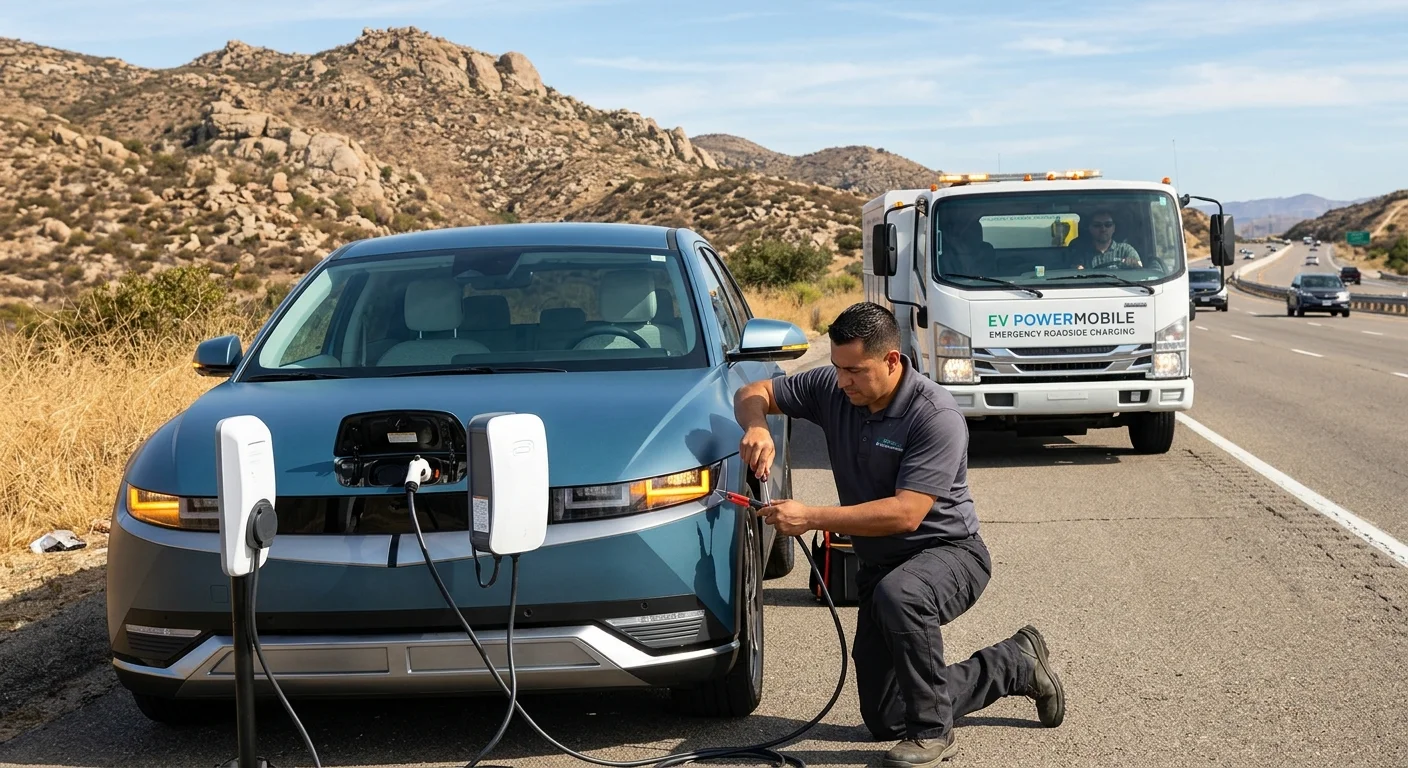
Independent operators in this network can jump or replace a dead 12V on site. They can also bring a 240V Level 2 source to the charge port. Native NACS for Teslas, and CCS or J1772 adapters for non-Tesla EVs. They handle Tesla and every major EV brand. Typical roadside charging adds 10 to 20 miles of range. That takes 15 to 30 minutes of charging. That’s charging time, not an arrival time. We don’t promise when someone gets there.
Don’t clamp a random gas-car pack onto an EV 12V. Confirm the live menu in the Tesla app. Charge Pro SF isn’t Tesla.
Who comes, and who sends the bill
Charge Pro SF is a referral line. We match stranded EV drivers with independent local mobile rescue operators. We don’t perform the work. We own no trucks, no yard, and no chargers. We employ no technicians, and we set no prices. We publish no arrival time, and the brand holds no license.
The operator quotes you before starting, then bills you directly. The pros we connect you with are licensed and insured. It isn’t a Charge Pro SF contractor license.
Mobile EV charging is the empty-pack job. Confirm the proposed service and the price with that operator before work starts.
Calls on this line play a recording notice. California Penal Code 632 requires all-party consent before a confidential call is recorded.
A mobile charge versus a tow on these grades
A plug doesn’t fix a smashed inlet. It doesn’t fix a pack that refuses current. When the car can take a charge, use a mobile charge instead of a tow. That leaves you on your own wheels.
Towing a dead EV is a clearance job. It doesn’t put miles back in the pack. California doesn’t cap ordinary private or consensual tow rates statewide. CHP sets rates only for its rotation vendors. This page won’t invent a Castro Valley tow bill.
What to say so the operator can find you
Give a location a stranger can drive to. “Eastbound I-580 at the I-238 interchange, right shoulder” is usable. “I’m in the hills” isn’t enough. Name the freeway, the direction, and the last exit. Add Palomares Hills, Five Canyons, Proctor, or Jensen Ranch if you’re there. Then give year, make, model, color, and the failure. Say if FSP or CHP is already with you.
When this is the right call
If the pack is empty on the Castro Valley hill towns, that’s an out-of-charge call. Same if the 12V died on Castro Valley Boulevard. Same if you stalled on I-238 toward I-880. We serve Castro Valley and the rest of the Bay Area. The operator who accepts the pin quotes first.
Call (415) 630-6268. That’s the match line. It isn’t a promise that a truck is already on your block.