When your EV dies on a Bay Area street, pack chemistry isn’t the question. You need to know whether the 12-volt battery quit. The other option is an empty traction pack. That split decides the rescue.
Start with what still works
Don’t open a forum thread about cell chemistry. A zero on the range readout points at the traction pack. A black screen and handles that won’t present point at the 12-volt system. Those two failures look alike from the sidewalk. They’re not the same job for the operator who comes out.
Write down what still answers you. Interior lights, the phone app, and the key fob run on 12-volt power. The charge-port door does too. If some of those still work and the car won’t drive, that’s a clue. If nothing answers, that’s a clue too.
“It died” hides the split. Read the dash message out loud, word for word. “Low 12V battery” and “0 miles remaining” send help in different directions.
The 12-volt battery is the wake-up switch
Every EV still carries a small 12-volt battery. It doesn’t turn the wheels. It powers the computers, locks, lights, and the relays that connect the main pack. When that small battery is dead, the car can sit dark. A full traction pack can still sit under the floor. That’s why a Tesla that won’t wake is often a 12-volt problem. It’s not always an empty pack.
This shows up after a long sit. Census ACS 2019-2023 figures put San Francisco’s pre-1980 housing at 77.2%. Daly City is 78.7%. San Bruno is 81.9%. Berkeley is 80.8%. That older stock is a proxy for plug-less apartments and street parking. A car that sat on a Daly City block all week is a 12-volt suspect. The same goes for a Berkeley curb.
Airport parking is the other long sit. SFO publishes an EV charging page, but this research pass couldn’t read it. Confirm what’s actually there in a browser.
A manufacturer-approved jump can restore the computers so the pack can reconnect. Jump points, covers, and approved steps change by make, model, and year. A Tesla frunk post isn’t a Rivian layout. It isn’t a Hyundai Ioniq cover either. If you’re in a non-Tesla, say so up front. Non-Tesla EV rescue is its own procedure.
Our note on what happens when an EV 12-volt battery dies stays on that failure. You still have to name which system quit.
The traction pack is the miles
The traction battery is the one you charge at home or at a public post. It stores the energy that turns the motor. That’s the pack people mean when they say “EV battery.”
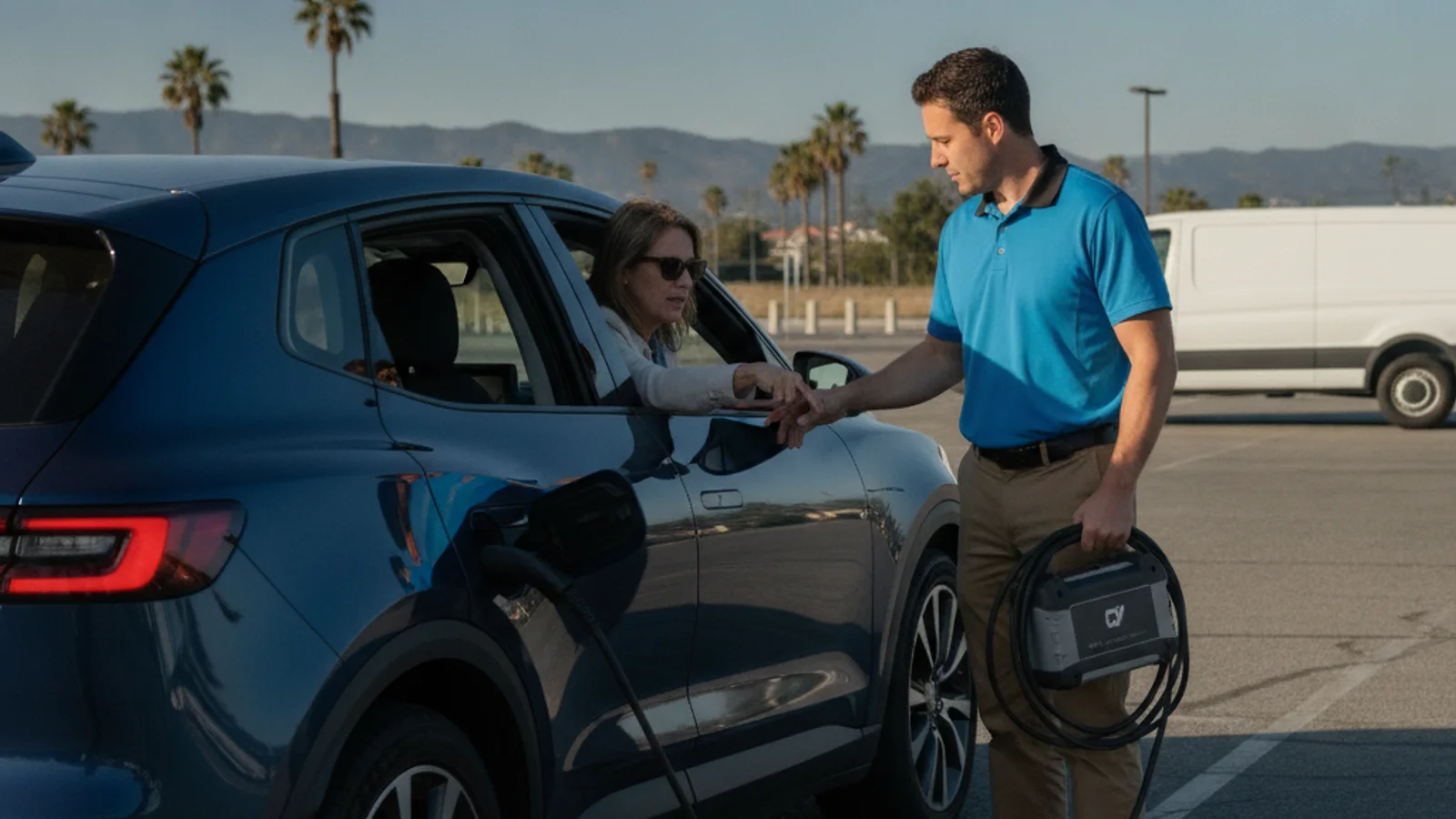
When that pack is empty, the car needs energy, not a jump. A 12-volt boost won’t put miles into an empty pack. The independent operators in this network bring a 240-volt Level 2 source to the car. They use a native NACS plug, or a CCS or J1772 adapter for non-Tesla EVs. That typically adds 10 to 20 miles of range. The charging window is 15 to 30 minutes. That’s charging time. It’s never an arrival time.
That’s the mobile EV charging path, not a low-voltage fix.
Confirm the range number, the charge-port light, and whether the car will accept a plug. If you can still roll to a named site, start with BART. Warm Springs / South Fremont has 42 Level 2 plugs. Lafayette has 4. Those are the BART lots this pass could verify. If you’re already on a shoulder, a public post isn’t the next move.
Why pack chemistry can wait
Forums love NMC versus LFP. None of that changes tonight’s call.
Chemistry is a buying decision. It isn’t a roadside diagnosis. The operator isn’t reading cell suppliers on the phone. They’re asking what the dash says, what still powers on, and where the car sits.
Charge Pro SF has no verified figures for pack capacity or voltage. It has none for cell mix on any model. Those numbers don’t belong in a roadside choice anyway. If you need them, use the current owner’s manual. The automaker’s own spec sheet is next.
How this split shows up around the Bay
The Bay Area isn’t one climate, one grade, or one housing pattern.
On the coast, San Francisco’s July average high is 71.5F on the 1961-1990 NWS normals. Inland, Livermore’s July average high is 89.7F. Antioch’s is 90.4F. Heat loads the traction pack on the SR-4 Delta run. The same is true on the I-580 climb toward Livermore. The 12-volt battery still has to wake the car after that sit.
San Ramon’s housing is 23.8% pre-1980. Dublin’s is 21.0%. Brentwood’s is 10.9%. Those places more often have garages. An empty pack after the I-680 ridge fits that landscape. A 12-volt death after a week on a San Bruno street fits older Peninsula stock.
Mountain View and Palo Alto collect campus cars. Those cars sleep through a workday, then refuse to wake. Santa Clara is on Silicon Valley Power. San Jose is PG&E with San Jose Clean Energy.
On a freeway, California Vehicle Code 21718 bars stopping except in limited cases. One exception is a disabled vehicle that can’t keep moving, once help has been summoned. CVC 22651(f) lets a vehicle be removed after four hours on a full-access-control freeway. That applies if it can’t move under its own power. If you’re on I-880, I-680, I-80, US-101, or SR-237, watch that four-hour clock.
The Freeway Service Patrol is a partnership of MTC, CHP, and Caltrans. Hours are Monday to Friday, 6 to 10 AM and 3 to 7 PM. You reach it by dialing 511 and saying “Freeway Assist,” or by a call box. The MTC page lists a free gallon of gas, jump-starts, and radiator refills. It doesn’t mention electric vehicles or out-of-charge help. Outside those hours, the CHP Rotation Tow Program assigns the tow.
A gas-can beat isn’t a charge for an empty pack. Confirm a 12-volt jump against the manufacturer’s steps before anyone clamps a cable.
Pacifica’s housing is 81.1% pre-1980. Half Moon Bay’s is 46.9%. Say which coast town you’re in.
What to tell the operator
Give the make, model, and model year first. Then the exact warning text.
Access and jump points change across brands and model years. Report the message as printed. Then report what still works.
Add the location type. A street in Oakland isn’t a shoulder on I-580 toward Livermore. A lot in Fremont near Warm Springs isn’t SR-1 through Pacifica. The operator needs that to know whether a 12-volt jump can even reach the terminals.
If you don’t know which system failed, say you don’t know. A guess dressed as a diagnosis wastes the visit.
A charge, a 12-volt jump, or a tow
Three buckets cover most calls.
A mobile charge fits when the traction pack is empty and the car can be reached. The independent operator quotes you before they start and bills you directly. Charge Pro SF is a referral line. It doesn’t own trucks, set prices, or do the work. It matches stranded drivers with local mobile rescue operators.
A 12-volt jump fits when the low-voltage battery has failed. The manufacturer has to support a roadside jump for that model. Don’t copy a video for a different car. Confirm the steps with the operator and the owner’s manual.
Transport fits when the cause is unclear. It also fits when the car can’t be reached safely. Some dashboard messages call for a shop, not a roadside fix. On private property, CVC 22658 governs posted tows. California doesn’t cap ordinary consensual tow rates statewide. Ask what the operator will do before anyone hooks the car.
How to jump start an EV stays on the 12-volt path. The Bay Area charging hub is for after you’re moving again.
Use your manual, not a forum thread
This article can’t tell you where your jump points sit. It can’t decode every warning string. It can’t say whether your automaker allows a roadside 12-volt jump.
Your current owner’s manual is the first check. Tesla’s own service material is next if the manual is silent. So are Rivian’s owner resources and each brand’s support line.
If the car is dark on an older Oakland block, start with the 12-volt battery. The same is true on a Daly City street. If you’re empty after a Livermore commute, you’re looking at the pack.
Call when the EV won’t power on or won’t charge. Call if it shows a message you can’t classify. The matched operator will use the vehicle details and the dashboard text. Call (415) 630-6268 and we’ll connect you with a local operator.