A Genesis GV60 or Electrified GV70 that won’t start is almost never an empty pack. The range can still look healthy. What failed is the small 12-volt battery. That battery wakes the computers, the locks, and the start button. On Bay Area street parking, that 12V is the part that dies first.
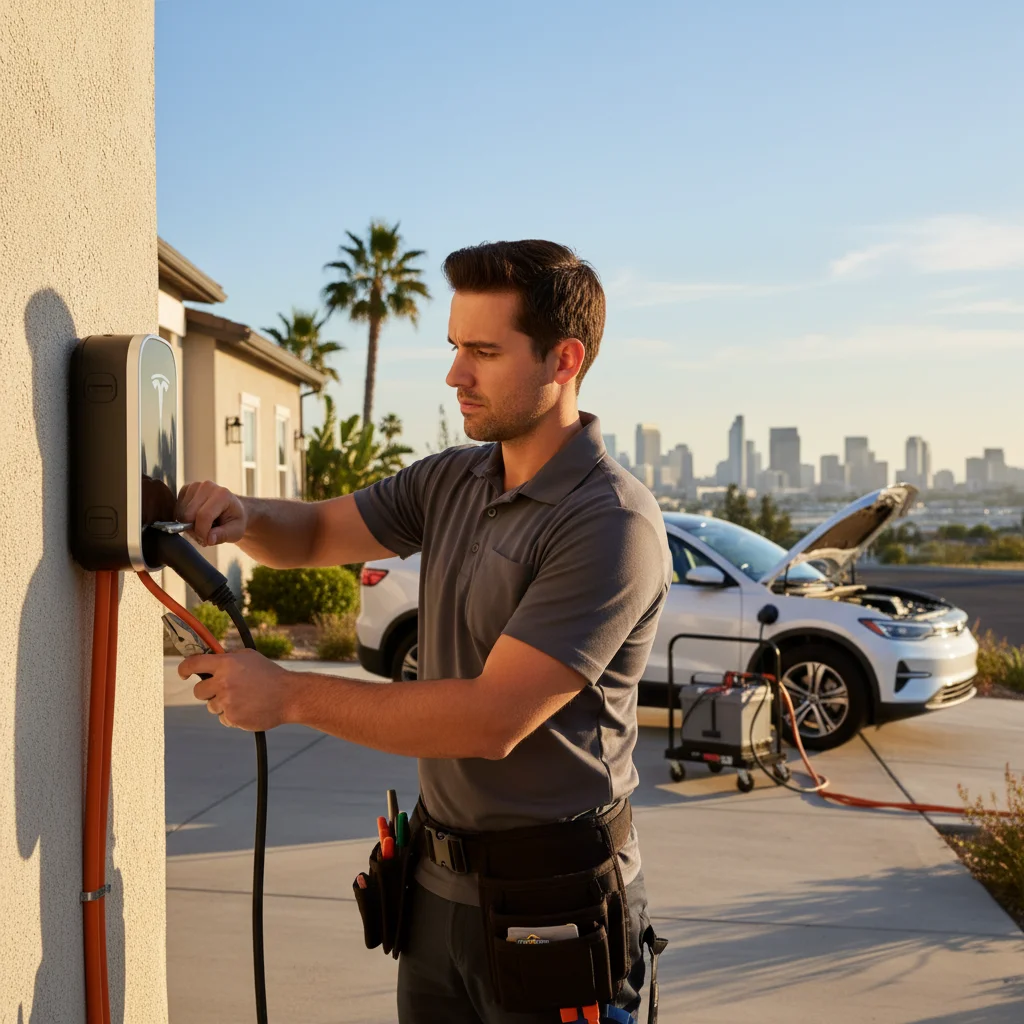
What a dead start looks like on these cars
People wait for a low-range warning. That’s a different failure. A dead 12V goes darker than an empty pack.
- No interior lights, no chime, and no screen when you open the door
- Flush handles stay flush, and the fob does nothing
- The frunk button and the charge-port button stay dead
- You might hear one faint click, then silence
If the dash lights and the car won’t go into Drive, stop. That’s a traction-pack problem, covered later. Don’t jump a car that’s already awake and talking. What happens when an EV 12-volt battery dies maps the cascade if you want the electrical picture first.
Two batteries, and only one moves the car
The GV60 and Electrified GV70 sit on Hyundai’s E-GMP platform. So do the Ioniq 5 and the Kia EV6. They share the electrical layout, including the weak 12V.
The big pack turns the motors. The 12V runs the brain that’s allowed to wake that pack. Locks, lighting, displays, and module talk all ride on 12 volts. When that small battery is flat, the traction pack is still there. It just stays locked out. Remaining miles don’t matter until the 12V comes back.
There’s a platform quirk that catches Genesis owners. If the traction pack sits very low, topping off the 12V can stop. Park a few days after that, and the auxiliary battery finishes draining. A GV60 with a healthy-looking range bar can still go dark. The pack wasn’t the failure. The 12V was.
The same pattern shows up on the Ioniq 5. What to check when your Hyundai Ioniq 5 won’t start covers that sister car in more detail.
Street parking is how this dies here
San Francisco’s housing stock is old. ACS 2019-2023 figures put pre-1980 buildings at 77.2 percent of the city. Daly City is 78.7 percent. San Bruno is 81.9 percent. Berkeley is 80.8 percent. Oakland is 77.9 percent.
That older stock means curb parking, tight garages, and cars that sit between errands. A GV60 left in the 94110 or 94114 ZIP areas isn’t plugged in overnight. The 12V keeps modules in a light sleep. After cool nights and milder days, a tired auxiliary battery just doesn’t wake.
Daly City repeats the pattern in the 94014 and 94015 ZIP areas. EV roadside help in Daly City when street parking is all you have is the local version of this sit-and-die loop.
Peninsula and South Bay garages write a quieter version. In San Carlos, Cupertino, Palo Alto, and Menlo Park, a second car can sit for weeks. Age on the 12V matters more than miles there. The same sit kills a 12V on an Oakland curb.
Heat inland, and a cooler coast that still cycles the battery
The 12V doesn’t love heat cycling. The Bay Area isn’t one climate.
1961-1990 NWS normals via WRCC put San Francisco’s July average max at 71.5F. Oakland Airport is 70.4F. San Jose is about 82F. Livermore’s July average max is 89.7F. Antioch is 90.4F. Gilroy is 88.3F. A count of days at or above 100F couldn’t be confirmed, so this piece doesn’t publish one.
A GV70 that parks outside in Livermore, Antioch, or Gilroy ages the 12V faster. The same car lasts longer in Pacifica or Half Moon Bay. The coast is milder. It isn’t gentle. Cool mornings and brighter afternoons still cycle a two- or three-year-old 12V. If yours is that old, watch it before a long sit.
PG&E delivers power across most of this map. Santa Clara, Palo Alto, and Alameda run municipal utilities instead. None of those programs wake a car that’s already dark on the street. Confirm current home-charging rates with your utility or CCA. This page doesn’t publish a figure.
Where the 12V actually sits
Body style splits the layout.
On the GV60 crossover, the auxiliary battery sits up front under the hood. That’s the same neighborhood as the Ioniq 5 unit. On the Electrified GV70, the layout follows the sedan-style E-GMP pattern. The battery can sit under trim, not in plain view.
You usually don’t jump from the battery’s own posts. The jump points are in the engine bay.
| Spot | What you should find |
|---|---|
| Under the hood, driver’s-side fuse box | Positive (+) jump terminal under a red cap |
| Under the hood, on the chassis | A bare, unpainted metal bolt for the negative clamp |
| Front compartment or under trim | The actual 12V auxiliary battery |
Use the interior hood release. Look for the black fuse-box cover on the driver’s side. Lift the red cap for the positive post. Find clean, unpainted metal for ground. Year and trim vary. If the bay doesn’t match, check the owner’s manual for your model year.
How to jump a GV60 or Electrified GV70
Use a portable jump pack, or a second car with jumper cables. Stay on the designated points.
- Open the hood with the interior release.
- Find the black fuse-box cover on the driver’s side.
- Lift the red cap to expose the positive terminal.
- Clamp the red lead to that terminal.
- Clamp the black lead to a bare chassis bolt, such as a strut tower or firewall bolt. Don’t clamp it to the battery’s negative post.
- If you’re using a donor car, match positive to positive and negative to negative. Then start the donor.
- Wait two to three minutes so the Genesis 12V can take a little charge.
- Try the start button. The boot can take a few extra seconds after a dead 12V.
If it wakes, drive to a charger. Let the system top the 12V back up. A single jump isn’t a repair. If the car dies again within an hour, the 12V needs replacement. Don’t throw another jump at it. The same clamp order applies across E-GMP cars. For the generic EV sequence, see How do you jump start an electric car without hurting it?.
When the dash is on and the pack is the problem
A jump does nothing if the 12V is already awake.
If screens come up and handles work, look at the range warning. If it’s out of range, you have a charging problem. The traction pack needs energy, not a 12V bump. Operators we connect you with bring a 240-volt Level 2 source to the car. For a Genesis they use a CCS adapter on that 240-volt feed. Typical charging time adds about 10 to 20 miles of range. That takes 15 to 30 minutes on the car. That’s charging time, never a promise of when someone arrives.
If the charge port won’t open, that’s a separate jam. Don’t force the door. For a pack that’s actually empty, start from out-of-charge recovery. Once the car will move, you can aim at verified Level 2 sites. BART’s Warm Springs / South Fremont lot has 42 plugs. Lafayette BART has 4 plugs. Confirm they’re working before you count on them. A USDOT grant is funding more BART Level 2 stalls by 2027. Don’t treat that as already built.
Where this happens around the Bay
Long airport sits are a 12V killer. A GV60 left in San Bruno or South San Francisco for a week or two often won’t wake. That includes the 94128 ZIP area. SFO’s electric-vehicle charging page exists, but it couldn’t be verified for this piece. Confirm stalls in a browser before you rely on one. Oakland International and San Jose International parking pages, read 2026-09-18, don’t show EV charging. Don’t treat that as proof the lots have none. No airport page publishes what to do when the car simply won’t wake.
Campus lots in Palo Alto, Mountain View, Sunnyvale, and Santa Clara leave cars sitting through a workday. A 12V that was already marginal can fail at pickup.
Freeway shoulders have their own clock. California Vehicle Code 21718 limits stopping on a freeway. The disabled-car exception applies when stopping is unavoidable and help is already on the way. CVC 22651(f) lets an agency remove a vehicle left more than four hours. That’s on a full-access-control freeway. That applies if you can’t move it under its own power. Get the car awake, or get a tow arranged, before that clock runs. That rule applies on I-80, I-580, I-680, I-880, US-101, and SR-237.
The Freeway Service Patrol is a partnership of MTC, CHP, and Caltrans. Hours on 511.org are Monday to Friday, 6 to 10 a.m. and 3 to 7 p.m. Dial 511 and say “Freeway Assist,” or use a call box. FSP lists jump-starts. The MTC FSP page, read 2026-09-18, doesn’t mention electric vehicles or out-of-charge help. A 12V jump might still sit in the jump-start bucket. An empty traction pack isn’t something that page describes. Outside those hours, CHP’s Rotation Tow Program assigns an approved tow vendor.
If you’re on a bridge approach, stay with the car and call for help. The seven state-owned bridges use all-electronic Open Road Tolling set by BATA and MTC. Cash ended in March 2020. Tolled direction is eastbound only on the Antioch, Benicia-Martinez, and Carquinez bridges. It’s westbound only on the Dumbarton, Richmond-San Rafael, Bay, and San Mateo-Hayward bridges. The Golden Gate Bridge is a separate district, southbound only into San Francisco. No published disabled-vehicle-on-a-bridge policy turned up for this page. Confirm current rules with 511 SF Bay or Caltrans District 4 QuickMap.
Express lanes run on I-80, I-580, I-680, I-880, US-101, and SR-237. FasTrak is required. If you stall there, don’t guess a median walk. That position wasn’t verified on a primary page.
What a local operator actually does
Charge Pro SF is a referral line. It matches stranded EV drivers with independent local mobile rescue operators. It doesn’t hold a trade license, own trucks, or send employees. The operator quotes you before any work starts and bills you directly.
Operators jump or replace a dead 12V on site. They can add Level 2 range with a CCS adapter. They handle Genesis, Tesla, and every major EV brand. Operators bring a native NACS plug for Teslas, plus CCS or J1772 adapters for the rest.
Charge Pro SF doesn’t set the price. Ask the operator what changes the quote. This page doesn’t publish a dollar figure, because the operator sets it.
The service area is the Bay Area. For a GV60, GV70, or any other non-Tesla EV, use the non-Tesla EV rescue page. Call (415) 630-6268 when you want a match.
Frequently asked questions
How do you jump-start a Genesis GV60?
Pop the hood from inside. Find the driver’s-side fuse box and lift the red cap. Ground the black clamp on unpainted chassis metal, not the 12V’s negative post. Give it two to three minutes, then press start. If the bay layout looks different, the owner’s manual for that year wins.
Where is the 12V battery in a GV60 or GV70?
It depends on the body. The GV60 keeps the auxiliary battery under the hood, up front. The Electrified GV70 can hide it under trim. Use the engine-bay jump terminals either way.
Can a Genesis EV die with charge still in the pack?
The traction pack doesn’t boot itself. The 12V has to wake the computer that unlocks high voltage. When that small battery is dead, yesterday’s range is locked behind a dark car.