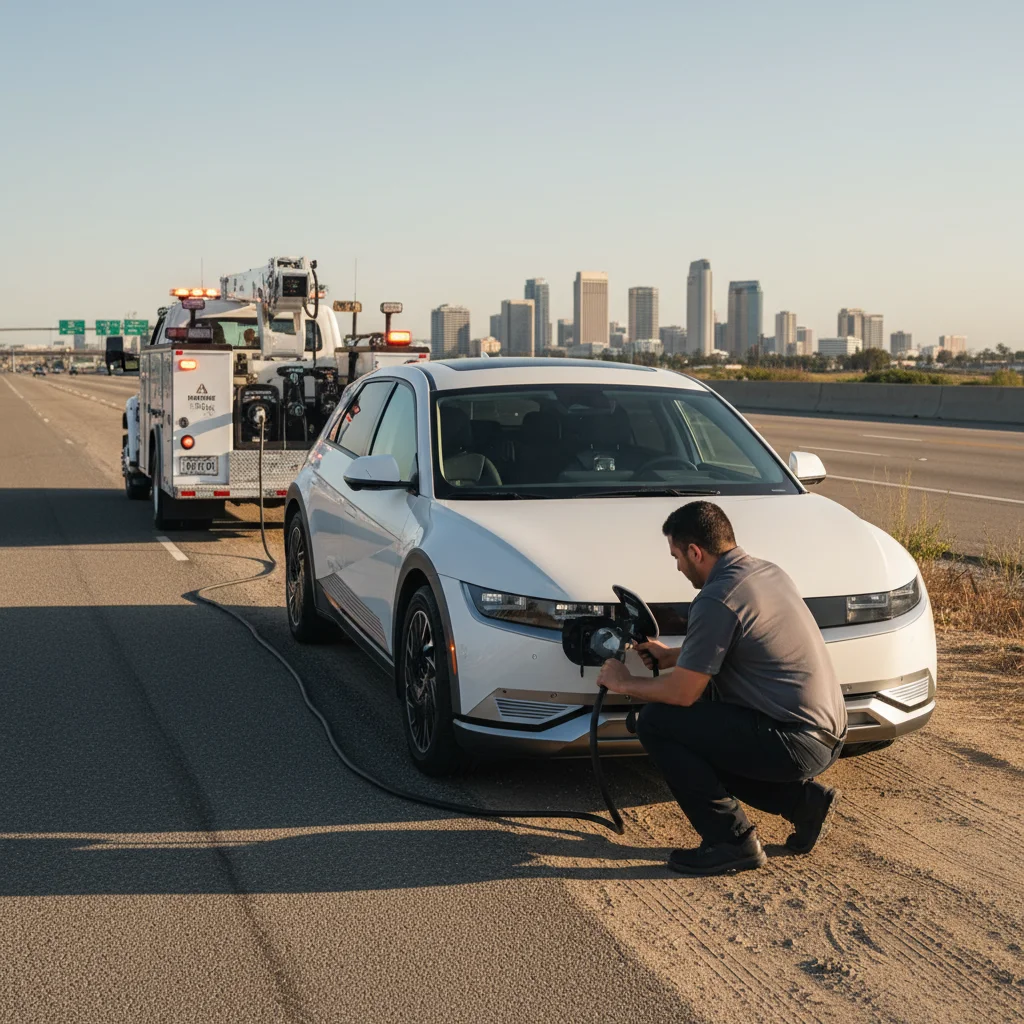
If your EV stalls on I-80 through Richmond, you need EV roadside assistance on that waterfront stretch. Get fully onto the right shoulder. Keep the hazards on. Charge Pro SF is a referral line. We match you with independent local mobile rescue operators. They bring a 240-volt Level 2 charge or a 12V jump. They quote you before they start. They bill you directly.
This is a waterfront city with yards, parks, and a bridge
Richmond is an incorporated city in Contra Costa County. The 2023 Gazetteer lists just over 30 square miles of land. ACS 2019-2023 puts the population at 115,396. That’s a large East Bay core city, not a one-exit suburb.
I-80 is the through spine. I-580 peels toward the Richmond-San Rafael Bridge. SR-123 is San Pablo Avenue. Richmond Parkway and Macdonald Avenue work the surface grid. Point Richmond, the Iron Triangle, Marina Bay, Hilltop, and North Richmond sit inside that map. El Cerrito and Berkeley sit south on I-80. San Rafael sits across the span.
The Chevron refinery sits on that shore. So do the Craneway and the Rosie the Riveter WWII Home Front park. Those sites pull cars along the water. A stall here is a Richmond stall. It isn’t a copied Oakland one.
Older streets and yard lots lean on public charging
About 67.2% of housing was built before 1980, per ACS 2019-2023. Census uses that share as a proxy for older panels and apartment density. This page can’t confirm which building has a 240-volt circuit. The Iron Triangle still has a lot of older street parking. North Richmond is the same kind of street. Overnight Level 2 isn’t a fact we can verify door by door.
That’s why a lot of Richmond cars lean on public charging. Waterfront yard lots work the same way. The car sits through a shift, then rolls out on a thin buffer. You watch the percent before you even reach I-80. Then the freeway and the bridge approach start spending what’s left.
The climate is mild and bayside. It’s breezy near the water. AC load stays low to moderate. That helps on a shore day. It doesn’t refill a pack that left home thin.
PG&E still owns the wires. MCE supplies generation in Richmond. MCE publishes Charge Up Contra Costa and the MCE EV Instant Rebate. Confirm current terms on mcecleanenergy.org. Outage reports still go to PG&E. None of that wakes a car that’s already stranded.
Richmond’s city hub keeps the local service links in one place. El Cerrito’s roadside guide covers the next city south on I-80.
The I-80 shoulder and the westbound bridge
I-80 through Richmond is the East Bay shore spine. I-580 is the peel-off to the Richmond-San Rafael Bridge. Westbound I-80 is pointed at the Bay Bridge cities. Eastbound I-80 is pointed at the Carquinez.
That bridge is one of the seven state-owned spans. Caltrans owns the structure. BATA and MTC set the tolls. Cash ended for good in March 2020. Open Road Tolling is all-electronic now. FasTrak, a license-plate account, or an invoice are the paths. The tolled direction is westbound only, Richmond toward San Rafael. Eastbound back into Richmond doesn’t pay at a plaza.
No primary page we read posted a disabled-vehicle rule for the bridge deck. That check was September 18, 2026. Confirm the current rule with Caltrans District 4 or 511 SF Bay. Don’t assume a shoulder on the span is a legal wait. If you’re on the deck or stuck in a toll queue, call 911 first. Say exactly where you are.
Express lanes run on I-80 and I-580. FasTrak is required. Hours are generally 5 AM to 8 PM weekdays. This page won’t tell you to pull left. Median or left-shoulder placement wasn’t verified on a primary source. If the pack is dying in an express lane, follow CHP. Aim for the right side when you can reach it.
A visitor day at the Rosie the Riveter park can spend a thin buffer. So can a long sit at the Craneway, or a shift car left in a waterfront yard. The 12V can die while the pack still holds energy. Don’t treat the next off-ramp as a sure save. This research pass didn’t verify a charger-by-charger map for Richmond, and we won’t invent sites.
For the wider I-80 script, use stranded on I-80 in the East Bay.
Shoulder law, 511, and the four-hour clock
CVC 21718 bars stopping on a freeway except in tight cases. A vehicle so disabled that stopping is unavoidable is one exception. You also need to have summoned another vehicle to assist. Turn the hazards on. Keep people out of live lanes. If you get out, use the passenger door.
CVC 22651(f) allows removal after four hours on a full-access-control freeway. That applies when the driver can’t move the car under its own power. The clock is a towing risk, not a waiting room.
The Freeway Service Patrol is MTC, CHP, and Caltrans together. Private tow firms run the beats under bid. Published hours are Monday to Friday, per 511.org. That’s 6 to 10 AM and 3 to 7 PM. Dial 511 and say “Freeway Assist,” or use a call box. The published list is a free gallon of gas, jump-starts, and radiator refills. The FSP page doesn’t mention electric vehicles or out-of-charge recovery. That reading is from September 18, 2026. Don’t treat an FSP truck as a traction-pack refill. After hours, the CHP Rotation Tow Program assigns the wrecker. You don’t pick the company.
Call 911 if you’re blocking a lane or you feel unsafe. Caltrans District 4 covers the nine Bay Area counties.
The pack is empty, or the 12V is
A silent EV is two different failures. One car rolled until the traction pack was done. The other won’t wake because the small 12-volt battery died.
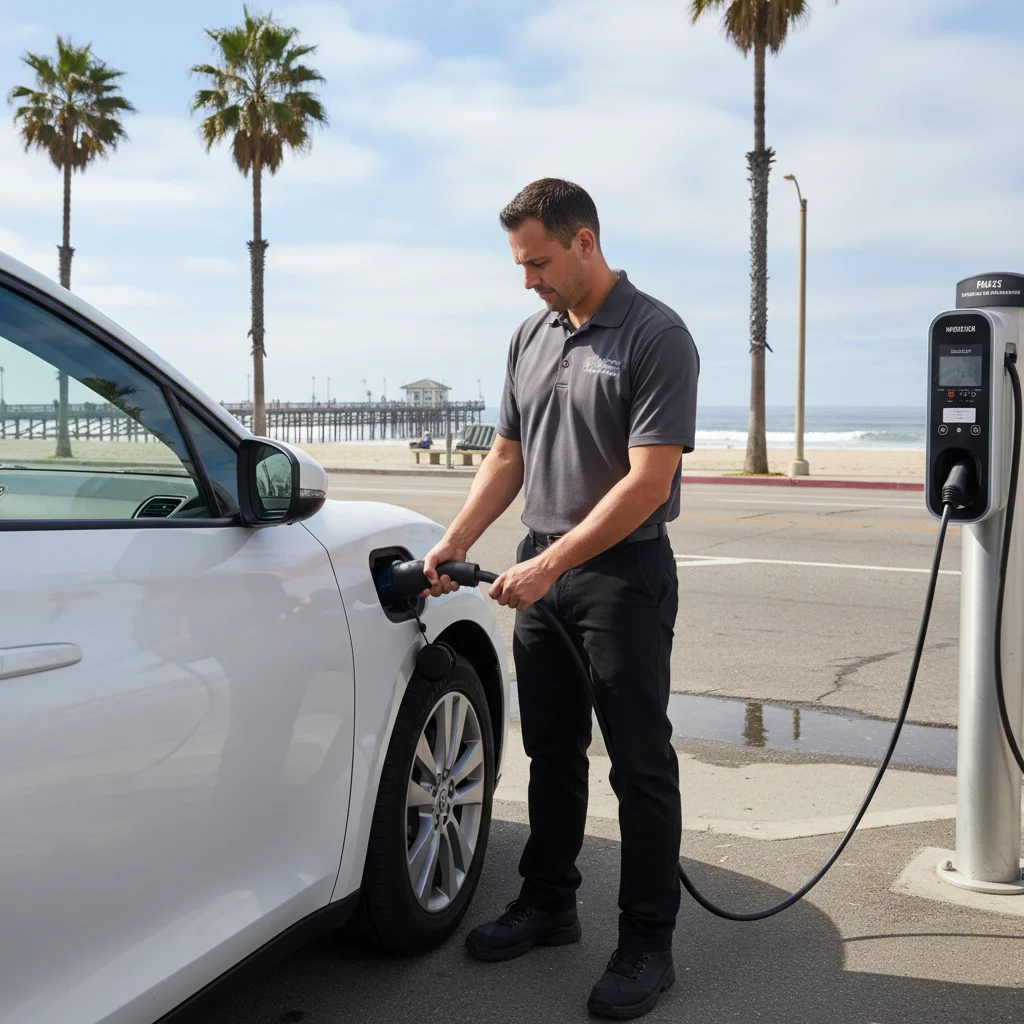
An empty pack wants energy at the charge port. Mobile EV charging is that job. Operators we connect you with bring a 240V Level 2 source. Tesla takes a native NACS plug. Other brands use a CCS or J1772 adapter. They typically add 10 to 20 miles of range. Plug time is typically 15 to 30 minutes. That window is charging time. It isn’t an arrival time. Charge Pro SF doesn’t publish arrival windows.
A dead 12V is quieter and meaner. Screens, locks, and the charge-port door can all fail. The traction pack can still hold energy you can’t reach. Tesla, Ford, Rivian, Hyundai, GM, and the other majors all carry that 12V. Some operators can jump or replace the unit on site. Ask before they start.
Tesla’s own roadside channel is a different network. Confirm what they’ll send in the Tesla app or on Tesla’s site. This page won’t invent their menu, and Charge Pro SF isn’t Tesla.
EV roadside assistance covers Tesla and every major EV brand.
Who comes, and who sends the bill
We’re a referral line, not the crew on the truck. We don’t hold the trade license for the work. We don’t own trucks, a yard, or chargers. We don’t employ the technician. The independent operator quotes you before anything starts, then bills you directly.
They typically bring a 240V Level 2 source, NACS for Tesla, and CCS or J1772 adapters for other EVs. They also bring 12V jump tools meant for EVs.
The pros we connect you with are licensed and insured. That sentence is about the network. It isn’t a Charge Pro SF contractor license.
We serve Richmond and every city in the Bay Area. Name the last exit you passed. Say Point Richmond, Hilltop, Marina Bay, or the Iron Triangle if you know it. Eastbound I-80 through Richmond is usable. Westbound toward the bridge is usable. Year, make, model, and color help too. Tesla versus everything else changes the plug. Say whether the car is still on, showing a low percent, or fully dark.
Tow when the car can’t take a charge
A plug doesn’t fix a smashed inlet. It doesn’t fix a pack that refuses current. It doesn’t fix a car that needs a bay. Mobile charging or a tow spells out that split.
California doesn’t cap ordinary private or consensual tow rates statewide. CVC 22658 is the private-property statute. CHP sets rates only for its rotation vendors. On rotation, you don’t choose the truck. Ask what you’ll pay if you still have a choice. This page won’t invent a Richmond tow bill.
A mobile charge that works leaves the car on its own wheels. Ten to twenty miles is usually enough to leave the shoulder. It isn’t a full fill. If you already know a station you can reach without hitting zero, use it. If you don’t, stay put and bring the charge to the car.
Call the referral line when the car is done
If the EV is dead on I-80, I-580, or a waterfront lot, call. Same if you’re on San Pablo Avenue, Macdonald Avenue, or Richmond Parkway. That’s an empty pack, a dead 12V, or a port that won’t open.
Call (415) 630-6268. Charge Pro SF will connect you with a local operator. That person can bring a 240-volt charge to the car. They can also jump a 12V if that’s the real fault. You get a quote before any work starts.